

Rising Fuel Costs in Fifth District States
Regional Matters
September 3, 2026
Introduction
In July, we explored how fuel prices have changed for consumers in the Fifth District and found that changes were not geographically uniform. Although crude oil prices had decreased somewhat when that post was written in mid-July, they spiked again toward the end of July and continued to fluctuate. As of mid-August, the cost of crude oil was up over 35 percent from late February, when the conflict in the Middle East began.
Like consumers, businesses within the Fifth District have been impacted by fuel price changes and have experienced persistent cost pressures. This post explores how state and local economies in the Fifth District might be impacted by elevated fuel costs.
West Virginia's oil and gas extraction industry is larger than that in other Fifth District states, which may provide a buffer from potential negative employment shocks from oil price increases. Meanwhile, areas with large shares of employment and Gross State Product (GSP) in heavily oil-reliant industries — such as the Carolinas — may be more vulnerable.
West Virginia May Be Buffered From Negative Effects of Oil Price Increases
Since the United States became a net exporter of petroleum, the country has become less vulnerable to global oil market disruptions. According to the Boston Fed, in the 1970s a national oil shock like the one we are currently experiencing would have been accompanied by an estimated 1.8 percentage point decrease in year-ahead employment growth. Today, no expert is anticipating that extent of national employment impact from the oil price increase.
On the other hand, there could be regional impacts. The Boston Fed estimates that in Massachusetts, where there is virtually no oil production industry, a 33 percentage point oil price increase could be tied to a 0.4 percentage point decrease in employment growth in the following year. On the other hand, Texas (where oil production represents a large portion of GSP) could anticipate an increase in employment growth of around 1.7 percentage points.
The Fifth District has one state — West Virginia — where a sizable share of GSP comes from oil and gas extraction. In West Virginia, this industry makes up around 4.15 percent of the state’s GSP. Although this share is large relative to the rest of the Fifth District, it is admittedly smaller than other high production states across the nation.
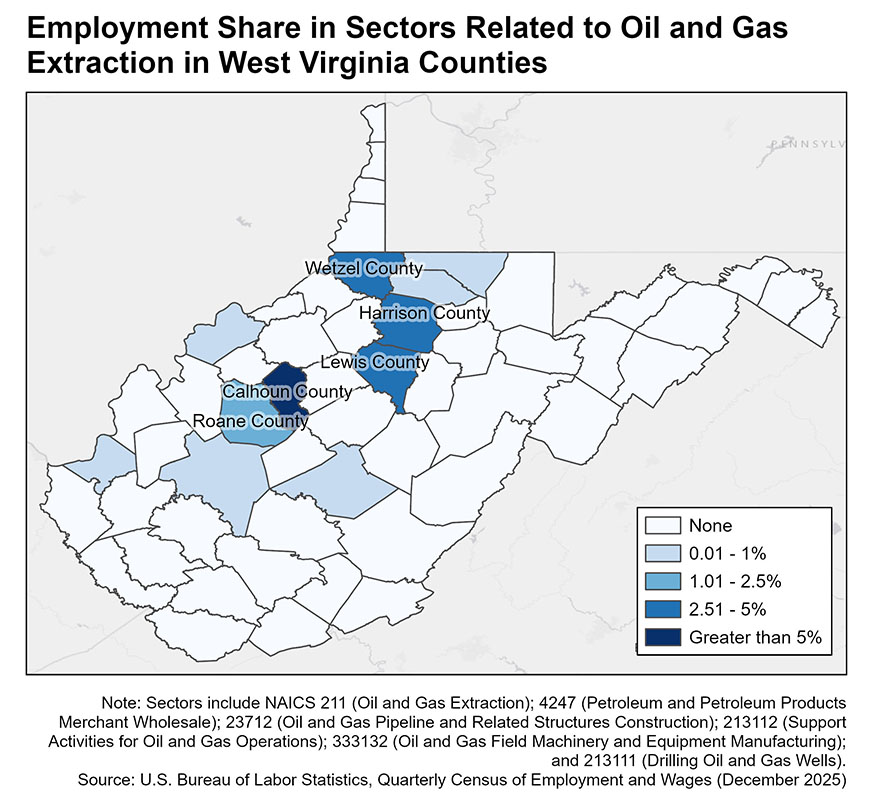
West Virginia's oil and gas extraction also comprises a higher share of employment. In the state as a whole, the share of employees within the oil and gas extraction industry (and related subsectors) is about 1.5 percent, though this can be even higher locally such as in counties like Roane, Calhoun, Lewis, Harrison, and Wetzel.
North and South Carolina Have Industries That Rely Heavily Upon Oil
Many industries rely heavily on oil for production and supply shocks can lead to elevated supply chain stress, changes in production activity, and increased input costs. The CFO Survey respondents in the second quarter of 2026 provided insight into the industries that rely more heavily on oil. For example, firms from industries such as manufacturing, retail and wholesale trade, and transportation and warehousing reported they rely more on oil than industries like professional and business services or finance and insurance.
Within the Fifth District, North and South Carolina have the largest share of both employment and GSP in the industries that survey respondents indicated were more oil reliant. In particular, the Carolinas have a lot of manufacturing. The CFO Survey manufacturing firms reported oil costs to include, on average, 30 percent of total cost. In South Carolina, manufacturing represents more than 40 percent of employment and over 35 percent of GSP.
Conclusion
On the one hand, higher oil prices might provide an opportunity for regions, such as some parts of West Virginia, with a concentration in natural resource extraction. On the other hand, in areas where industries rely heavily upon oil and gas as an input, elevated supply chain stress may influence production activity and ultimately lead to slower employment growth. The Richmond Fed will pay close attention to the experiences of businesses within the Fifth District as they navigate the changing energy landscape.
Views expressed are those of the author(s) and do not necessarily reflect those of the Federal Reserve Bank of Richmond or the Federal Reserve System.


Contact Us