

SEP by SEP: How the Fed Walks Inflation Back to 2%
Macro Minute
September 29, 2026
In September's Federal Open Market Committee (FOMC) meeting, Fed policymakers once again released their Summary of Economic Projections (SEP). The median projection for headline PCE inflation in 2026 rose to 3.7 percent year over year compared to 3.6 percent in the June SEP. The median projection for core PCE inflation rose to 3.4 percent versus 3.3 percent in June. Policymakers' median projections of the appropriate federal funds rate by the end of 2026 rose to 4.1 percent from 3.8 percent in June. In this post, we discuss how SEP projections have fared against the actual evolution of inflation and the fed funds rate.
Figure 1 below compares median quarterly FOMC projections for headline PCE inflation (in gray) to realized headline PCE inflation (in black) since the SEP's inception in November 2007.
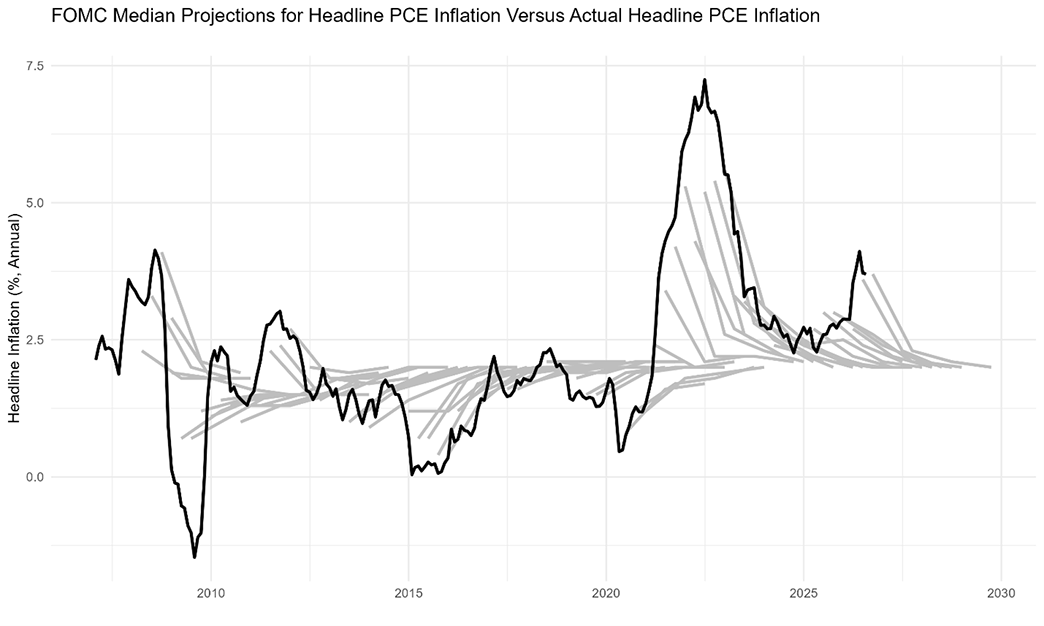
Figure 2 below shows the SEP median projections for core PCE inflation versus actual core PCE inflation, revealing a similar pattern to Figure 1.
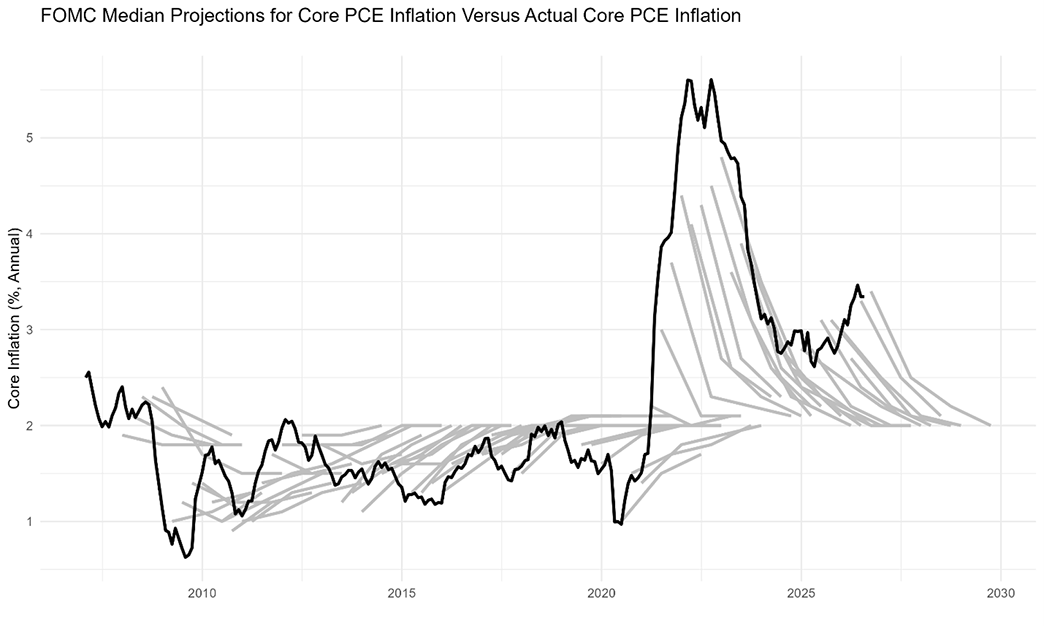
Figures 1 and 2 show that policymakers' projections for inflation typically converge back to the 2 percent target. Thus, the median projections were generally upward sloping from 2010 to 2019 (when inflation came in below the 2 percent target) and have been downward sloping since 2021 (when inflation was above target).
The figures also highlight that realized inflation rarely follows the path traced out by the median projection. Thisis not surprising, given that policymakers' projections generally assume that no further shocks hit the economy. This assumption creates a gap between the SEP's projections and reality, because shocks will in fact continue to happen over the forecast period.
However, shocks cannot explain the apparent overoptimism of Fed policymakers in forecasting inflation's return to target, regardless of whether inflation is too low or too high. This systematic overoptimism may reflect in part the fact that the SEP is not a forecast of how inflation will evolve, but a projection of how inflation should evolve under each participant's view of appropriate monetary policy. As explained in each SEP release, "appropriate monetary policy" is defined as the future path of policy that each participant deems most likely to foster outcomes for economic activity and inflation that best satisfy his or her individual interpretation of the Fed's dual mandate.
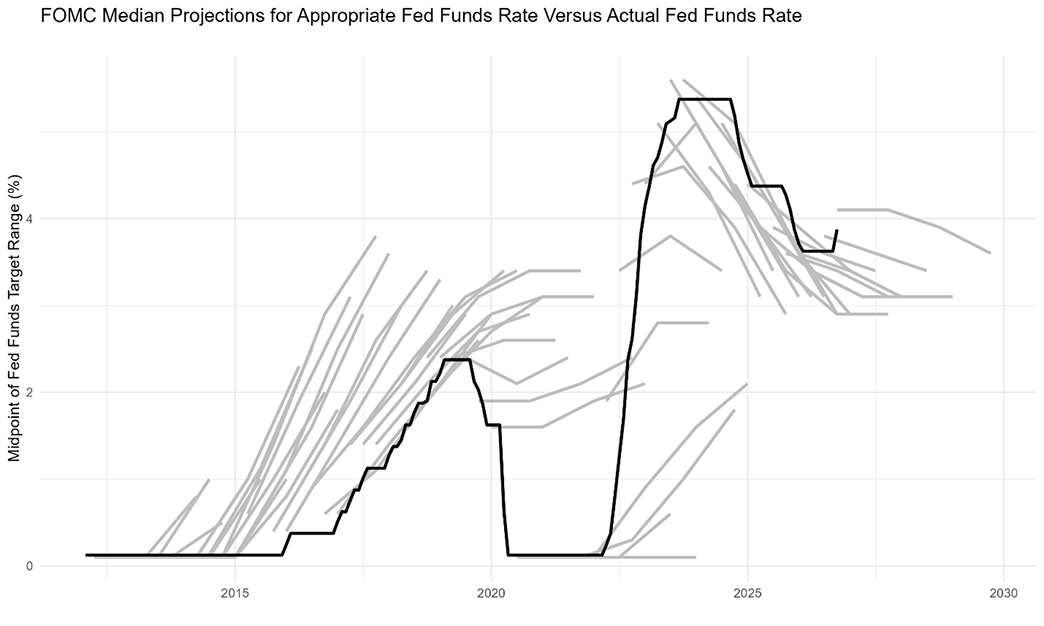
Figures 1 and 2 suggest that "appropriate" monetary policy for the median FOMC participant would generally return inflation to target within the three-year projection horizon. This will lead to an overoptimistic forecast if inflation proves to be more persistent than policymakers assume. With inflation returning to target at the end of the projection, policymakers would also generally return the benchmark policy rate to its long-run level which, unlike the 2 percent inflation target, changes over time depending on economic conditions. (See the Richmond Fed's Lubik-Matthes Natural Rate of Interest estimate for more on this topic.)
Figure 3 shows the median FOMC projection for the fed funds rate compared to the actual rate over time. The black line shows the midpoint of the fed funds target range from January 2012 to August 2026. The gray line shows median projections for the appropriate fed funds rate from January 2012 to September 2026. While the SEP has been around since November 2007, the FOMC only began publishing policymakers' projections of the fed funds rate in January 2012.
Despite the "appropriate monetary policy" nuance underlying the SEP, private-sector forecasters have benchmarked their own forecasts of how the economy will evolve against the Fed's projections. Recent work by Eric Engstrom at the Board of Governors documents how private forecasters have relied on SEP projections in forming expectations for interest rates. He finds a systematic relationship between private survey-based and market-based interest rate forecast errors and the gap between current expectations and lagged SEP projections, suggesting that information encoded in the SEP plays a role in private expectations formation. Because of this, the Fed's economic projections matter despite the projections becoming stale as new economic data are released, and despite a persistent gap between projections and actuals.
Significant changes to the SEP in the near future are widely anticipated. Fed Chair Kevin Warsh has announced a task force reviewing how the Fed communicates policy deliberations and decisions amid uncertainty, while abstaining from offering projections in the latest two SEP publications. How these changes, if they occur, alter the influence of Fed communications on private-sector expectations formation will be worth watching.
Views expressed in this article are those of the author and not necessarily those of the Federal Reserve Bank of Richmond or the Federal Reserve System.


Contact Us