
How Are Higher Oil Prices Affecting Firms?
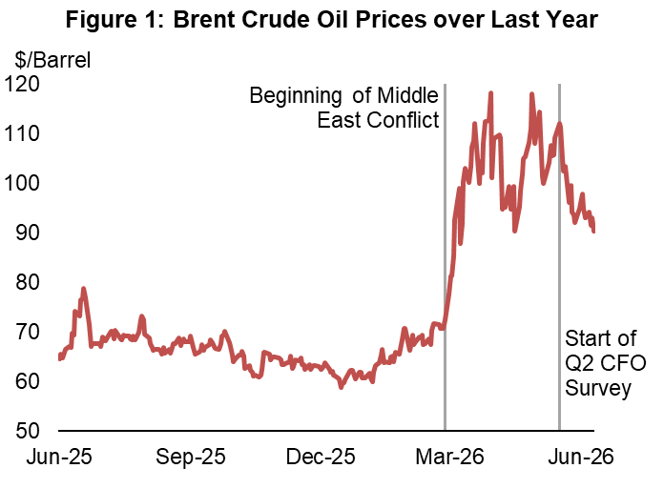
In the most recent CFO Survey, we explore how higher oil prices since the start of the Middle East conflict are impacting firms and their expectations. Between the onset of the Middle East conflict on Feb. 27 and the fielding of our survey on May 18, crude oil prices increased $41 per barrel. While oil prices have since declined, they remain well above their pre-conflict levels (Figure 1), and their trajectory remains highly uncertain. In the remainder of this post, we will examine how the oil price increase has impacted firms' unit costs, prices, and demand to date. Additionally, we will assess firms' expectations for how they expect oil prices to impact their costs and prices under two hypothetical scenarios.
Firms Report Higher Unit Costs but More Modest Changes to Prices and Demand Thus Far
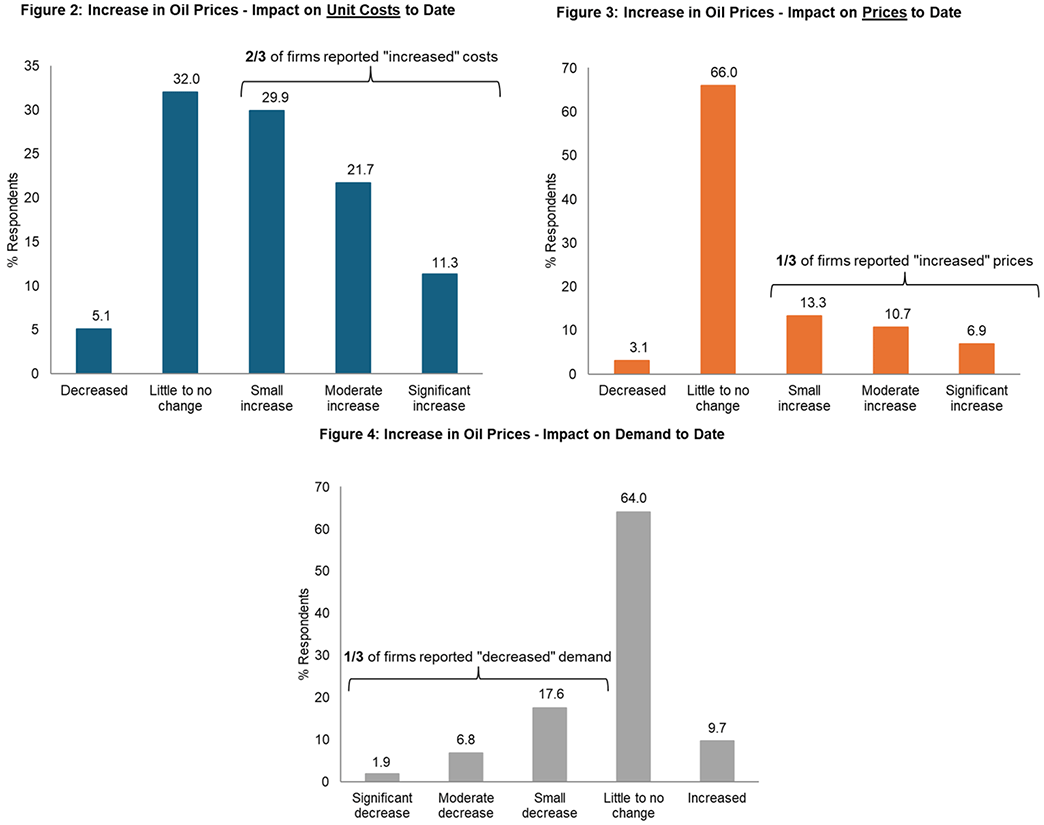
When asked about the impact of higher oil prices since Feb. 27, around two-thirds of firms reported higher unit costs (Figure 2) but only one-third of firms reported increasing the prices they charge their customers because of higher oil prices (Figure 3). This suggests that at least some firms are absorbing the oil-related cost increases rather than passing them through to customers. Although it is not a focus of this article, only one-third of firms reported lower demand for their goods or services that they could ascribe to oil price increases (Figure 4).
Impact Highest Among Goods-Producing Industries, Firms Exposed to Oil
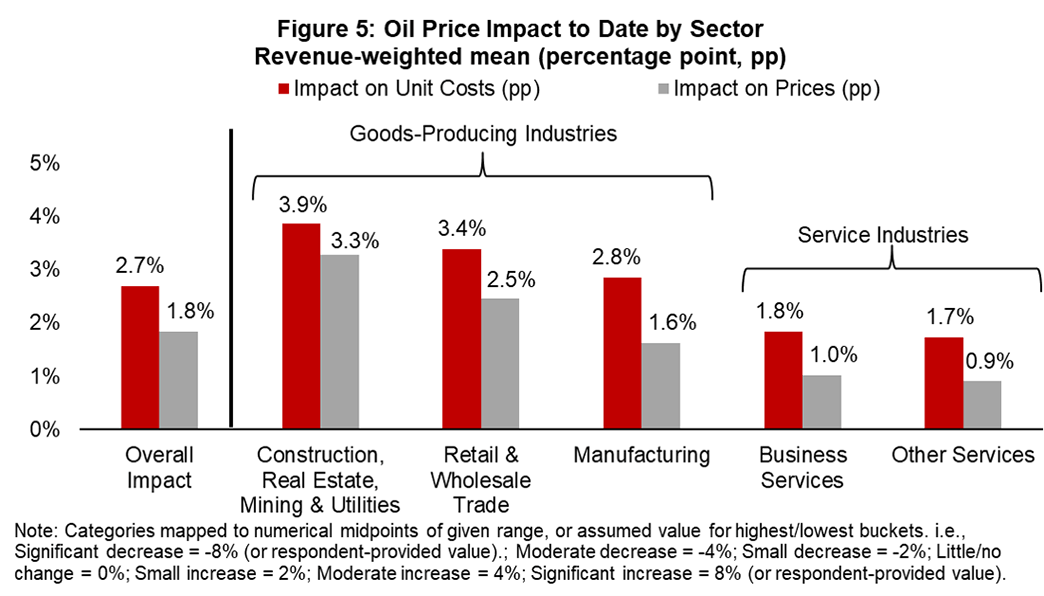
Since the questions eliciting the impact of higher oil prices assign percentage point ranges to each category (e.g., "moderate increase" was defined as an increase of 4 to 6 percentage points), we can quantify firms' responses. We find that, on average, higher oil prices added 2.7 percentage points to firms' unit cost growth and 1.8 percentage points to their price growth. We also find that no industry is entirely insulated from the effects of higher oil prices, but the impacts are generally more highly concentrated in goods-producing industries than in services industries (Figure 5).
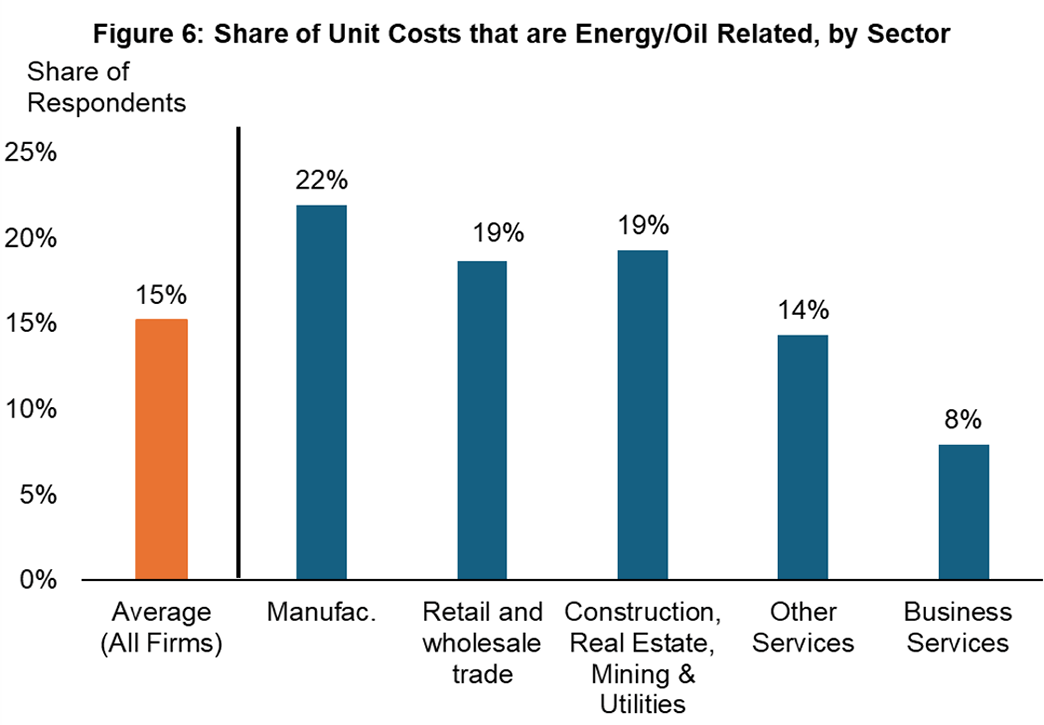
Unsurprisingly, the goods-producing industries that reported the largest impact on their costs and prices are the same industries that are most exposed to oil or energy costs (Figure 6).
Impact of Oil Prices Going Forward
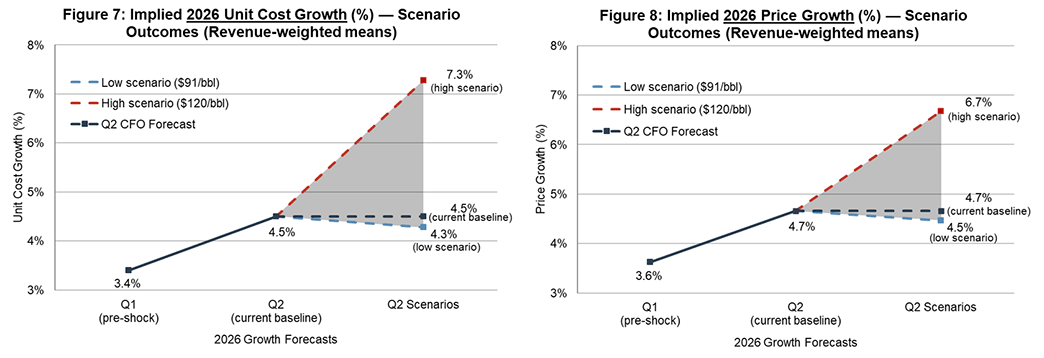
To gauge the likely future effects of oil price changes, we asked firms for their expectations in two states of the world — one in which oil prices average $120 per barrel through the end of 2026 (a "higher-price" scenario), and a second in which oil prices gradually decline to the market-implied level of $91 per barrel that prevailed at the time the survey was fielded (a "lower-price" scenario). For comparison, the panel's current unconditional expectations were for 4.5 and 4.7 percent growth in unit costs and prices, respectively, for 2026. In the higher oil price scenario, firms expect significantly higher unit cost and price expectations — of 7.3 percent and 6.7 percent, respectively, for 2026 (Figures 7, 8). In the lower-price scenario, unit costs and prices do not materially decline from current expectations. This suggests that firms place significantly higher probability on oil prices gradually declining over the remainder of 2026, and it implies meaningful upside risks to firms' cost and price expectations should higher oil prices materialize.
Conclusion
Most firms noted a meaningful impact from higher oil prices on their unit costs but a more limited impact on the prices they charge customers. The impact has been particularly large for firms that are more exposed to oil and those in goods-producing industries. Firms have also highlighted significant attendant consequences of higher oil price growth for their own cost and price growth. We will look to future surveys to shed light on how the evolution of oil prices impacts financial decision-makers' expectations and whether that impact remains contained.
Receive an email notification when The CFO Survey updates are posted online.