
Are Firms Financially Constrained?
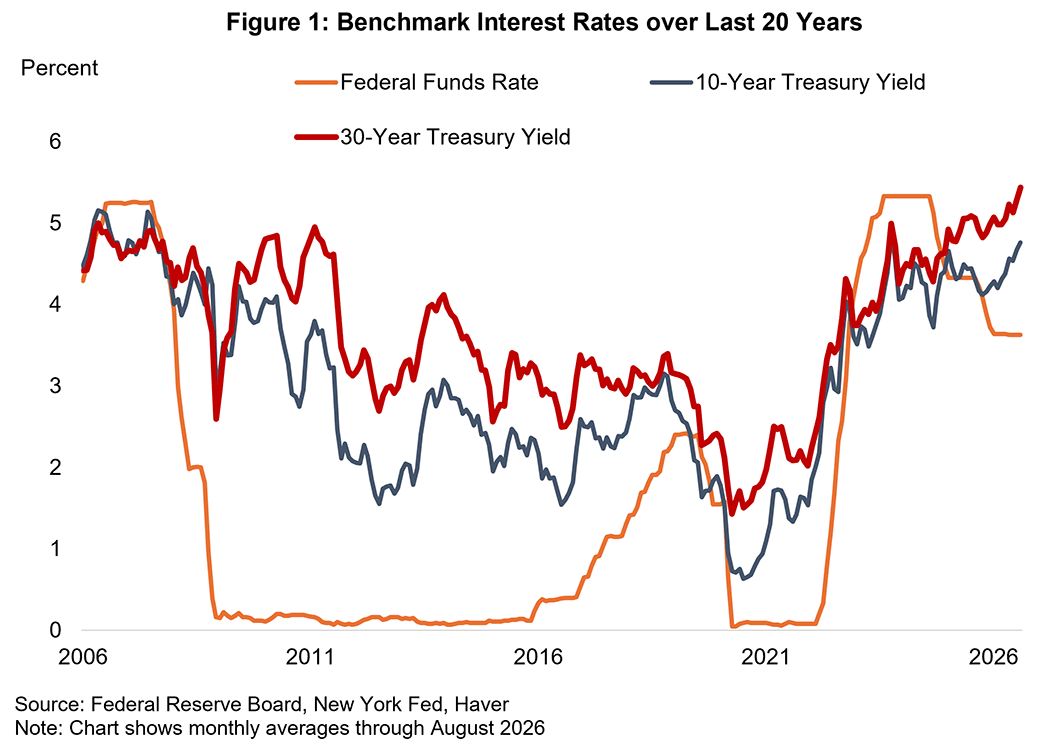
Since 2020, U.S. firms have faced two sources of pressure on their finances. The first is cost-driven: The global pandemic's upending of supply chains, successive rounds of tariff policy changes, and conflict-driven increases in oil prices all pushed input costs higher. The second is from credit conditions. Elevated inflation prompted the sharpest monetary tightening cycle since the 1980s. And, despite some easing on the short end of the curve, benchmark 10- and 30-year borrowing rates recently touched their highest levels in nearly 20 years (Figure 1), suggesting that costs of financing have moved even higher over the past six months. Together, these pressures raise a central question: Are firms meaningfully financially constrained?
Evidence from the most recent CFO Survey suggests that, in aggregate, the answer is no — but with some important qualifications, especially for smaller firms.
Margins Are Near Normal in Aggregate
Amid the elevated inflationary environment we've seen since 2021, a series of cost-driven shocks (pandemic supply chain disruption, geopolitical strife, tariffs, and surging oil prices) may have squeezed firms' profitability, putting some firms in a tenuous position. To find out, we queried firms' gross profit margins for 2025 (realized) and 2026 (expected). And to get a quantitative sense of how significant the squeeze has been or is anticipated to get, we also asked for the profit margin percentage that they consider to be "normal."
Despite more than five years of cost pressures spanning labor, energy, materials, and financing, roughly half of firms report gross profit margins for 2025 and 2026 that are broadly in line with what they consider to be normal (within 1 percentage point). Three-quarters of firms report gross profit margins for 2025 and 2026 that are +/- 3 percentage points from self-described normal levels, while the remaining firms are distributed roughly evenly on either side of normal (Figure 2).
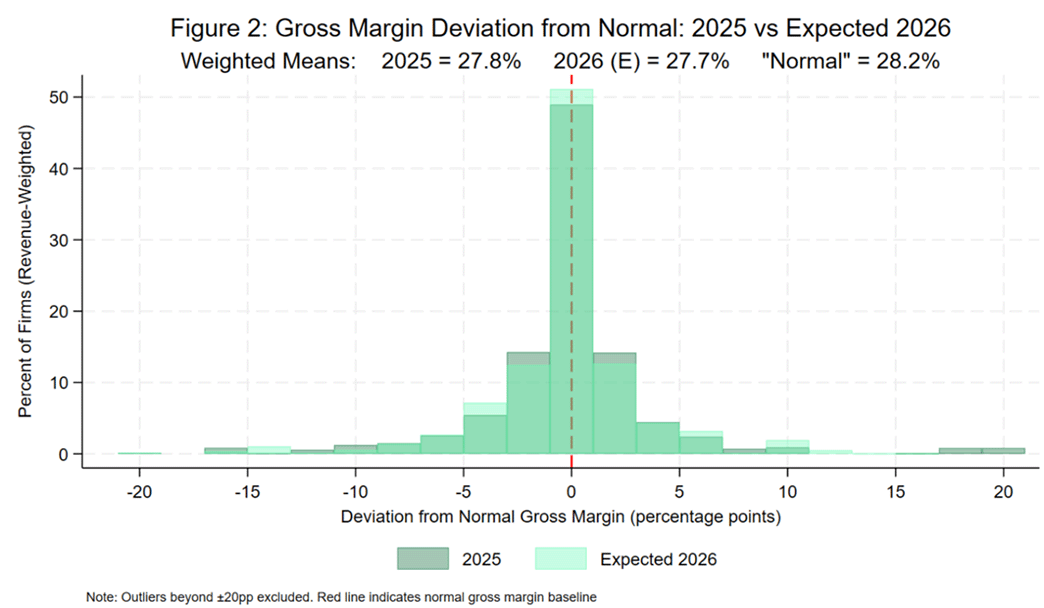
This distribution suggests that, in aggregate, firms have largely succeeded in maintaining margins through some combination of price increases, cost efficiencies, and shifts in product or service mix. The narrative of a sustained, broad-based margin squeeze — however plausible given the magnitude of recent cost shocks — is not borne out in the cross-section of survey responses.
Financing Conditions Are Not Broadly Restrictive
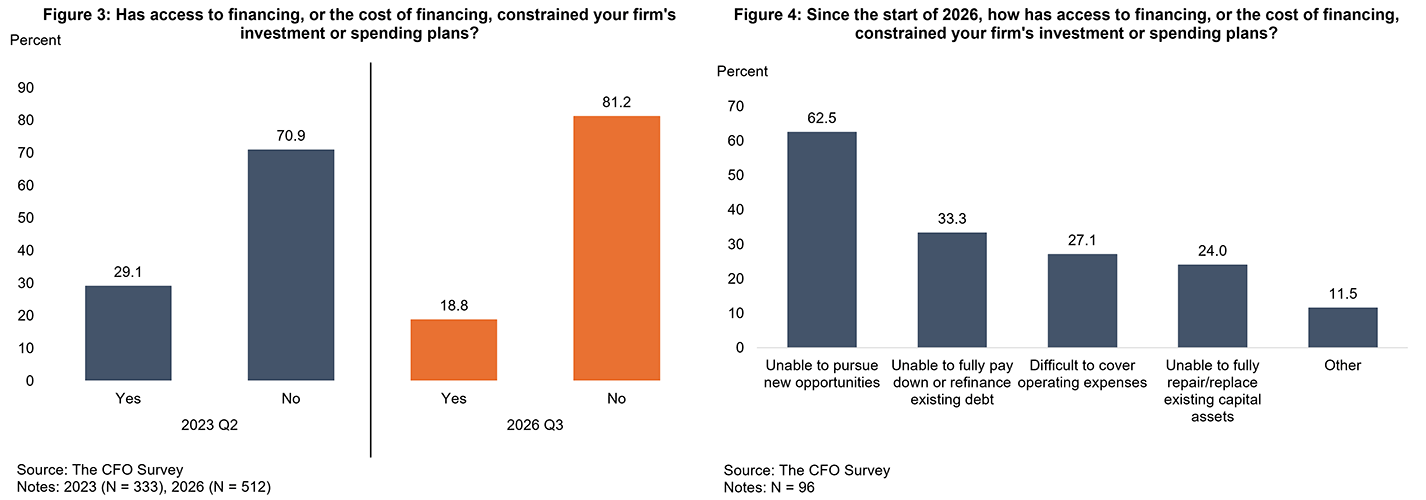
Elevated borrowing rates are a second potential constraint on firm behavior. While borrowing costs are high, survey evidence suggests that they are not a binding constraint on most firms. Only 19 percent of respondents indicate that access to financing, or the cost of financing, has constrained their firm’s investment or spending plans (Figure 3). This is lower than nearly 30 percent of firms that responded in the affirmative during Q2 2023, the last time this question was asked. Among the firms that indicate financial constraints, over 60 percent note that the constraint prevented them from pursuing new business opportunities. Fewer firms report difficulties paying down debt, covering operating expenses, or repairing/replacing capital assets (Figure 4).
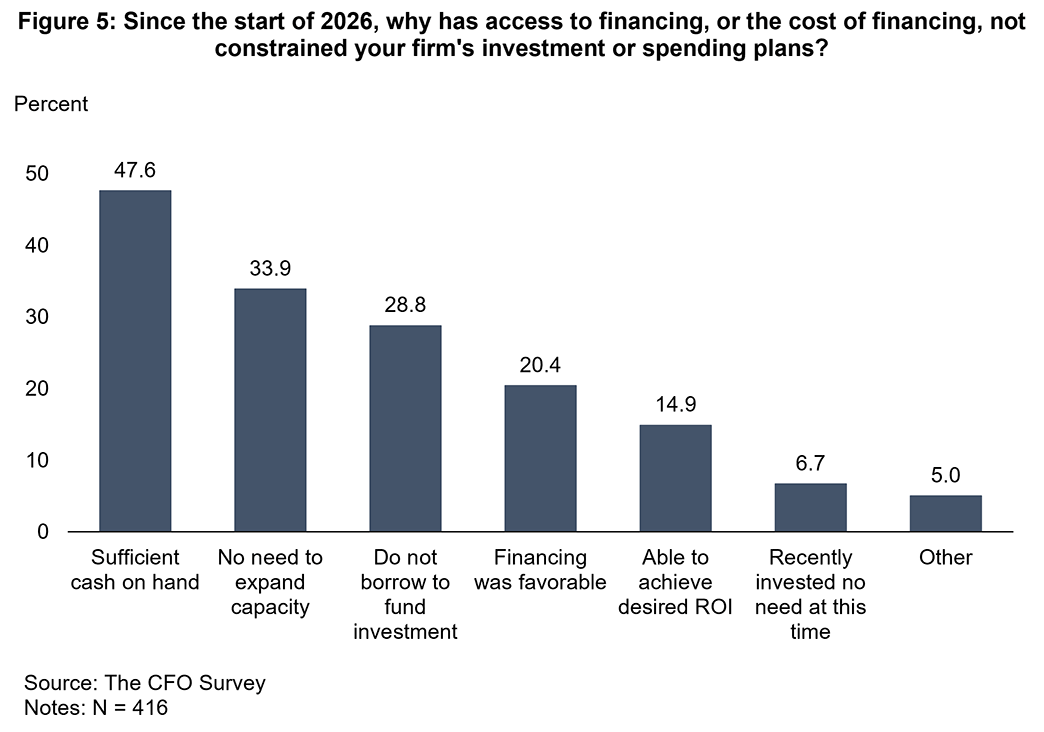
Among firms that are not financially constrained, they point to a variety of factors, though nearly half suggested that sufficient cash has enabled them to be less reliant on external financing and thus less exposed to elevated credit costs (Figure 5).
Small Firms Experience Modestly More Financial Constraints
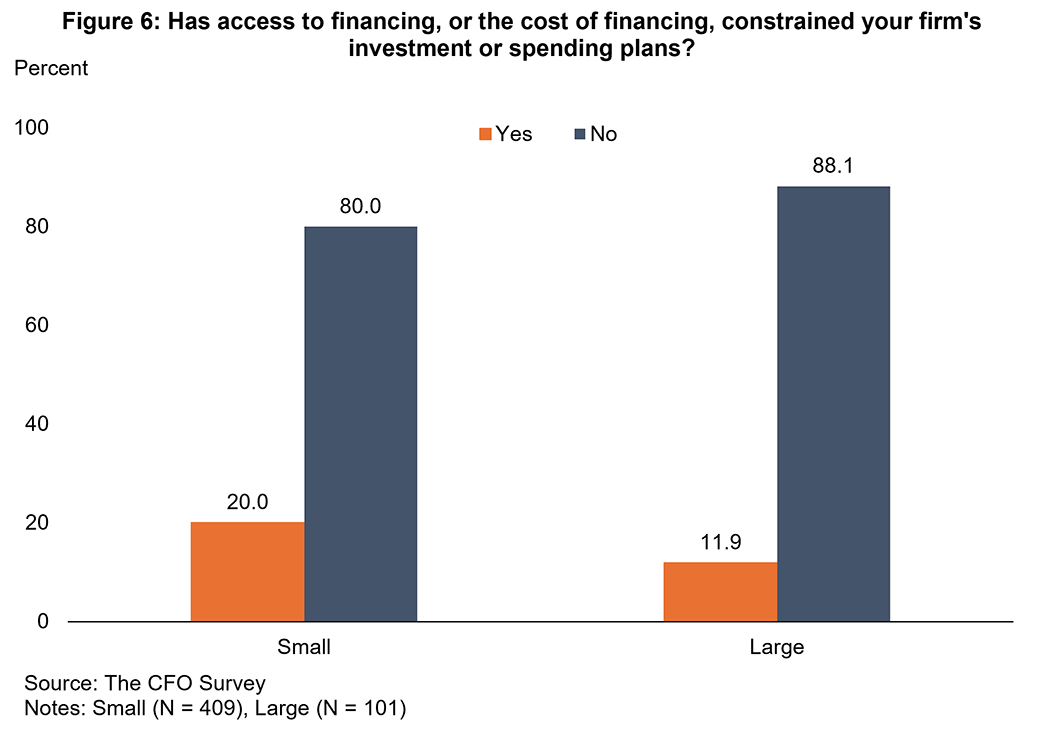
Strikingly, around double the proportion of smaller firms (<500 employees) report being financially constrained compared to larger firms (Figure 6). Though elevated, this only represents one-fifth of respondents — while 80 percent of smaller firms do not cite credit costs as a constraint. Moreover, a plurality characterized their margins as approximately normal. Taken together, these data suggest that the impact of any financial constraints on smaller firms remains broadly contained. Even so, these results suggest that the transmission of monetary tightening to firm-level financial conditions has been uneven and concentrated among firms that lack the scale, market access, and/or balance-sheet flexibility to fully insulate themselves from higher rates and prolonged cost pressures.
Financial Conditions and Firm Behavior: Spending and Hiring Remain Intact
If financial constraints are binding, one would also expect to observe meaningful cutbacks in expenditures and hiring plans. However, most firms report increased spending over the last three months — the largest such share in four years (Figure 7). Hiring intentions tell a similar story. The net share of firms hiring (either for replacement or new positions) is nearly 70 percent, in line with the average over the past year. Firms planning workforce reductions remain in the minority at around 7 percent (Figure 8).
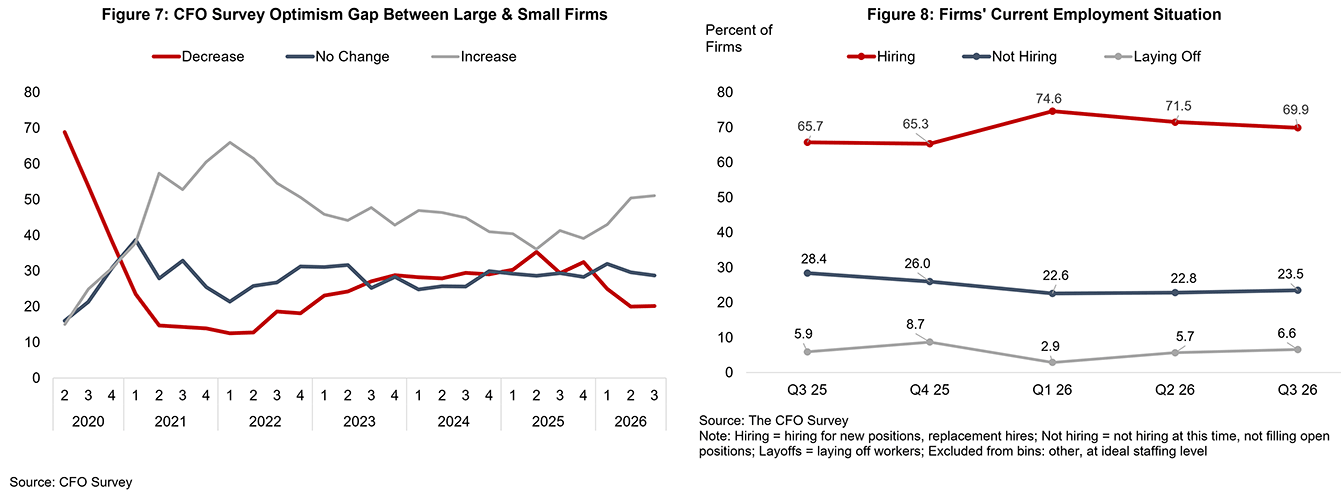
The relative stability of spending and employment plans across firm sizes suggests that any financial constraint is not yet producing large-scale behavioral adjustment.
Conclusion
On its face, the evidence on the health of economic activity from the CFO Survey is reassuring: Most firms report profit margins near their own-firm norms, relatively few cite borrowing costs as a binding constraint, and spending and hiring plans remain broadly intact.
However, these results do little to assuage concerns over continued inflationary pressures. Despite elevated cost pressures, margins, on net, remain close to "normal," suggesting firms are likely passing on much of these elevated costs without significant pushback. Moreover, according to firms, financial conditions are not restrictive enough to crimp borrowing or slow down their plans, hence they are not curbing real aggregate activity significantly enough to curb inflationary pressures.
We will continue to explore this issue in future surveys to inform how firms' financial conditions are evolving, particularly amid heightened uncertainty over further pressures on inputs costs and the prospect of sustained higher borrowing costs.
Receive an email notification when The CFO Survey updates are posted online.