

RIC Spotlight: Strengthening the Rural Workforce Through STEM Education
Regional Matters
November 20, 2025
The Richmond Fed's Rural Investment Collaborative (RIC) seeks to improve economic investment in small towns and rural communities through collaborations with rural hubs and funding sources to help communities develop project proposals and make access to funding easier. Steven DK Brown is a member of the 2024 cohort of the Community Investment Training program, which allows participants to develop investment-ready proposals and connect them with potential capital providers.
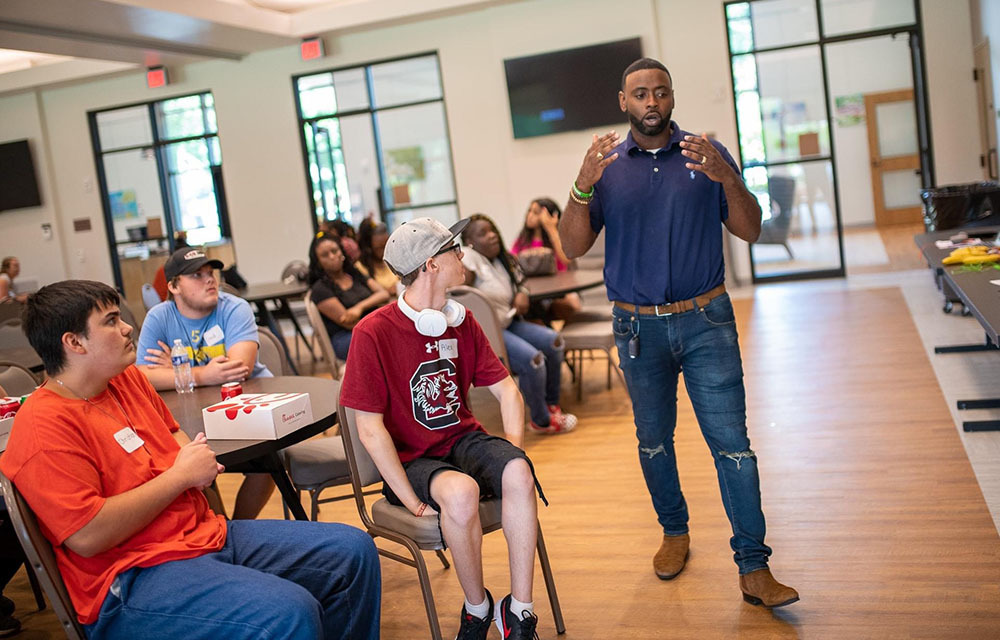
For Steven DK Brown, founder of Dreams, Imagination and Gift (DIG), starting a STEM education program in his rural hometown of Williston, South Carolina, was a no brainer: To him, rural areas and innovation go hand in hand.
"When you identify someone who has done something innovative, don't be surprised if they are from somewhere you have never heard of," says Brown. "They likely had to be creative their whole life."
But, according to Brown, that innovative capacity often goes untapped. Many rural areas don't have sufficient resources to identify and cultivate the talent of students — an issue he's addressing through the work of DIG, a nonprofit that aims to strengthen the pipeline of STEM, or science, technology, engineering, and math professionals through educational opportunities, mentorship, and social and emotional development.
After 12 years of operating after-school programs in Barnwell, Allendale, and Aiken counties, Brown is expanding DIG's reach and impact through the construction of a multiuse STEM center. He envisions the center not only as a space to build upon existing programs, but also as a tool for broader workforce development initiatives and community engagement. For a community that has long faced economic difficulties, Brown is looking forward to the STEM center becoming a bright spot.
"Our project is bigger than a building," says Brown. "I think it's going to break some of these barriers and show that power is in community."
Williston and the surrounding communities that comprise Barnwell County, South Carolina, are no stranger to barriers. Approximately 29 percent of Barnwell County residents live at or below the poverty line, which is roughly double the South Carolina average. The median household income is about $42,000 annually, almost 40 percent below the state average. Educational attainment is also much lower: The share of residents without a high school diploma is almost 50 percent higher, while the share of residents with a postsecondary degree is 35 percent lower than the state average.
| Median HH Income (2023 ACS 5-yr) | Poverty Rate (2023 ACS 5-yr) | 20-Year Job Growth (2005–2025) | 20-Year Labor Force Growth (2005–2025) | % Population With Bachelor's Degree | |
|---|---|---|---|---|---|
| Barnwell | $42,000 | 28.5% | -35.5% | -16.2% | 12.8% |
| Allendale | $32,000 | 26.5% | -22.7% | -20.5% | 13.3% |
| Aiken | $68,000 | 13.9% | 17.9% | 3.1% | 31.1% |
| South Carolina | $67,000 | 14.2% | 28% | 23.9% | 33.3% |
| Source: Bureau of Labor Statistics, American Community Survey | |||||
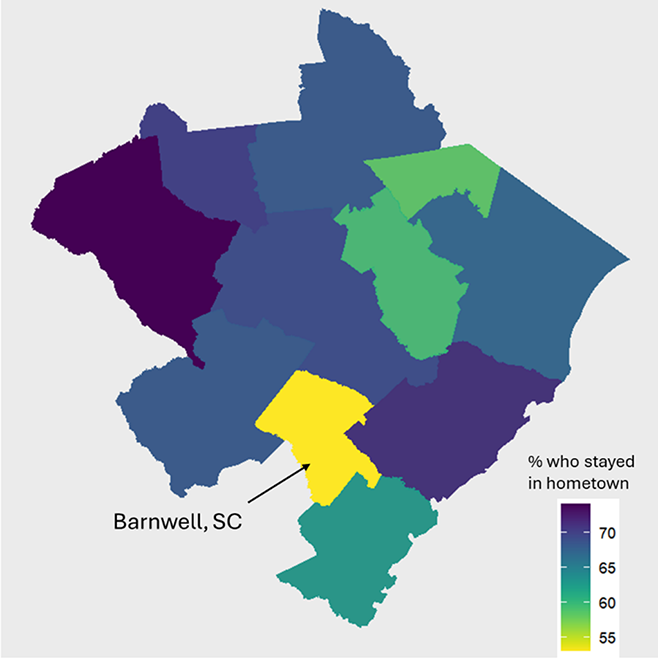
In addition, the population of Barnwell County is shrinking and so is worker availability. Between 2010 and 2020, Barnwell's population declined by 9 percent, as natural decline (births versus deaths) exceeded net in-migration. Additionally, with older residents comprising an increasing share of the population and younger residents relocating to surrounding areas, the size of the labor force has been falling. (See Figure 1 below.)
This is a pattern that Brown personally identifies with: After graduating with a degree in electrical engineering, the most attractive employment prospects were outside of Williston. He landed a job as an electrical engineer at Fluor Corporation, an engineering construction company in Greenville, South Carolina.
"Because people weren't investing in rural communities, for those like me who got out, the first job to look for is outside the community," says Brown.
Both the numbers and stories speak to a persistent challenge that many rural areas like Barnwell face. Jobs go where people are, and without a workforce that meets the demand of potential employers, rural areas are often skipped over for new industry, which further hinders opportunities for economic development and growth. In Barnwell, job growth has been mostly negative or stagnant over the past two decades, declining by 35 percent between 2005 and 2025.
The Opportunity Insights Young Adult Migration data further explore this pattern of rural flight. With tax records from individuals born between 1984 and 1992, the data track whether young adults remained in their hometown or relocated by age 26. Of all the commuting zones in South Carolina, Barnwell had the lowest share of young adults who remained in their hometown (53 percent), compared to large metros like Charleston and Greenville, where over 70 percent of young adults remained in their hometown.
Young adults from Barnwell, South Carolina, didn't move far, however. The top geographies for relocation in South Carolina were Columbia (12 percent), Aiken (6.1 percent), Savannah (5.3 percent), Charleston (3.8 percent), Greenville (2.4 percent); Atlanta, Georgia (1.7 percent); and Charlotte, North Carolina (1.5 percent). Expectedly, there wasn't a significant inflow of young adults into Barnwell from other areas: Only 25 percent of young adults living in Barnwell were from other commuting zones.
Although there is no magic bullet to rural flight, addressing the workforce gap by developing and retaining talent — a major goal of Brown's STEM center project — is key to attracting employers. Research suggests that access to STEM education can support economic growth through innovation, entrepreneurship, and improved workforce outcomes. STEM expertise is widely used in industries such as manufacturing, construction, and health care, and STEM occupations tend to have higher wages, on average. Moreover, in the midst of rapid technological change, investments in STEM enable adaptation to the evolving work landscape. Nationally, the Bureau of Labor Statistics projects that the number of STEM jobs will increase at almost three times the rate of non-STEM occupations between 2023 and 2033.
Plans for DIG's STEM center include tech labs to improve existing STEM models, programs for college readiness, classrooms that support hands-on learning and problem solving, and innovation zones that convene conversations around economic development. In addition to developing and nurturing local talent, Brown hopes that the center can serve as a community anchor — a source of identity that enhances Williston's quality of life and attracts visitors and new residents alike.
One of the driving forces behind Brown's decision to create DIG was a story he heard repeatedly: capable high school graduates from his hometown not pursuing or completing higher education. Of the 116 students who have attended DIG and reached graduation age, 100 percent have graduated high school, and 92 of these students have enrolled in a postsecondary institution. It's even more promising that 14 students who were a part of the program are either engineers or are currently pursuing an engineering degree.
The challenges of rural areas are complex, but Brown's engineering background has given him an affinity for finding solutions. Ultimately, he hopes the STEM center will not just be transformative for Williston, South Carolina, but that it will serve as a replicable model that awakens the untapped potential of rural communities everywhere.
Views expressed are those of the author(s) and do not necessarily reflect those of the Federal Reserve Bank of Richmond or the Federal Reserve System.


Contact Us