
Public-Private Partnerships Drive Rural Revitalization
Regional Matters
July 9, 2026
The Richmond Fed's Rural Investment Collaborative (RIC) seeks to improve economic investment in small towns and rural communities through collaborations with rural hubs and funding sources to help communities develop project proposals and make access to funding easier. Maria Saxton, director of planning and community development for the Town of Clifton Forge, is a member of the 2026 cohort of the Community Investment Training program. Katie Ryan, former director of operations for Clifton Forge School of the Arts, was a member of the 2024 cohort. The Community Investment Training program allows participants to develop investment-ready proposals and connect them with potential capital providers.
Driving westward on Virginia's Route 64 toward the West Virginia border, you'll come to a building that serves as the eastern gateway to Clifton Forge, Virginia. This building and others in the town are being redeveloped for new use. But they're more than construction projects. According to Saxton and Mary Fant Donnan, executive director of The Alleghany Foundation, these projects are integral to Clifton Forge's historic downtown and the town's economic future.
Shifting Economic Winds Contribute to Boom — Then Decline — In Clifton Forge
Clifton Forge, Virginia, was born from industrial development in Virginia's Alleghany Highlands region. Through the mid-1900s, its economy boomed, fueled by the iron and railroad industries.
However, widespread transitions from steam-powered train engines to diesel-powered engines post-World War II led to sharp declines in railroad employment and brought economic hardship to Clifton Forge. As with many towns and rural places when industry leaves, these shifting economic trends left Clifton Forge with aging buildings and infrastructure.
Clifton Forge sits in Alleghany County, Virginia, which borders West Virginia. Like many rural counties that have faced economic decline, Alleghany County's working-age population shrank in the last two decades. While the county's unemployment rate is the same as other rural Virginia counties, it has a lower poverty rate, lower educational attainment, lower household incomes, and fewer businesses per capita.
| Alleghany County | Virginia | |||
|---|---|---|---|---|
| Demographic and Economic Indicators | All | Urban | Rural | |
| Under 20 Years Old | 20% | 25% | 25% | 22% |
| Age 25+ with at least a Bachelor's | 15% | 42% | 45% | 20% |
| Median Rent | $765 | $1,579 | $1,696 | $903 |
| % Households w/ Housing Costs > 30% Income | 18% | 29% | 29% | 24% |
| Unemployment Rate | 4% | 4% | 4% | 4% |
| % of Population in Poverty | 12% | 10% | 9% | 15% |
| % Census Tracts Low- and Moderate-Income | 0% | 28% | 29% | 21% |
| Bank Branches per Capita | 13 | 21 | 20 | 32 |
| Number of Businesses per Capita | 162 | 241 | 247 | 198 |
| Median Family Income | $73,409 | $115,213 | $130,308 | $77,183 |
| Note: In this table, "urban" refers to Virginia counties with a Rural-Urban Continuum Code (RUCC) of 1-3, and "rural" counties correspond to a RUCC of 4-9. Sources: Census Bureau's 5-Year American Community Survey (2020-2024), Bureau of Labor Statistics (2025), St. Louis Fed's Competitive Analysis and Structure Source Instrument for Depository Institutions (2025), U.S. Bureau of Economic Analysis (2023), and U.S. Department of Agriculture's Rural Urban Continuum Codes (2023). |
||||
Beginning in the mid-2000s, dedicated residents — along with local government and community organizations — partnered to save historic buildings in Clifton Forge's downtown. By 2011, a former sawmill was converted into the Clifton Forge School of the Arts. Five years later, the historic Masonic Theatre gained new life through private and public investments, including New Market Tax Credits, historic tax credits, and other funding sources.
Clifton Forge's downtown revitalization is the result of a deliberate, long-term, grassroots effort that has gained momentum in recent years. According to Saxton, early redevelopment projects have attracted new visitors, stimulated private investment, and helped strengthen the town's appeal to both prospective residents and businesses.
Building on this progress, the town recently launched several planning initiatives — including a community and economic development strategic plan and a comprehensive downtown master plan — to guide future investment and ensure sustainable, coordinated growth. Together, these efforts are focused on expanding the number of locally owned businesses, increasing lodging options, enhancing the downtown experience, and creating a vibrant, resilient community for residents and visitors alike. They aim to accomplish this, in part, with two revitalization projects:
- 608 Main Street: A former car showroom is being redeveloped for mixed use, with space for small businesses on the ground level and housing on the upper levels. The property has undergone significant stabilization, including a complete roof replacement, reconstruction and reinforcement of the rear exterior wall, and stabilization of the historic front façade.
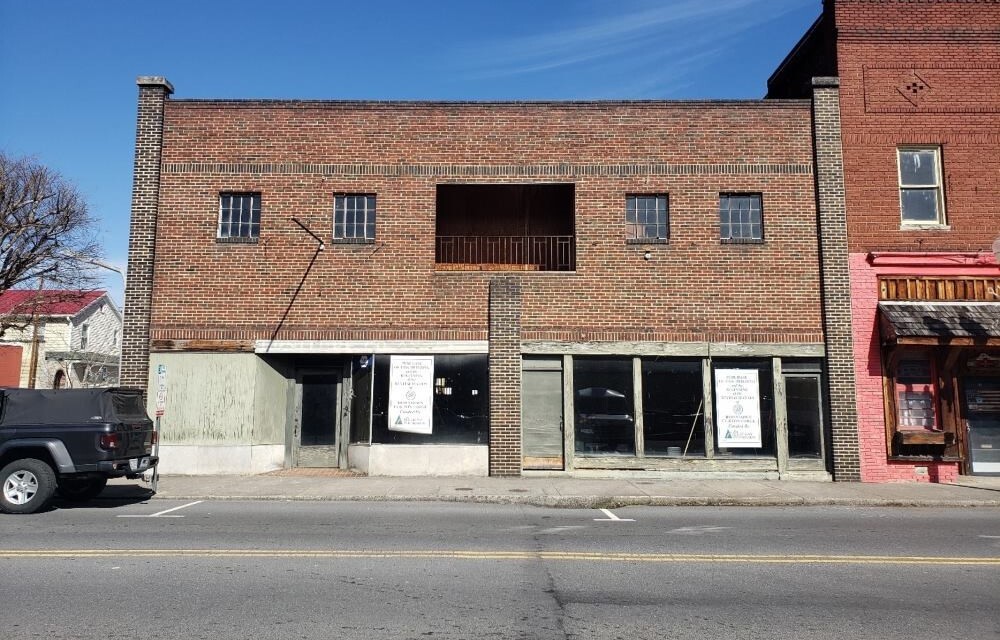 608 Main Street building. Credit: Maria Saxton
 - Historic train depot: A former CSX building sits on the western edge of Clifton Forge. The town envisions giving the building a second life as a boutique hotel that celebrates the community's rich railroad heritage while expanding lodging options for visitors. Once the town finalizes acquisition of the property, it will undertake feasibility analyses and other predevelopment due diligence, including market assessments, building evaluations, and financial analyses to determine the most viable redevelopment approach.
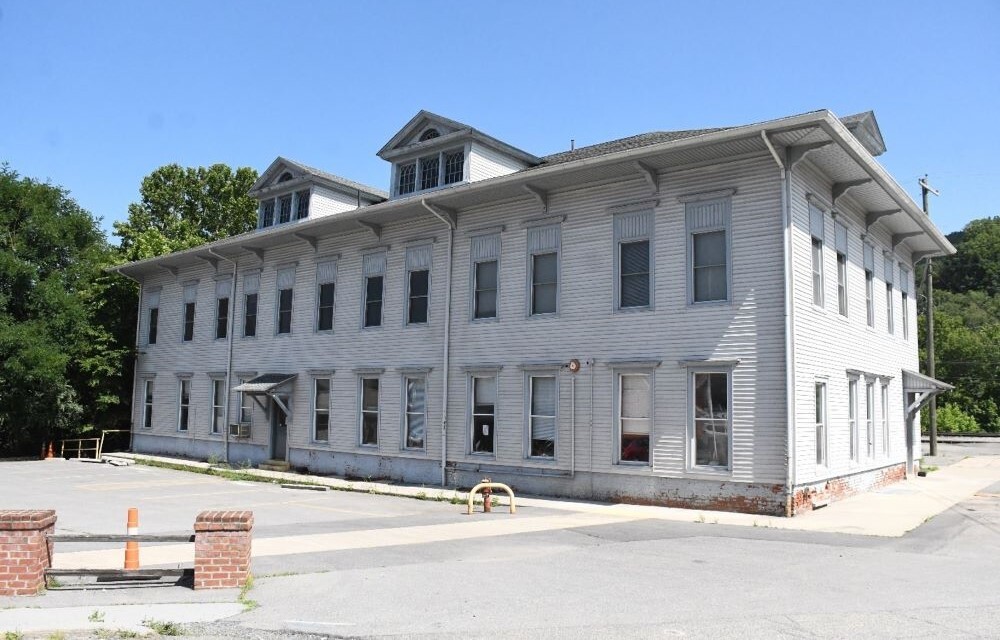 CSX train depot and office building. Credit: Gavin Dressler
Given how complicated and expensive historic renovations can be, what does a town like Clifton Forge need to do to make these projects happen?
Philanthropic Partnerships Fill Funding Gaps
Small towns and rural communities often face barriers to investment. Supply-side barriers include fragmented funding programs and fewer investors, while demand-side barriers include limited staff, a smaller pool of local contractors, and fewer potential market-rate tenants.
With limited investment, partnerships between public and private — or philanthropic — entities become crucial. Many times, the private sector alone will not redevelop a property, especially for a historical site that requires costly restoration. In the case of 608 Main Street, for example, it cost almost $300,000 to remediate structural issues. In many cases, it would be more cost effective for private developers to raze the buildings and start from scratch.
These two revitalization projects in Clifton Forge exemplify the ways that public entities, private organizations, community foundations, and residents often need to work together to make larger commercial real estate development happen in smaller towns.
Rural areas struggle to attract philanthropic funding compared to urban areas, even when accounting for population differences. According to the USDA's Investigate Your Community Tool, which tracks grantmakers across U.S. counties, between 2014 and 2021, urban Virginia counties averaged about $2 billion in grant funding annually ($270 per capita). In comparison, rural counties averaged just $54 million ($55 per capita). In the same period, Alleghany County averaged around $425,000 in grants annually ($28 per capita). Not all the grant funding in Alleghany County is from The Alleghany Foundation. But the presence of a regional foundation plays a role in providing funding for rural redevelopment.
Roadmap for Rural Revitalization Involving Public, Private, and Philanthropic Entities
How exactly is The Alleghany Foundation working with the Town of Clifton Forge to revitalize two buildings? Donnan and Saxton described some of the critical elements of tackling partnership projects.
Plan for the Ecosystem of Development: Donnan noted that in rural places, the market may be less prepared to bear redevelopment costs. To overcome this, rural leaders need to identify the development interests of the community and bring together more players to make deals work. While private funders will take some projects, others may need intervention from the nonprofit sector.
"There's a fairly robust community of foundations in Virginia — both community foundations and private foundations — that are trying to have a good conversation about being able to get bigger returns in the community for the way we use our assets," said Donnan. She proposed that foundations may employ creative solutions, like creating low-interest loans for program-related investments, or creating recoverable grants for development.
Anticipate Pitfalls: It is important to have partners that can help navigate funding options to overcome obstacles. Donnan explained, "Public entities can bring some in-kind contributions to the table that are immensely important. Local leadership is also really helpful for the purposes of getting permitting through, offering guidance on processes, securing state funding, as well as the financial stake that they have in these types of projects."
Capitalize on Momentum: Donnan shared that The Alleghany Foundation became interested in some revitalization projects thanks to volunteers in the town. "When you see energy and volunteers, follow that energy because that will be a driver for what actually gets done." Donnan referred to these as "spark plugs" in the community; even a small amount of interest or volunteerism can turn into something larger.
Reaching Critical Mass: The Alleghany Foundation made grants to the Town of Clifton Forge for building and land acquisition to help get both projects started. Local leaders focused on scale from the start, knowing the challenges that can come from piecemeal investment. At 608 Main Street, for example, The Alleghany Foundation made grants to purchase three separate buildings on the block and adjacent land as it became available. Donnan explained that it would be challenging to revitalize just one building on this block. If one building is restored between two dilapidated buildings, it does not have the same transformative effect as having several restored buildings next to each other.
Build Local Capacity: Local leaders also invested in their own training and expertise. As Donnan noted, the people that drive partnerships in revitalization are critical: "In urban places, you often have robust private sector developers. In rural places, these are learning opportunities, and it takes a lot of different partners coming together."
Thanks to the partnerships around revitalization, the Town of Clifton Forge is now a regional hub for education, the arts, commerce, outdoor recreation, and heritage tourism. It is home to Mountain Gateway Community College, revitalized commercial and community spaces, scenic trail systems, and an Amtrak rail station. The town has taken advantage of the economic benefits from nearby natural amenities and recreation, like rivers and state parks. Through continued investment in historic preservation, strategic redevelopment, and community-focused planning, Saxton and Donnan hope to play a meaningful role in the next chapter of Clifton Forge's ongoing revitalization story.
Views expressed are those of the author(s) and do not necessarily reflect those of the Federal Reserve Bank of Richmond or the Federal Reserve System.


Contact Us