


< !--cell-- >
< !--end grid-x-->


Free to Speculate
British frontier policy threatened Colonial land speculation on the eve of the American Revolution
Econ Focus
Third Quarter 2014
As Britain's secretary of state for the Colonies, Wills Hill, the Earl of Hillsborough, vehemently opposed American settlement west of the Appalachian Mountains. As the Pennsylvania Provincial Assembly's agent in London, Benjamin Franklin enthusiastically advocated trans-Appalachian expansion. The two bitter enemies disagreed about many things, and British land policy in the Colonies was at or near the top of the list.
In the late 1760s, Franklin joined forces with Colonial land speculators who were asking King George's Privy Council to validate their claim on more than 2 million acres along the Ohio River. It was a large western land grab — even by Colonial American standards — and the speculators fully expected Hillsborough to object. But instead of opposing the deal, Hillsborough encouraged the speculators to "ask for more land," Franklin reported, "enough to make a Province."
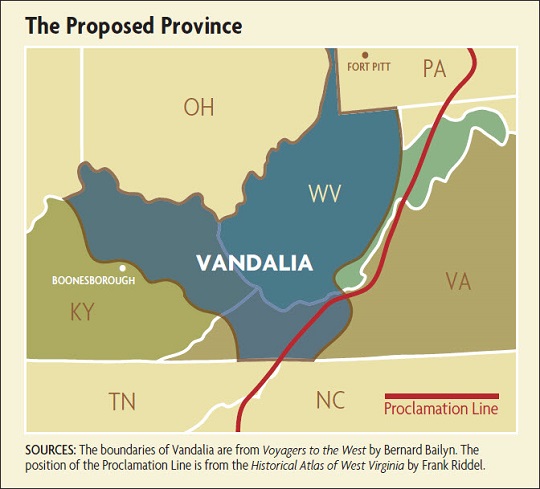
It was a trick. Hillsborough knew the Privy Council frowned upon large land grants, so he reasoned that a much bigger proposal would have a much smaller chance of winning approval. But Franklin and his partners turned Hillsborough’s tactic against him. They increased their request to 20 million acres only after expanding their partnership to include well-connected British bankers and aristocrats, many of them Hillsborough’s enemies. This Anglo-American alliance proposed a new colony called Vandalia, a name that Franklin recommended to honor the queen's purported Vandal ancestry. The new colony would have included nearly all of what is now West Virginia, most of eastern Kentucky, and a portion of southwest Virginia, according to a map in Voyagers to the West by Harvard historian Bernard Bailyn.
 Download article
Subscribe to Econ Focus
Receive an email notification when Econ Focus is posted online.
By submitting this form you agree to the Bank's Terms & Conditions and Privacy Notice.
Contact Us