

Monthly Job Reports: How Do Private Sources Fare?
Economic Brief
March 2026, No. 26-08
Key Takeaways
- The Bureau of Labor Statistics produces monthly estimates on job gains/losses through the Current Employment Statistics' establishment survey.
- In the past few years, more alternative job reports have become available through private sources, such as ADP, Revelio, LinkUp and Intuit.
- While job estimates from these private sources can replicate the trend pattern of their official BLS counterpart, they are not always accurate and reliable at higher frequencies, especially during volatile periods.
A key determinant of a strong labor market is a high level of net job creation. One important indicator is the Employment Situation Summary from the Bureau of Labor Statistics' (BLS') Current Employment Statistics (CES) program. While this release contains many interesting facts about the labor market, the establishment survey portion contains one statistic that is often more highlighted than others by policymakers and market participants: the number of jobs gained or lost from one month to the next.
In this article, I discuss how the BLS calculates this specific statistic and what alternative private data sources have become available in the past few years. Importantly, I discuss how much can be learned from these alternative sources.
Current Employment Statistics: Establishment Survey
The BLS puts a tremendous amount of effort into producing monthly statistics on the U.S. labor market through its CES program. This program consists of a household survey and an establishment-level survey. The latter survey produces monthly measures of payroll employment, which allows for assessing whether the economy has gained or lost jobs on net.
But why would we need to rely on surveys in the first place? Businesses file employer tax returns with the IRS, so could we not just calculate aggregate payroll employment directly from these returns? Technically yes, but employer tax returns are filed quarterly and are due on the last day of the month following the end of each quarter. (For instance, employer tax returns for the first quarter are due on April 30.) As a result, data would come in at a "low" frequency and with a lag of at least one month.
Implementing questionnaires that cover (nearly) all employers is prohibitively costly, so the BLS relies on the establishment-level survey of its CES program. In a nutshell, this survey collects employment data from about 115,000 businesses and government agencies.1 Importantly, it is constructed to be representative of the U.S. economy and can generate employment statistics at the detailed industry level. In the following, I will explore BLS' methodology behind the establishment survey and why the BLS is in a unique position to conduct such a survey.
Establishment Survey Methodology
One of the BLS' advantages is that it is also responsible for the Quarterly Census of Employment and Wages (QCEW) program. The data coming out of the QCEW program contain all employers in each state covered by the unemployed insurance (UI) system.2 The BLS creates a version of the QCEW with longitudinally consistent establishment identifiers, leading to the BLS' Longitudinal Database (LDB), which contains private businesses as well as state and local governments.
The simplest way for surveying is to randomly select establishments from the LDB. However, this could create a biased sample since it is possible to overdraw certain industries or regions. To avoid such sampling biases, the CES sampling frame (based on the first quarter of the most recent year in the LDB) is broken down by state, industry and establishment size. There are eight size classes and 13 industry groups, so each state is essentially divided into 104 cells. The BLS then randomly samples within each of these cells. The number of draws in each cell is determined by its number of eligible establishments. Thus, the BLS would sample twice as much from a cell with twice as many establishments.
The procedure is repeated each year with an updated universe file to account for compositional shifts in geography and/or industry as well as business births and deaths. However, many businesses (about 20 percent to 25 percent) do not survive their first year, meaning they could open and close without ever being counted. To deal with this issue, the CES program receives a "birth" update drawn from the third quarter LDB whenever it is available.3 Also, the BLS assigns each observation a sampling selection weight to help the survey represent the full U.S. economy. These weights are roughly based on inverse probability of selection. For example, if there are 100 employers in a cell and the survey collected two observations from that cell, then these observations receive a weight of 50 (100/2).
In the end, the CES establishment survey covers about 115,000 businesses and government agencies and about 613,000 worksites (or establishments). Even though the universe file contained about 11.8 million establishments in the first quarter of 2024, the CES establishment survey covers about 26.3 percent of nonfarm aggregate payroll employment. This is because the survey is skewed towards larger employers, which is noted in the table below.
| Universe (QCEW) | Survey (CES) | ADP (Convenience Sample) | |||
|---|---|---|---|---|---|
| Employees | Units | Employment | Units | Employment | Employment |
| 0-9 | 72.9% | 10.4% | 33.8% | 0.3% | 10.8% |
| 10-19 | 12.5% | 7.6% | 11.7% | 0.5% | 8% |
| 20-49 | 8.7% | 12.1% | 15.2% | 1.5% | 13.6% |
| 50-99 | 3% | 9.7% | 9.9% | 2.2% | 10.9% |
| 100-249 | 1.8% | 13.1% | 11.2% | 5.6% | 13.9% |
| 250-499 | 0.6% | 9.4% | 6.6% | 7.7% | 10% |
| 500-999 | 0.3% | 8.8% | 5.4% | 13.1% | 8.8% |
| 1000+ | 0.2% | 28.9% | 6.2% | 69.1% | 23.9% |
| Notes: Figures from the BLS are from March 2024, and ADP figures reflect March 2025. Sources: BLS and ADP. |
|||||
Even though most employer businesses in the U.S. are small (zero to nine employees), only a third of the CES sample consists of these small employers. Instead, the CES sample disproportionately consists of businesses with 500+ employees (11.6 percent of respondents versus 0.5 percent of businesses), though this group has a notable share (37.7 percent) of total workers. Nevertheless, the use of sampling weights ensures that employment stocks are measured accurately.
Private Companies Sources: What Is Available, and Are Alternatives Reliable?
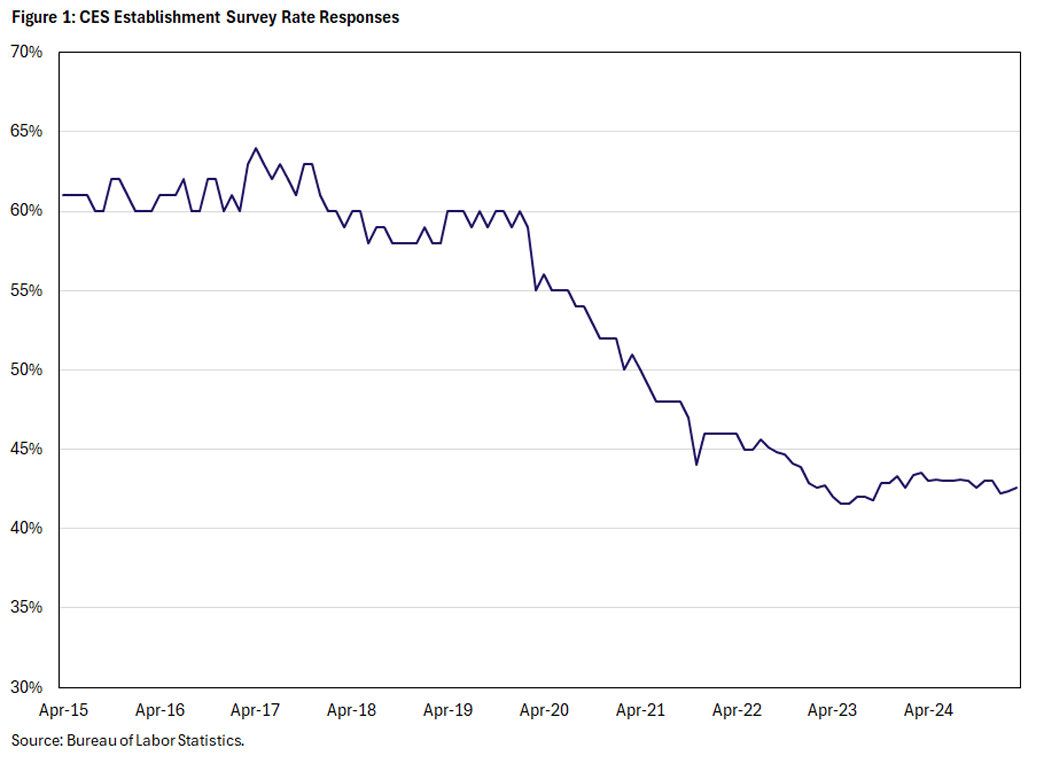
Though it has many strengths, the CES establishment survey is not perfect. First, the survey has been dealing with a significant decrease in its response rate (as seen in Figure 1), making it increasingly more difficult for the BLS to keep the CES survey representative. In the past 10 years, the CES establishment survey response rate has declined by almost 20 percentage points from 61 percent in April 2015 to 42.6 percent in March 2025.
Second, the BLS does not produce a jobs report if the government is shut down. During episodes of high uncertainty, accurate and up-to-date information on labor market statistics is crucial. However, this was lacking during last year's government shutdown.
Fortunately, alternative private data sources are available. Currently, the most well-known is provided by Automatic Data Processing (ADP), a private company specializing in employment services such as payroll processing. One significant benefit of ADP is that many employers use its services: It provides payroll services for more than 26 million employees. As a result, ADP's data cover about one-fifth of nonfarm private employment in the QCEW when weighted by employment.
Every month, ADP releases its National Employment Report, which is constructed from a convenience sample. While the methodology behind the construction of its sampling weights is not completely clear, the reweighted ADP convenience sample is supposed to reflect observable characteristics (such as industry and geography) from the publicly available QCEW. Its unweighted sample overrepresents large employers just like the CES establishment survey, but it contains significantly more employment among smaller businesses. As can be seen from the last column of Table 1, almost 11 percent of employment in ADP's convenience sample belongs to businesses with less than 10 employees.4
In the end, how do the ADP data perform relative to the official statistics from the BLS? Figure 2 compares estimates for month-over-month net changes in nonfarm private employment from several sources.
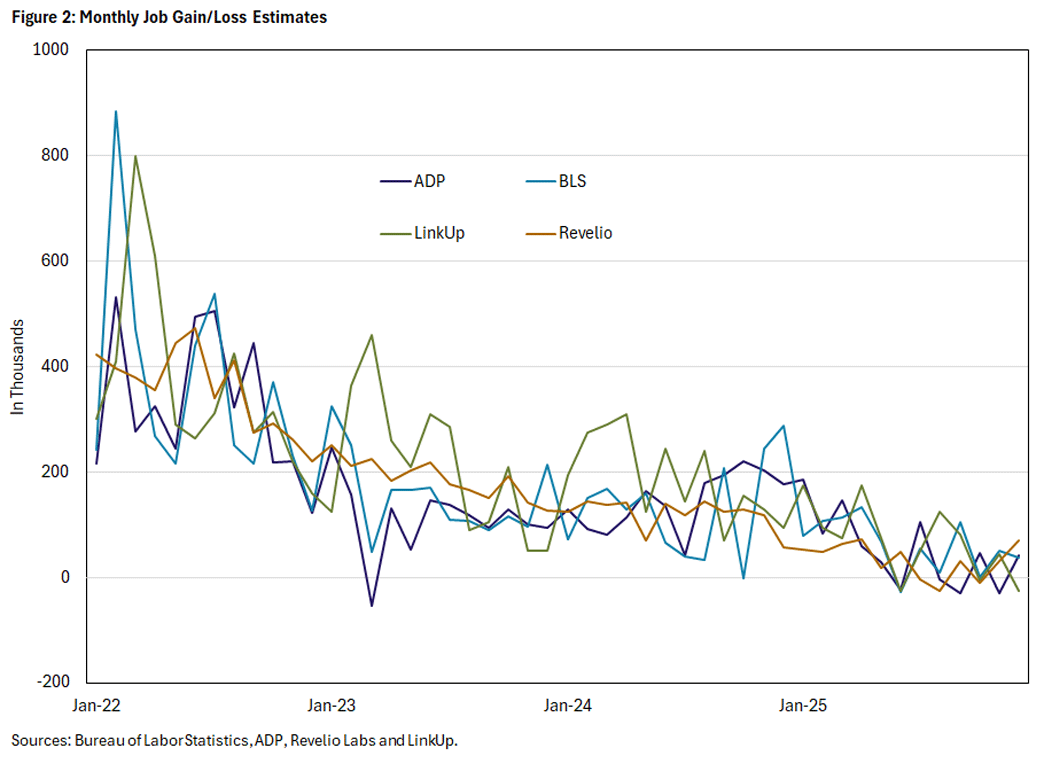
At first glance, the data from ADP seem to closely match the data from BLS' CES establishment survey. The correlation between the two series since January 2022 is quite high at 0.798. Importantly, the ADP series captures the trend of its BLS counterpart. This is not surprising since both datasets are benchmarked against data from the QCEW. Moreover, almost 90 percent of the time, ADP predicts job gains or losses whenever the BLS does.
But do the two series also agree on the level of job gains or losses? If we compare the ratio between job gains/losses from ADP relative to BLS, we see that ADP does well on average. It tends to underpredict BLS' estimate by only 4 percent or so, as seen in Table 2.
| ADP | LinkUp | Revelio | |
|---|---|---|---|
| Correlation w/ BLS | 0.798 | 0.530 | 0.691 |
| Correct Sign | 89.6 | 93.8 | 89.6 |
| Mean of Ratio | 0.962 | 1.448 | 1.082 |
| Standard Deviation of Ratio | 0.927 | 1.972 | 1.176 |
| Error Within 50% | 64.6 | 0.5 | 45.8 |
| Error Within 25% | 45.8 | 0.3 | 22.9 |
| Error Within 10% | 16.7 | 0.1 | 4.2 |
| Notes: "Correlation" calculates the correlation between a private company's estimate with its BLS counterpart. "Correct Sign" depicts the percentage of months (over the period 2022-25) in which the private company's estimation of whether there were job gains or losses from one month to another matched the BLS' direction. The third and fourth rows display summary statistics of the ratio of the private company's estimate on monthly job gains/losses relative to BLS' official estimate. The last three rows show what percentage of months (over the period 2022-25) the private company's estimate was within a certain error margin of BLS' official estimate. Sources: BLS, ADP, Revelio Labs and LinkUp. |
|||
This number is subject to some caveats. First, these results hold only when trimming outliers. ADP's estimates were considerably different than CES establishment survey figures in two periods:
- October 2024, when BLS estimated a loss of 1,000 jobs while ADP estimated a gain of 221,000 jobs
- October 2025, when BLS estimated a gain of 1,000 jobs and ADP estimated a gain of 47,000 jobs
Furthermore, ADP predicted the wrong direction three times in the last six months of 2025. That is, it predicted job losses while the BLS estimated job gains.
Also, the previously mentioned average hides a lot of volatility. The standard deviation for the ratio between ADP's and BLS' estimates is almost as high as its mean. ADP's estimates were within 50 percent, 25 percent and 10 percent of BLS estimates 64.6 percent, 45.8 percent and 16.7 percent of the time, respectively. In other words, ADP's estimates deviated less than 10 percent from official numbers only one out of every six times.
While one can be critical of ADP's estimates, they still seem to perform well compared to estimates produced by other private companies. In recent years, companies such as Revelio and LinkUp have also started publishing estimates on job gains/losses. Revelio sources its data from company websites, major job boards and staffing firm job boards, including LinkedIn and Indeed. LinkUp compiles and aggregates data directly from employer websites. As a result, LinkUp tends to be skewed towards larger employers.
Table 2 initially suggests similar results for LinkUp and Revelio as for ADP. This is especially true for Revelio: Just like ADP, the ratio between Revelio's and the BLS' estimates are close to 1 on average, and Revelio's correlation with the CES establishment survey is around 70 percent.
However, its estimates are less frequently within the BLS' range when compared to ADP. Since January 2022, ADP's estimates deviated less than 50 percent from the BLS estimates about 64.6 percent of the time. This is significantly lower for Revelio at 45.8 percent. On average, Revelio seems to be performing better than LinkUp. However, LinkUp's estimates seem more often within 50 percent, 25 percent and 10 percent of BLS' official estimates compared to Revelio.
Estimates for Small Businesses: Intuit
Another private data source is produced by Intuit, a company that provides small businesses with software for finances, taxes and marketing. One of its products, QuickBooks, allows Intuit to construct its Small Business Index, which tracks the net monthly change in payroll employment among small businesses (one to nine employees for U.S. firms).
It might be useful to focus on small businesses because these employers contribute disproportionately to aggregate job creation. Using data from the Business Dynamics Statistics (BDS) over the period 1978-2023, we can infer that small businesses were responsible for about 20.7 percent of aggregate job creation (on average) even though their employment share is only a bit more than half of that (12.3 percent).5 Furthermore, small businesses could be more exposed to aggregate conditions and be the first group of employers to be impacted by a recession.
However, checking the quality of Intuit's estimates is not straightforward. While the BLS does not publish job estimates by size class, the BDS does, reflecting job estimates by size class as of March 12 each year. This is useful because we can create a counterfactual series that is based on cumulative predicted changes in small business' employment by Intuit.
For example, Intuit provides month-over-month changes in small business payroll employment. If we sum these monthly estimates from March-April 2024 to February-March 2025, then this is Intuit's estimate for the annual change in small business' employment from March 2024 to March 2025. If we add this change to some base stock of employment, then we obtain the small business employment stock as implied by Intuit's estimates on net job growth. The closer the implied series is to the BDS series of employment by small businesses, the better the quality of Intuit's estimates.
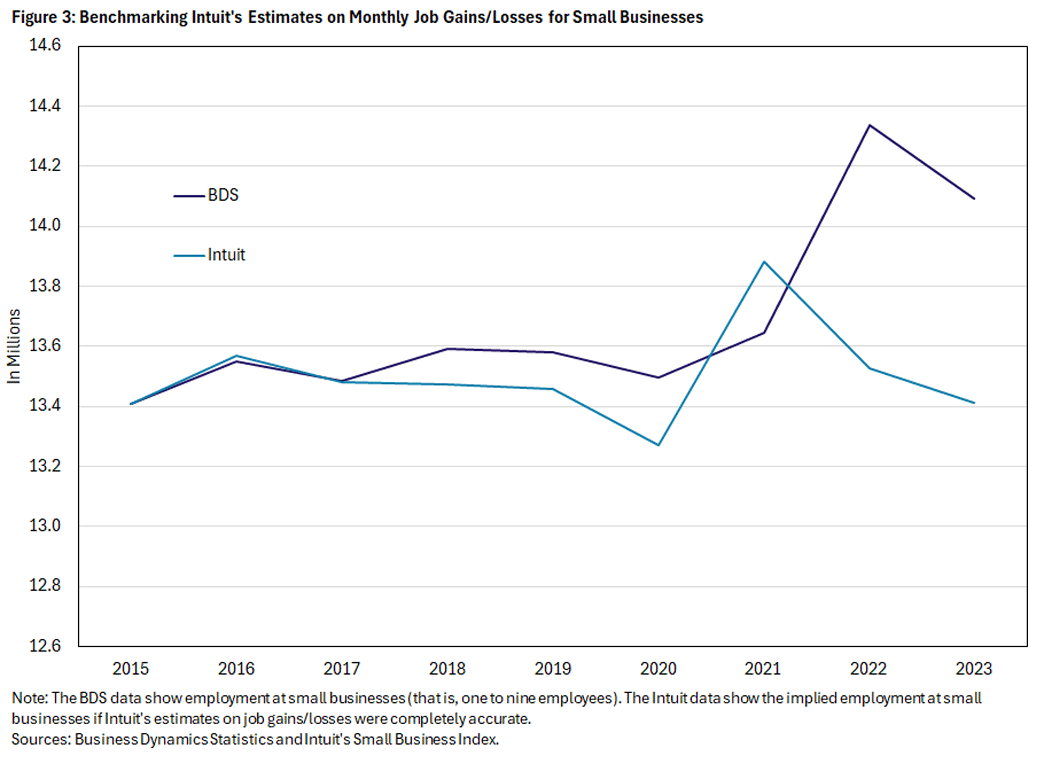
Figure 3 shows that Intuit's implied estimates are almost completely in line with the BDS series until 2017.6 From 2017 until the start of the pandemic, however, Intuit seemed pessimistic about small business job growth compared to BDS. Moreover, it severely underpredicted the increase in small business employment around the end of the pandemic. This rise in employment was likely created by the pandemic startup surge. By 2023, Intuit's implied series is off the BDS by about 680,000 jobs, which is about 4.8 percent of the total stock of employment among small businesses.
Based on these observations, we can conclude that Intuit's estimates seem reasonable. However, it performed poorly during unusual periods like the pandemic. It should be noted that this feature is also present in, for example, the ADP data. At the onset of the pandemic (April 2020), the ADP data also severely underpredicted the large fall in jobs: The BLS noted a loss of 19.6 million jobs, while ADP estimated 6.1 million jobs lost.
Conclusion
The ability of the labor market to create more jobs than it destroys is a key indicator of its health and an important input for policymakers' and market participants' decisions. As a result, the BLS puts considerable effort into its CES establishment survey that can produce estimates for month-over-month changes in payroll employment. While this survey is benchmarked on a dataset covering the universe of employers, it is facing a declining response rate and is frequently subject to revisions due to, for example, the difficulties incorporating the changes in payroll employment due to business births and deaths. Moreover, estimates from the BLS are not available during times like a government shutdown.
To fill this gap and complement BLS estimates, private companies like ADP, Revelio and LinkUp are producing monthly job reports. While most of these series can reproduce the trend component of official BLS estimates and are highly correlated with it, their precision at a higher frequency can be underwhelming at times. ADP's job growth estimates have been within 25 percent of official BLS estimates less than half of the time since the start of 2022. Nevertheless, ADP performs better than Revelio and LinkUp in this regard. Both sources have generated estimates that are within 25 percent of official BLS estimates only one in every four months.
Importantly, estimates from private companies tend to be less precise during unusual events such as the pandemic. This implies that policymakers should exercise caution when interpreting these data sources during volatile periods, which is exactly when a sharp policy response may be required.
Chen Yeh is a senior economist in the Research Department at the Federal Reserve Bank of Richmond.
1
An establishment's employment is measured by the number of payroll employees with strictly positive wages, regardless of full-time or part-time status. The CES establishment survey focuses on employment on the 12th day of a month.
2
By construction, almost all businesses are required to register with their state's labor department and contribute to the UI fund. Exceptions include, for example, independent contractors and gig workers.
3
Despite this update, the BLS notes that "there is an unavoidable lag between an establishment opening for business and its appearance on the sample frame making it available for sampling." The BLS deals with such issues through its net birth-death model.
4
Strictly speaking, the ADP sample does not contain employers but payroll accounts as a unit of observation. ADP implicitly assumes that a payroll account is equivalent to an establishment/company work location.
5
It should be noted that the contribution of small businesses to aggregate job creation has been declining. Small businesses were responsible for almost 24 percent of aggregate job creation in 1978. This had declined to 17.6 percent in 2023.
6
By construction, the two series coincide in 2015 since the Intuit data starts in April 2015.
To cite this Economic Brief, please use the following format: Yeh, Chen. (March 2026) "Monthly Job Reports: How Do Private Sources Fare?" Federal Reserve Bank of Richmond Economic Brief, No. 26-08.
This article may be photocopied or reprinted in its entirety. Please credit the author, source, and the Federal Reserve Bank of Richmond and include the italicized statement below.
Views expressed in this article are those of the author and not necessarily those of the Federal Reserve Bank of Richmond or the Federal Reserve System.


Subscribe to Economic Brief
Receive a notification when Economic Brief is posted online.
Contact Us