
How Bank Lending Standards Shape the U.S. Macroeconomy
Economic Brief
September 2026, No. 26-31
Key Takeaways
- Changes in lending standards affect GDP performance, with changes to business lending standards having a greater impact on overall U.S. economic growth than changes to household lending standards.
- The tightening of business lending standards is associated with a significant and persistent drop in real GDP growth. The magnitude of the effect depends on economic conditions, as it is significantly stronger when GDP is below its long-run trend, interest rates are away from their effective lower bound or economic uncertainty is elevated.
- A tightening of bank lending standards has a larger, more immediate negative impact on GDP growth than the positive effect of an easing in lending standards.
The provision of credit to firms and households is a fundamental pillar of macroeconomic performance in the U.S. While the domestic financial system includes many different entities, banks remain a significant component, especially in the direct provision of loans. At the end of 2019, U.S. chartered depository institutions accounted for approximately 40 percent of all loans provided to U.S. businesses and households.1
For many economic actors, these institutions represent the primary (and sometimes exclusive) source of funding. Consequently, changes in bank lending conditions are critical in evaluating the economic outlook and the state of financial conditions. As then-Federal Reserve Chair Jerome Powell noted in 2023, the tightening of bank credit acts as a restraint on economic growth.2 However, understanding this relationship requires disentangling a complex two-way street: While banks influence the economy, the state of economic activity and monetary policy also impacts how banks evaluate lending opportunities.3
Our 2026 paper "Bank Lending Standards and the U.S. Economy" — co-authored with Elijah Broadbent and Tyler Pike and henceforth referred to as BEPS — makes progress in quantifying these effects. By analyzing decades of survey data on banks' attitude toward lending, we document that shocks to bank lending standards (particularly those directed to businesses) have a significant and persistent impact on aggregate output, interest rates and inflation. Crucially, this new research reveals that the sensitivity of the economy to these shocks is not uniform. Instead, it depends heavily on the stage of the business cycle, the level of interest rates and the prevailing climate of economic uncertainty.
Measuring Banks' Attitude Toward Lending
BEPS uses the Senior Loan Officer Opinion Survey on Bank Lending Practices — commonly known as the SLOOS — to quantify the attitude of banks to provide loans at any given point in time. The Fed has conducted this quarterly survey and collects information on lending standards, loan terms and loan demand across various categories. The survey defines lending standards as the internal processes banks follow for approving or denying loan applications. These standards often capture the extensive margin of lending (or how many loans banks make), while loan terms like interest rate spreads, collateral requirements and covenants relate to the intensive margin (or how much banks lend).
Within the context of imperfect information, it has long been understood that interest rates are not sufficient to optimize the general lending decision.4 Banks use multiple levers to adjust lending. Following a well-established literature,5 this research focuses on quarter-to-quarter changes in the standards maintained by banks when deciding to approve a loan application, which is a key decision tool.
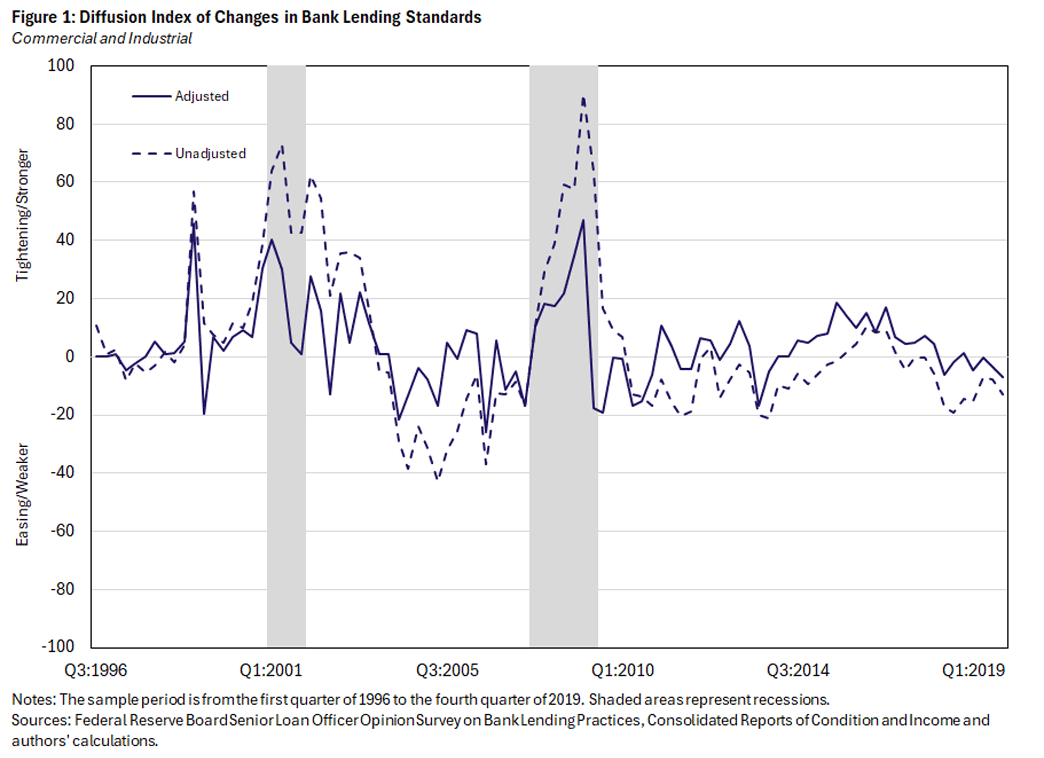
To make this qualitative data operational for economic modeling, BEPS constructs diffusion indexes where individual bank responses are weighted by the respective lending volumes to ensure that the measure reflects the commensurate impact on the aggregate economic activity. In quantifying the individual survey responses to construct the diffusion index, an individual bank that tightens lending standards is assigned a value of 1, while a bank easing standards receives a value of -1. No change in standards is reflected with a value of zero. Figure 1 illustrates the results for one important category: commercial and industrial loans. (BEPS presents the results for all other categories of loans.)
Identifying the Shock to the Supply of Bank Credit
A significant challenge when analyzing the impact of credit availability on the economy is the real possibility of endogeneity. That is, if a bank tightens standards because the economy is entering a recession, it is difficult to determine if the lack of credit is causing the slowdown or if the slowdown is causing banks to be more cautious. To address this, BEPS employs two distinct identification methods.
The first is a macro approach, which uses a standard vector autoregressive model.6 This method employs timing restrictions, such as the assumption that macroeconomic variables like GDP do not react instantly to a lending shock within the same quarter.
The second is the micro approach, which uses bank level data to purge the lending standards index of factors that might influence it, such as perceived loan demand, bank specific profitability and the broader macroeconomic outlook.7 This involves a dynamic fixed effects panel regression where the residuals represent the pure exogenous shock to credit supply.
A key methodological finding of BEPS is that the macro and micro approaches yield remarkably similar results. For economists and journalists in the private sector, this is a significant insight because bank level micro data is often confidential and restricted. The aggregate macro data — which is available to the public — can serve as highly reliable information to identify and study the effects of credit shocks.
Business and Household Lending Standards Shocks: Where the Power Lies
The research in BEPS provides a deep dive into the relative importance of different loan types. Consider two groups: business lending and household lending. The data reveal a stark disparity in the macroeconomic implications of shocks to those two groups, as seen in Figure 2. Shocks to business lending standards are the primary drivers of fluctuations in aggregate output. A tightening of business standards leads to a significant drop in real GDP growth, with the peak effect occurring roughly four quarters after the initial shock. This shock reduces growth by approximately 30 to 40 basis points.
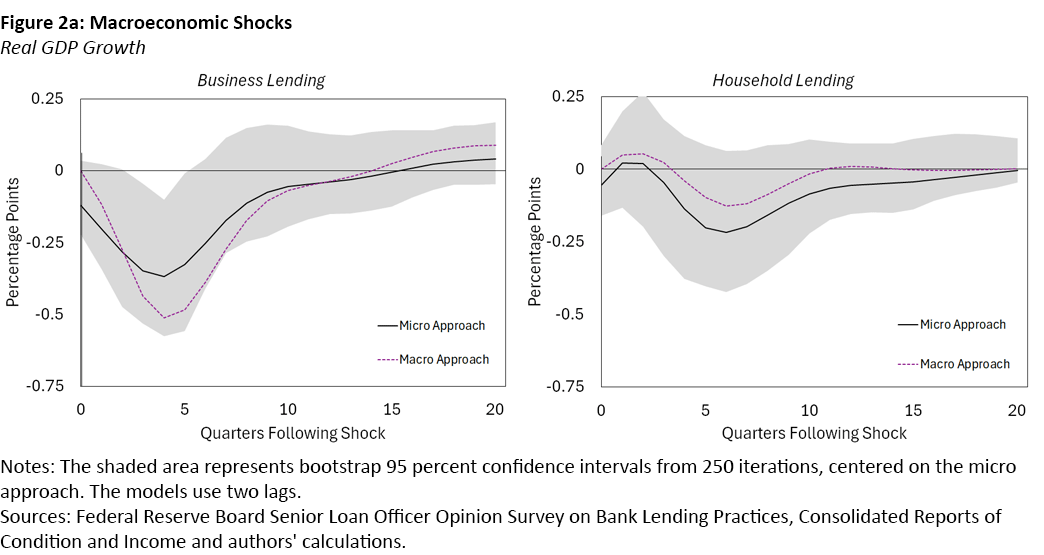
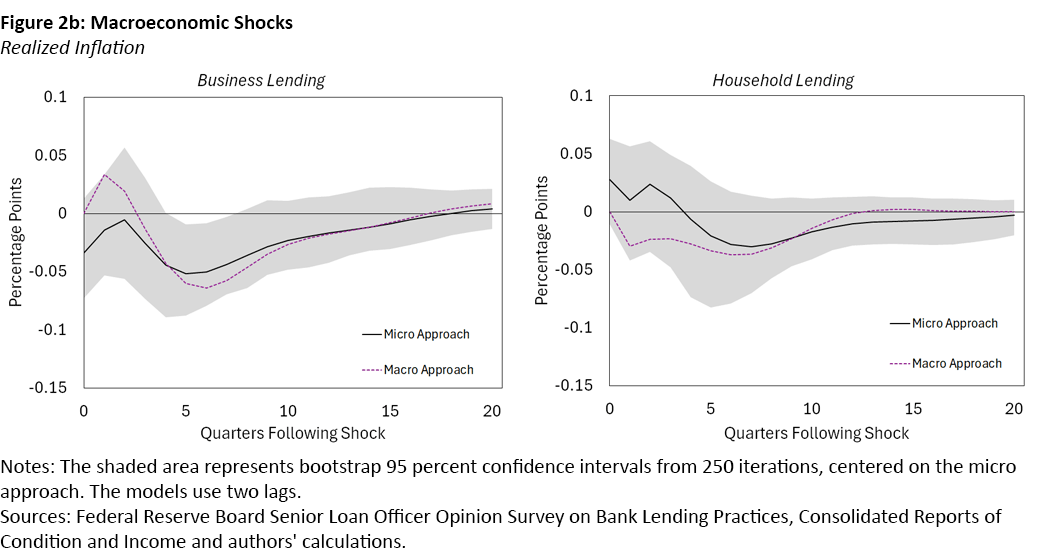
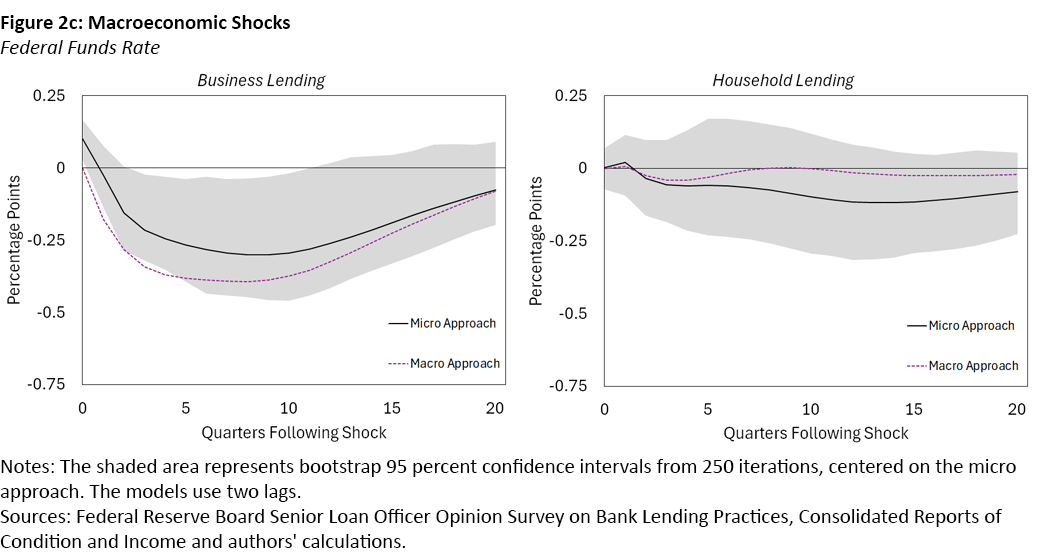
In contrast, shocks to household lending standards have a much more subdued and often statistically insignificant effect on aggregate output. A few mechanisms may explain this difference. First, banks are a more critical and essential source of funding for businesses than for households, who may have access to more automated or securitized forms of credit like credit cards or mortgages. Second, business investment is notoriously cyclical and volatile. The literature finds that equipment and structures investment is the component of aggregate demand most responsive to shocks in lending standards.8 When banks restrict credit, the resulting drop in investment quickly ripples through the broader economy.
In general, the research points to sizable feedback effects where a tightening in standards drives a slowdown in lending and in economic growth, which then induces banks to further tighten credit, reinforcing the initial slump. Importantly, BEPS also reveals, perhaps unsurprisingly, that the activity of the largest banks is the primary driver of these aggregate effects. And yet, shocks to smaller regional banks can also have some noticeable effect.
Economic Conditions Matter: When Do Bank Credit Shocks Matter Most?
The impact of credit tightening by banks depends strongly on the state of the economy. Using threshold vector autoregressive models, BEPS partitions the sample period into subperiods with distinct U.S. economic conditions and studies how responses to shocks in lending standards change when economic conditions change.
The first contingency is a measure of the state of the business cycle. Tightening bank credit shocks are far more consequential when the level of GDP is below its long-run trend.9 During these periods, the financial net worth of firms is often lower, making them more sensitive to an increase in the external finance premium.10 Conversely, when GDP is above trend, firms can often find alternative funding sources, making a bank tightening less impactful.
The second state considered by BEPS is the proximity of interest rates to their effective lower bound. Shocks have larger and more persistent effects when interest rates are away from their natural lower bound. According to a pair of recent papers,11 bank credit and risk-taking ebb when the economy is operating in a persistently low interest-rate environment, with interest margins compressed and internal capital generation reduced. Based on this reasoning, a tightening shock to lending standards can have a more subdued impact on bank activity and general economic conditions, as banks already operate in a conservative mode and with limited room to further contract credit in response to the tightening shock.
Finally, the study finds that credit shocks are amplified during periods of increasing or high financial uncertainty. High uncertainty makes agents more conservative and funding alternatives harder to secure. This situation can create a self-reinforcing cycle when combined with a bank driven credit crunch.12
Asymmetric Effects of Tightening and Easing Shocks
The study also uncovers a fundamental asymmetry in how the economy reacts to bank credit availability. Tightening shocks have a much larger and more immediate effect on output than easing shocks. While a sudden restriction of credit triggers a drop in bank lending capacity and a slowdown in GDP growth, a loosening of standards does not always result in a commensurate boost to economic growth, as seen in Figure 3.
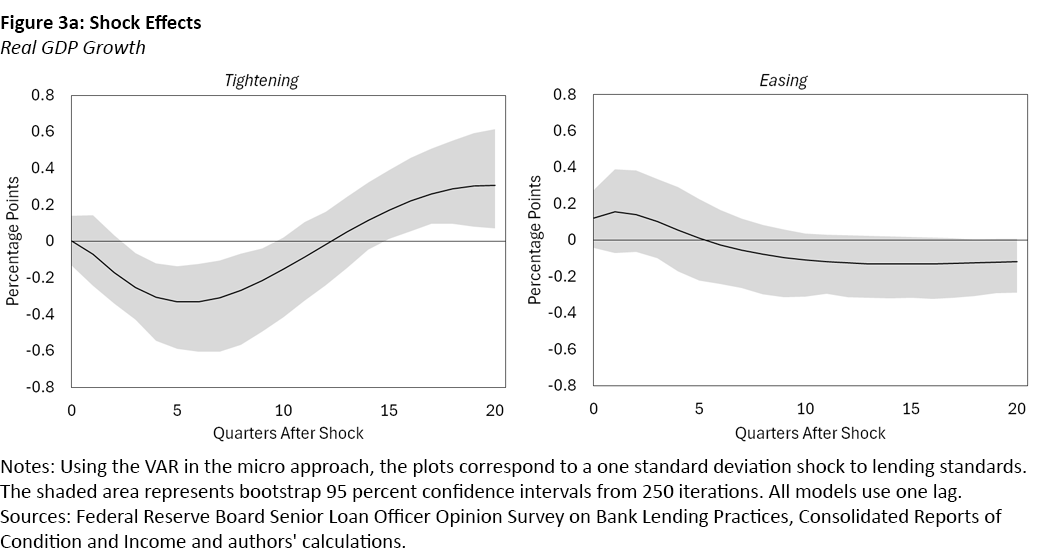
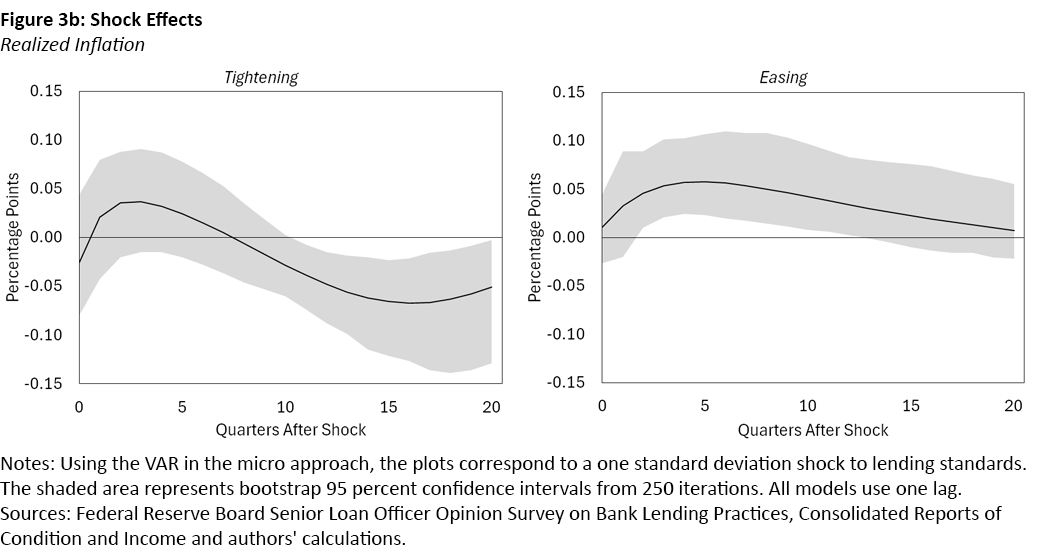
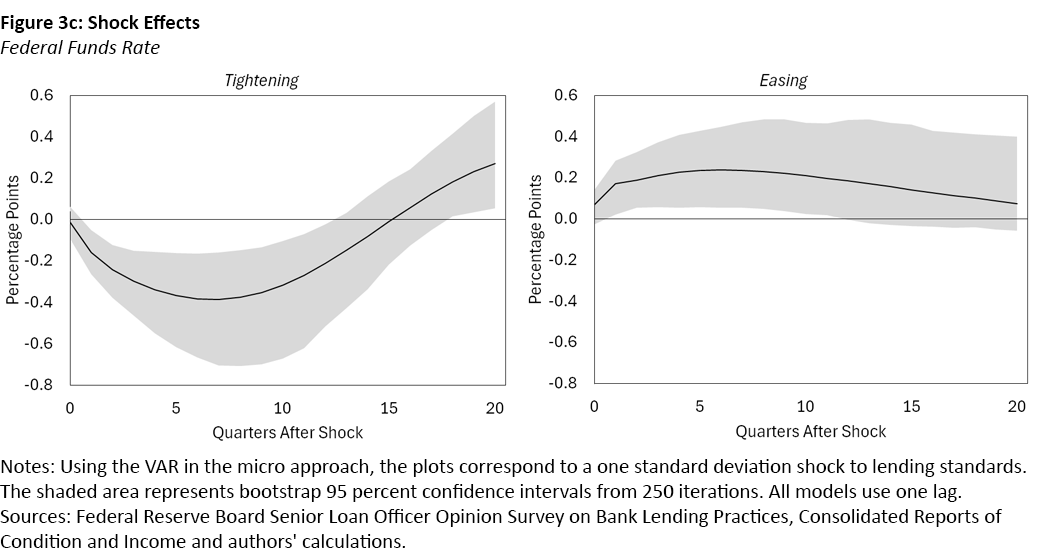
This finding aligns with the 2022 paper "Are the Effects of Financial Market Disruptions Big or Small?,"13 which provides evidence that unfavorable financial shocks have stronger effects than favorable ones. For practitioners, this means that the negative effects of a credit squeeze are generally more powerful and predictable than the positive effects of a credit easing.
The Transmission Mechanism
BEPS helps to clarify the internal transmission channel of these shocks: from lending standards to bank lending capacity to GDP growth. When banks tighten standards, there is a noticeable and quick drop in bank lending growth, measured as the sum of loans outstanding and unused credit commitments. This reduction in the supply of credit leads to a contraction in private domestic demand, particularly investment.
Of note, while the effect on GDP is large, the effect on inflation is relatively muted and subdued. Interest rates do tend to fall in response to the slowdown caused by tighter credit, but the inflationary impact is much weaker than the real output effects.
Conclusion
The study provides a rigorous empirical investigation, helpful for understanding the credit cycle as a driver of business cycles. A few key takeaways emerge:
- Monitoring lending standards for businesses — particularly for commercial and industrial loans — can provide a potent signal for future GDP slowdowns.
- The context in which the bank credit shock happens is key: A tightening of standards is much more concerning when the system is already under stress, such as when output is below trend, interest rates are very low or uncertainty is high.
Overall, this research underscores the idea that bank attitudes toward lending are a critical barometer for the health of the U.S. macroeconomy.
Huberto Ennis is group vice president for micro, macro and financial economics, and Horacio Sapriza is a senior economist and policy advisor, both in the Research Department at the Federal Reserve Bank of Richmond.
1
See the Financial Accounts of the United States from the Federal Reserve Board of Governors.
3
See the 2021 paper "Feedbacks: Financial Markets and Economic Activity" by Markus Brunnermeier, Darius Palia, Karthik Sastry and Christopher Sims.
4
See, for example, the 1981 paper "Credit Rationing in Markets With Imperfect Information" by Joseph Stiglitz and Andrew Weiss and the 1987 paper "Costly Monitoring, Loan Contracts and Equilibrium Credit Rationing" by Stephen Williamson.
5
See, for example, the 2006 paper "The Credit Cycle and the Business Cycle: New Findings Using the Loan Officer Opinion Survey" by Cara Lown and Donald Morgan and the 2014 paper "Changes in Bank Lending Standards and the Macroeconomy" by William Bassett, Mary Beth Chosak, John Driscoll and Egon Zakrajsek.
6
This approach was pioneered in this context by the previously cited paper "The Credit Cycle and the Business Cycle: New Findings Using the Loan Officer Opinion Survey."
7
This approach follows the previously cited paper "Changes in Bank Lending Standards and the Macroeconomy."
8
See the 2024 article "Unpacking the Effects of Bank Credit Supply Shocks on Economic Activity" by Michele Cavallo, Juan Morelli and Rebecca Zarutske.
9
The long-run trend in GDP is determined following the 2018 paper "Why You Should Never Use the Hodrick-Prescott Filter" by James Hamilton.
10
This is a concept central to the financial accelerator literature by the 1989 paper "Agency Costs, Net Worth and Business Fluctuations" by Ben Bernanke and Mark Gertler.
11
See the 2023 paper "The Reversal Interest Rate" by Joseph Abadi, Markus Brunnermeier and Yann Koby and the 2024 paper "Negative Nominal Interest Rates and the Bank Lending Channel" by Gauti Eggertsson, Ragnar Juelsrud, Lawrence Summers and Ella Getz Wold.
12
See the 2020 paper "Liquidity Traps and Monetary Policy: Managing a Credit Crunch" by Francisco Buera and Juan Pablo Nicolini.
13
Authored by Regis Barnichon, Christian Matthes and Alexander Ziegenbein.
To cite this Economic Brief, please use the following format: Ennis, Huberto; and Sapriza, Horacio. (September 2026) "How Bank Lending Standards Shape the U.S. Macroeconomy." Federal Reserve Bank of Richmond Economic Brief, No. 26-31.
This article may be photocopied or reprinted in its entirety. Please credit the authors, source, and the Federal Reserve Bank of Richmond and include the italicized statement below.
Views expressed in this article are those of the authors and not necessarily those of the Federal Reserve Bank of Richmond or the Federal Reserve System.


Subscribe to Economic Brief
Receive a notification when Economic Brief is posted online.
Contact Us