

The Surprising Resilience of Corporate Profit Margins
Key Takeaways
- Public companies' gross margins have held up (and even grown) despite a decade of supply shocks. The median company's gross margin rose about 3 percentage points (or roughly 10 percent), and this isn't just a shift toward high-margin services, as average gross margins still grew more than 10 percent within the five largest industries.
- Healthy margins suggest that rising input costs aren't squeezing firms into cutting labor costs, which makes gross margin pressure an unlikely cause of the declining labor share over the past decade.
- Business-facing firms have seen faster margin growth than consumer-facing ones, though margins grew for both.
Businesses have been hit by a remarkable number of supply shocks in the last decade. The pandemic, tariffs and the wars in Ukraine and Iran have generated uncertainty while increasing input costs. Yet, 86 percent of S&P 500 companies beat earnings estimates in the second quarter of 2026. In this article, we'll examine how corporate profit margins have trended over the past few decades.
Why Examine Corporate Profit Margins?
Corporate profit margins influence how supply shocks will affect inflation, because weak margins could potentially pressure corporations to cut wages. Looking at public data from the last decade, we find that public company gross profit margins have been virtually invincible in the face of shocks.
We take a narrow lens on profits by focusing on gross margins, which is the part of corporate profits that reflect the difference between prices received (net sales) and prices paid for inputs (cost of goods sold). Gross margins capture the impact of, say, gas prices or tariffs on input prices, and the evolution of gross margins shows the extent to which prices adjust to higher costs. This allows us to explore changes to profits arising from shocks to inputs, although we will not capture other important components in total corporate profitability such as labor and overhead costs.
Gross Margins Over the Last Decade
Even as corporations bemoan the impact of cost increases, gross profit margins are not just undented but have seemingly increased. Over the last decade, the median public company's gross margins actually increased 3 percentage points (or 10 percent), as seen in Figure 1.
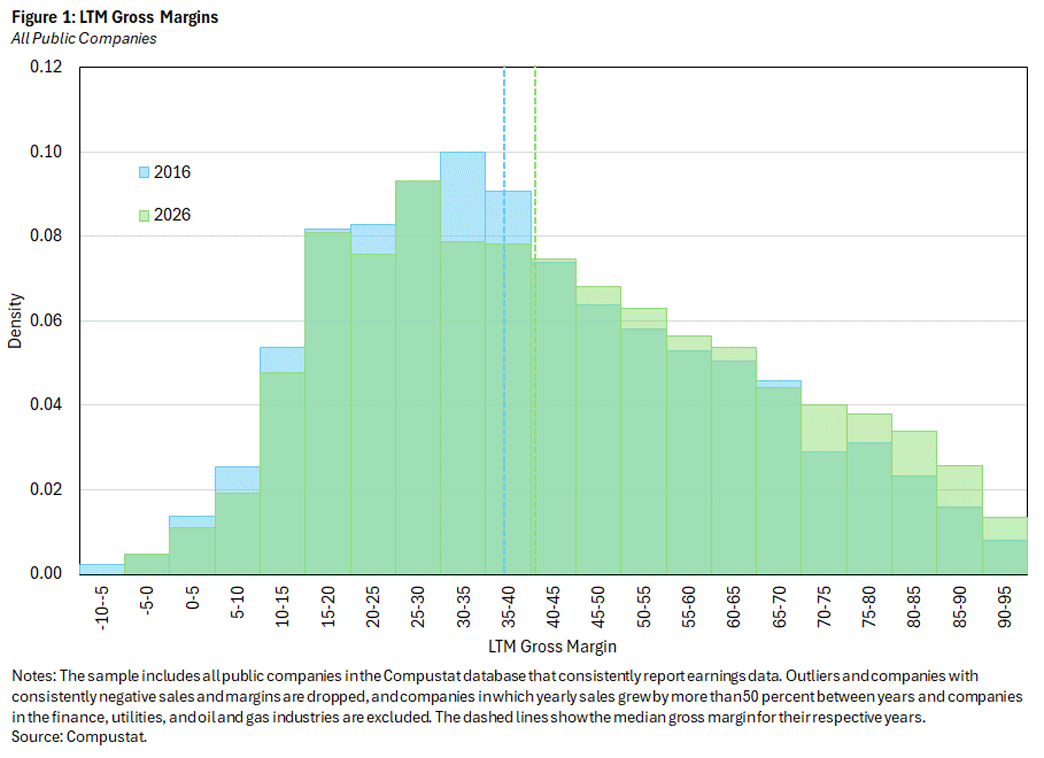
Some of this evolution reflects composition effects from the changing nature of the U.S. economy and public companies. For instance, the average gross margin of the 500 largest U.S. companies by sales has increased at a different rate than that of all companies, jumping 9 percent from 2006 to 2016 and an additional 5 percent from 2016 to 2026. Among these companies, the number of professional services firms nearly doubled from 2006 to 2026, while the number of manufacturing firms fell by a quarter. Since most inputs to professional services firms are labor, these firms have much higher gross margins, on average, than manufacturing firms do.
However, higher margins are not an artifact of the changing industry composition of public companies. Figure 2 replicates the first figure by showing the distribution of corporate profits in 2016 and 2026 but limits the analysis to the evolution of margins within the five industries with the most sales:
- Wood, chemical and plastics manufacturing
- Metal and electronic equipment manufacturing
- Wholesale trade
- General merchandise and online retail
- Information services
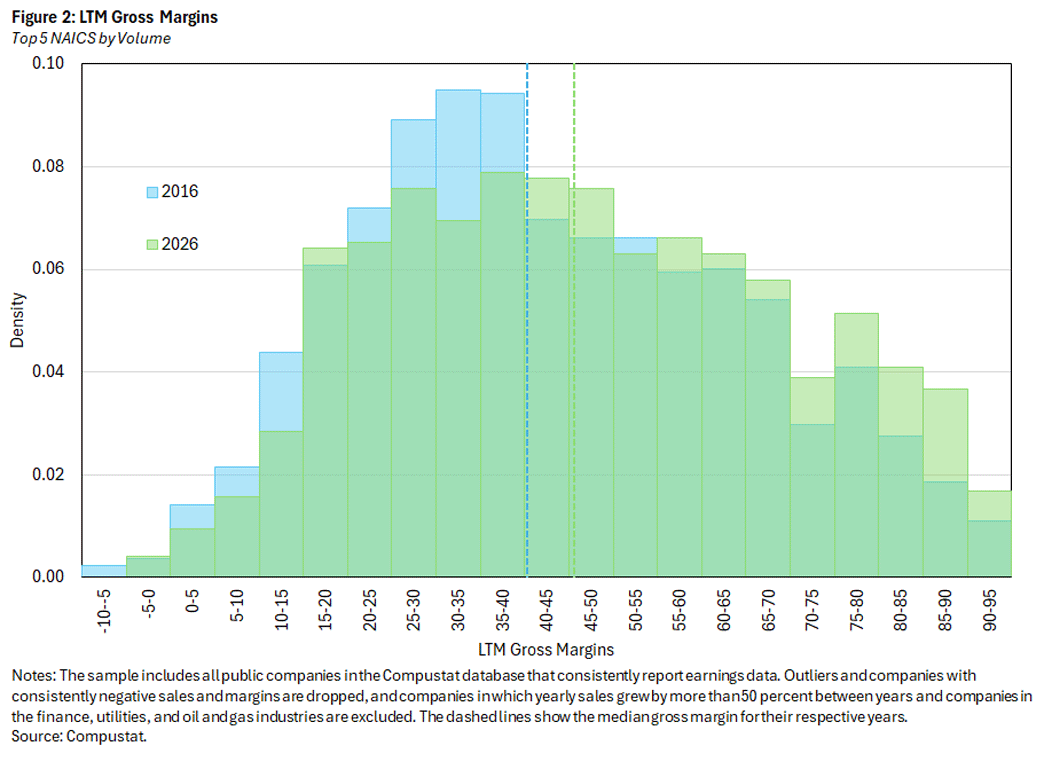
Even if we control for changes over time in the industry composition of U.S. public companies, average margins have grown by more than 10 percent. Within the wholesale trade sector — which covers firms that mainly sell merchandise to other firms — the average gross margin has increased by almost 30 percent since 2006.
Gross Margins and Business-to-Consumer Companies
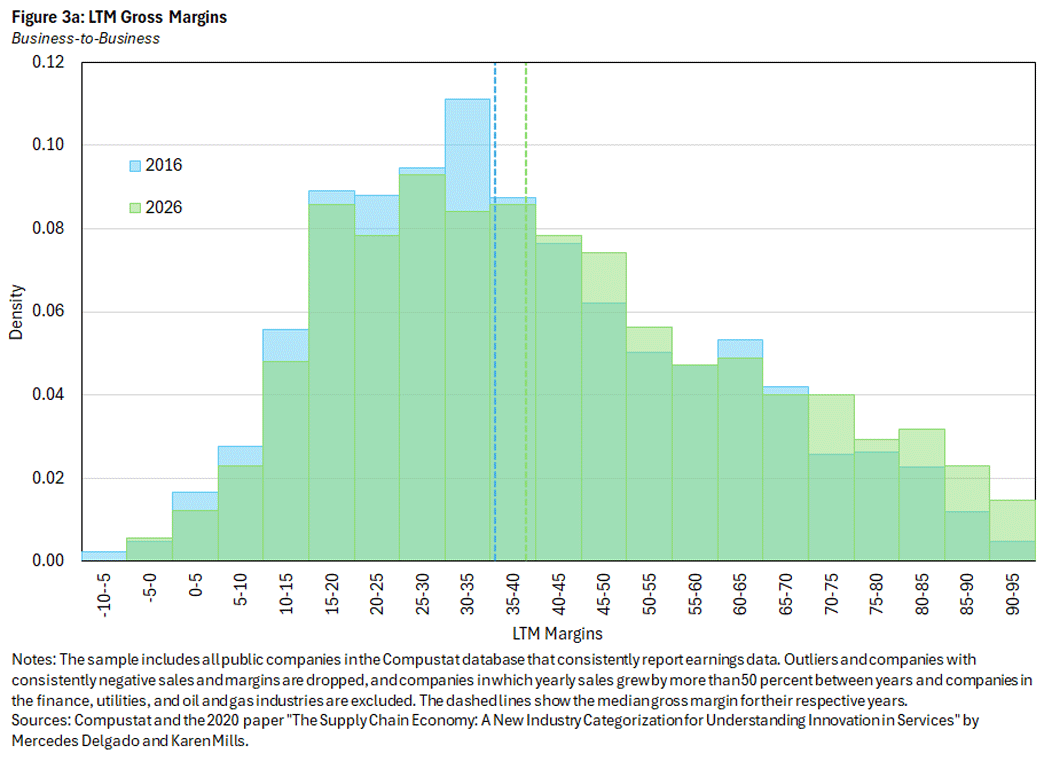
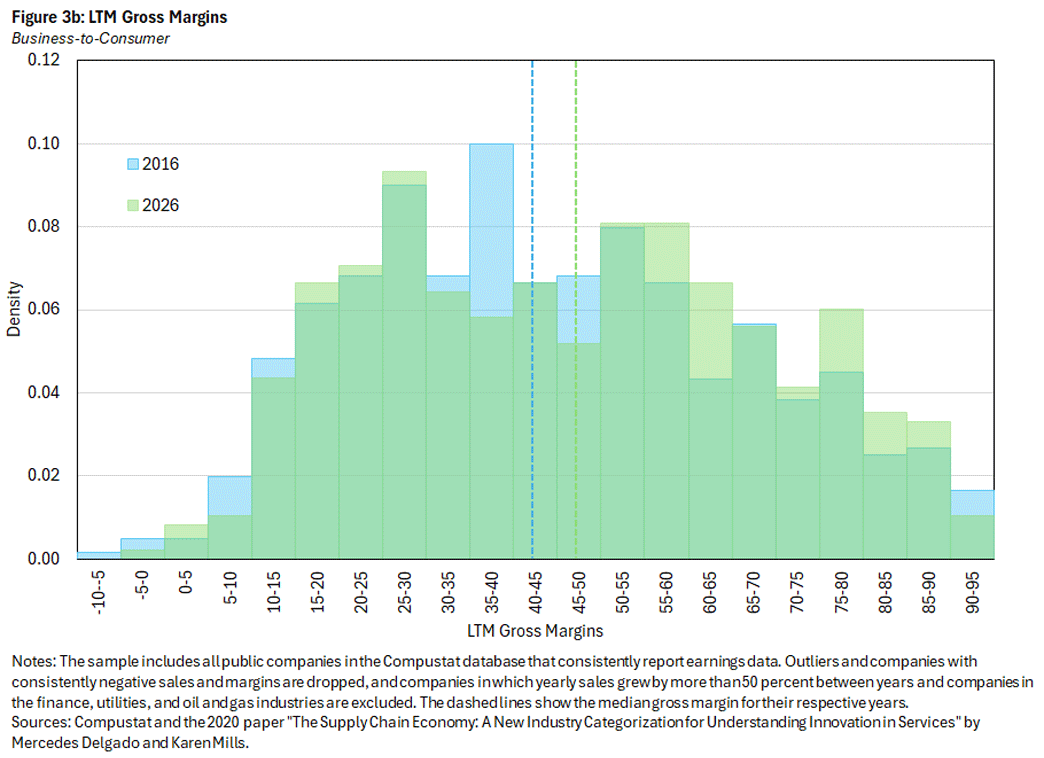
In our outreach to businesses, we hear very different challenges from businesses that are closer to consumers, with business-to-business (B2B) companies more sanguine about passing through costs than companies that mostly sell to individuals (B2C).1 In fact, when comparing B2B and B2C public companies, we find that average margins for B2B companies grew by 8 percent over the past decade while those for B2C companies grew by only 5 percent.2
Why Are Gross Margins So Resilient?
The resilience of gross margins suggests that, in the face of rising input prices, corporations have been able to pass on supply shocks or to increase productivity. While we cannot rule out something different happening in the future if the economy confronts more supply shocks, consistent margins reduce pressure on companies to cut labor costs.
Taking a step back, economic theories of competitive markets suggest that prices should converge to marginal costs. An estimation of marginal cost would account not just for cost of goods sold — as the gross margin does — but also for labor and payments to capital, all on a tax-adjusted basis. Different methods result in different conclusions about how markups have changed over time. Some papers have documented markups increasing over time and across countries.3 Others argue that markups have remained constant.4 And a 2021 paper challenges the view that product-market concentration has changed in the U.S., pointing out that while national concentration may have increased, local concentration has been falling.5
Conclusion
Because costs for other inputs might be changing, it’s important not to overextrapolate from the evidence on gross margins. Gross margins measure the extent of pass-through in input prices but do not capture changes in the cost of labor and overhead, nor other components of net profits such as interest expenses or taxes. For instance, a 2026 article argues that economy-wide markups rose from about 10 percent above marginal cost in 1960 to about 25 percent in 2020, but the profit share of GDP showed no lasting rise, because growing overhead and fixed costs absorbed most of the gains.6 That said, gross margin pressures can be ruled out as a source of the decreasing labor share we have seen in the U.S. economy over the last decade.
Anna Kovner is an executive vice president and the director of research, and Lorelei Lin is a research associate, both in the Research Department at the Federal Reserve Bank of Richmond.
See, for example, the 2026 article "What Businesses Are Saying: Steady Overall With Pockets of Stress" by Andrew Bauer, Renee Haltom and Matthew Martin.
See the 2020 paper "The Supply Chain Economy: A New Industry Categorization for Understanding Innovation in Services" by Mercedes Delgado and Karen Mills. This paper sorted six-digit 2012 NAICS codes into these two categories based on their share of sales to households in the 2002 U.S. Benchmark Input-Output Accounts. After mapping these codes to their 2022 three-digit equivalents, we classified the three-digit industries as B2B if at least half of the corresponding six-digit subsectors were B2B in this paper. Not all 2022 NAICS could be matched with a 2012 NAICS, so for comparison, we also used generative AI to classify 2022 three-digit NAICS into B2B and B2C based on keywords in their Census Bureau descriptions. We used the paper's classification when the generative AI classification conflicted and the generative AI classification when the paper's classification was missing.
Examples include the 2018 working papers "Markups in the Digital Era" by Sara Calligaris, Chiara Criscuolo and Luca Marcolin and "Global Market Power" by Jan De Loecker and Jan Eeckhout.
Examples include the 2019 paper "Are Price-Cost Markups Rising in the United States? A Discussion of the Evidence" by Susanto Basu; the 2022 working paper "Rising Markups or Changing Technology?" by Lucas Foster, John Haltiwanger and Cody Tuttle; and the 2026 paper "Markups Across Space and Time" by Eric Anderson, Sergio Rebelo and Arlene Wong.
See the 2021 paper "Diverging Trends in National and Local Concentration" by Esteban Rossi-Hansberg, Pierre-Daniel Sarte and Nicholas Trachter.
See the 2026 article "Market Power Rose, Why Didn't Profits?" by Thomas Hasenzagl and Luis Perez.
To cite this Economic Brief, please use the following format: Kovner, Anna; and Lin, Lorelei. (November 2026) "The Surprising Resilience of Corporate Profit Margins." Federal Reserve Bank of Richmond Economic Brief, No. 26-37.
This article may be photocopied or reprinted in its entirety. Please credit the authors, source, and the Federal Reserve Bank of Richmond and include the italicized statement below.
Views expressed in this article are those of the authors and not necessarily those of the Federal Reserve Bank of Richmond or the Federal Reserve System.


Receive a notification when Economic Brief is posted online.