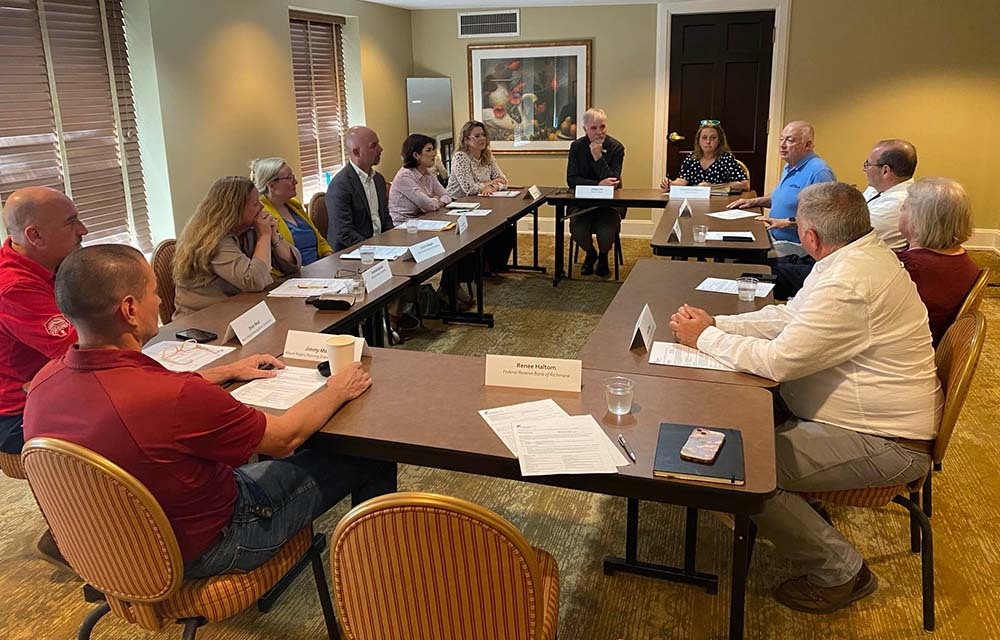
In the lead-up to the December Federal Open Market Committee cycle, we heard that the economy was chugging along with disproportionate support from high-income consumers and artificial intelligence (AI). Many firms noted they were hesitant to invest or hire too significantly going into 2026; uncertainty and costs remained too high. Consumers pushed back against price increases, squeezing margins. Labor availability was improving, but skill and geographic mismatches continued, and there were no signs that either hiring or firing would pick up soon. You can read more in December's "What Businesses Are Saying."
In this post, we draw from more recent conversations, from mid-December to mid-January. While conditions remained largely similar to the prior cycle, we note a few shifts, which we discuss below.
Overall Momentum: Firms Feel on Sturdier Footing, but Still Hesitate to Make Moves
Lean firms feel increasingly confident in their ability to navigate uncertainty. Business leaders commonly describe themselves as cautiously optimistic. When pressed, they credit both external and internal factors. To some extent, firms expect 2026 to be more stable than 2025, without external shocks of the magnitude of "Liberation Day." To a greater extent, business leaders seem increasingly confident in their own resilience. They faced 2025's challenges and made it to the other side. They've fine-tuned supply chains and operations and identified efficiencies. They are running lean, which makes them feel more agile in the face of elevated uncertainty. As a reminder, conversations went through mid-January; it is not yet clear how more recent events have impacted their sentiment.
Potential demand boosts fuel optimism as well. Data centers and AI-related businesses continue to see strong demand. Contacts in the leisure and hospitality industry point to large nationwide events as promising engines of demand, such as the World Cup and America's 250th anniversary. In the manufacturing space, a few firms flag positive signals. One sees signs that the yearslong lull in equipment orders, which followed a strong pull forward during the pandemic, may finally be coming to an end. A few note that the equipment replacement cycle could force some demand this year. Across the board, there's an expectation that coming tax stimulus should support consumer spending.
Increased optimism for 2026 does not necessarily mean firms are making moves. Overall, business leaders seem cautiously optimistic in the sense that they've adapted to the sense of instability and, to use their own words, are "less traumatized." As a result, they are generally more upbeat. Investment seems stronger than last year but remains restrained. A focus on efficiency may also be limiting how much optimism translates into spending.
Consumers are still spending but with increasing sensitivity. Contacts share that consumers are increasingly cost-conscious — taking advantage of discounts and trading down where they can. Most consumer-facing firms share that consumers are still willing to spend: They're simply prioritizing what offers the most value (i.e., the best "bang for their buck") and what they value the most (i.e., their personal priorities).
Rate cuts come up infrequently. In general, few contacts bring up rate cuts on their own. When asked, many businesses, especially within real estate, note that additional rate cuts would be helpful on the margin. Some flag that the potential disconnect between movements in the federal funds rate and long-term rates can make it challenging to discern how cuts would impact their plans in practice.
Labor Markets: Low-Hire, Low-Fire Seems Set to Continue
Companies maintain steady headcount or downsize via attrition. Even with cautious optimism, it is rare to hear about significant hiring plans. After trimming in 2025, most firms plan to hold steady. Some firms plan to continue downsizing via attrition. This lean stance has been challenging for entry-level job candidates who struggle to find employment.
Wage pressure is generally easing. Even as the labor market loosened in 2025, firms often reported wage growth above pre-COVID-19 levels. More recently, wage growth is seemingly cooling, falling back down to pre-COVID-19 norms.
Pricing: Margins Still Squeezed From Both Ends
Cost pressure continues. Most firms continue to point to rising costs from the same drivers, such as utilities and various forms of insurance. Of note, fewer contacts bring up tariffs on their own when discussing cost pressures, although conversations occurred prior to the recent threat of new tariffs.
Customers resist price increases. Many business-to-consumer (B2C) firms note they feel very little wiggle room on price, as customers are increasingly price sensitive. This is particularly the case for smaller firms. Some firms note discounting was necessary to move inventory during the holiday season. A few business-to-business (B2B) firms also note resistance to further price increases — a shift from prior cycles during which B2B firms had generally found it easier to pass along costs than B2C firms.
Tariff costs are still making their way through the system. Several firms that report customer resistance to price increases still plan to slowly pass on tariff costs to the extent possible. They aim to make the increases as unnoticeable as possible, spreading them out over time and a broad set of items. Some share increased pressure to pass on costs given their stockpiled pre-tariff inventory is dwindling. A few note they've done all they can to cut other costs or offset with efficiencies and see no choice left but to raise prices.
Efficiency gains help some firms navigate squeezed margins. Most of these efficiencies are not coming from AI. One firm reports they've sold underutilized assets. Another has adjusted their pay structure to improve incentives for higher productivity. Several note that productivity investments during the post-pandemic labor shortage, such as automation and streamlining of processes, have given them some breathing room. Trimming vacant positions to reduce headcount has also helped. While not widespread, a few firms mentioned layoffs as a cost-cutting measure.
Some larger firms are focused on winning back customers. Since the post-pandemic inflation began, many consumer-facing firms reported rising prices and revenue but shrinking volumes. Tariffs exacerbated this. Some of those firms now share they are focused on winning back market share by refining product offerings. It's unclear whether the drive for volume will eventually lead to price discounts.
Looking Forward: Where Are We Headed?
This coming cycle, we'll continue to monitor how conditions evolve on both sides of our dual mandate. How do firms thread the needle between rising costs and increased price sensitivity from customers? Do any firms start turning to labor as a cost-cutting lever? What would it take for firms to start hiring again? Do interest rate cuts start to move the needle more broadly? Do firms retain their sense of optimism, and does it begin to translate to more forward-leaning decisions?
Views expressed are those of the author(s) and do not necessarily reflect those of the Federal Reserve Bank of Richmond or the Federal Reserve System.