

The Ins and Outs of Long-Term Unemployment
Key Takeaways
- The recent rise in long-term unemployment is almost entirely accounted for by a decline in unemployment outflow rates, especially the rate at which unemployed workers find jobs.
- Inflows into unemployment from employment remain low by historical standards, indicating that the rise is not driven by increased layoffs.
- Outflow rates have fallen most for workers already unemployed 27 weeks or longer, widening the duration gap and signaling that current dynamics are different because such widening has previously only occurred if the economy was in a recession.
The U.S. labor market is sending mixed signals. On the positive side, headline unemployment remains low by historical standards, layoffs are subdued, and quit rates have normalized following pandemic-era turbulence. Yet one piece of data has drawn growing attention: The share of long-term unemployment — defined as unemployed workers who have been jobless for 27 weeks or more — has been rising. In this initial article of a three-part series, we examine the mechanics of that rise and focus on how rather than why (which will be covered in subsequent articles in this series).
A Flow Framework for Unemployment
Unemployment is a stock — the number of people without jobs and actively searching at a point in time — that is filled and drained by ongoing flows. At any moment, individuals can occupy one of three labor market states:
- Employed (E)
- Unemployed (U)
- Not in the labor force (N)
Individuals move between these states at rates that economists track using the Census Bureau's Current Population Survey (CPS).
While workers can move from one state to another at any given point, the standard accounting framework decomposes movements in unemployment into four key transition rates.1 Inflows from employment to unemployment (EU) and from nonparticipation to unemployment (NU) raise the stock, and outflows from unemployment to employment (UE, the job-finding rate) and from unemployment to nonparticipation (UN) reduce it. Long-term unemployment can rise if inflows surge — pushing more people into the unemployment pool — or if outflows weaken, leaving people in the pool for longer.
The distinction matters. A surge in inflows accompanies most recessions: Layoffs spike, the unemployment pool expands, and a larger fraction of workers will inevitably accumulate long durations even with stable outflow rates. By contrast, a fall in outflow rates produces a different signature: The inflow side looks normal, but each individual who becomes unemployed takes longer to leave the pool, and the share of long-term unemployed grows mechanically as a result.
Outflows Have Fallen; Inflows Have Not
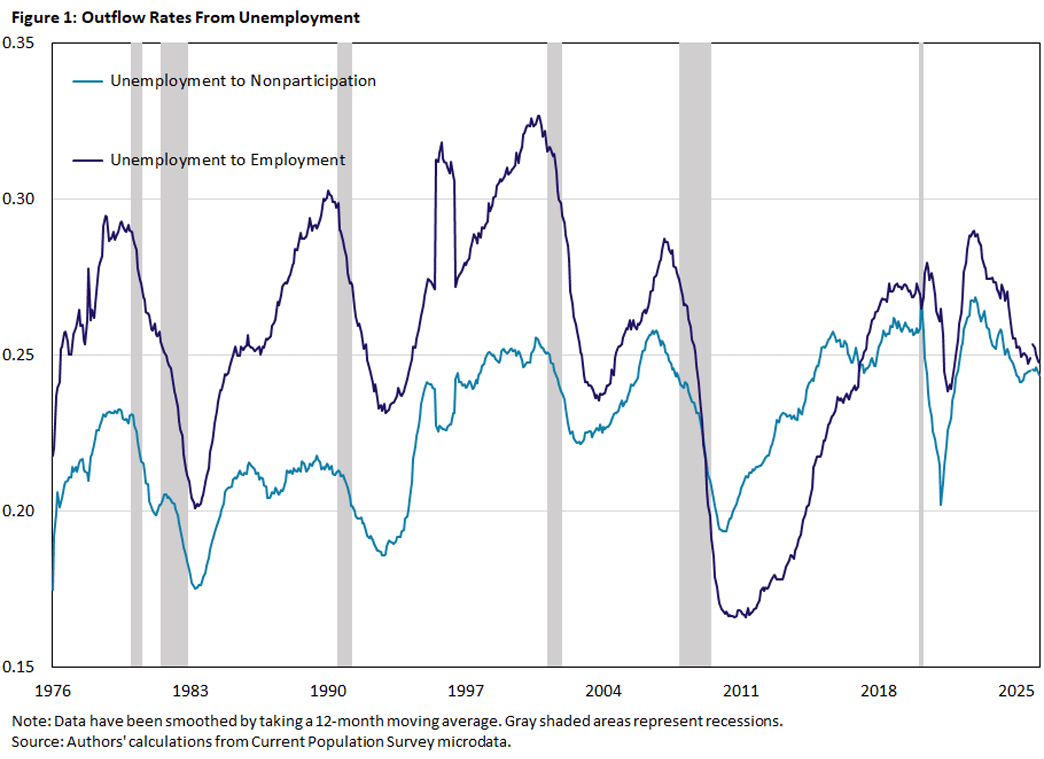
Both UE and UN are procyclical — meaning they rise during expansions and fall during recessions — and neither has shown a strong secular trend over the past half-century, as seen in Figure 1. Since 2023, however, the job-finding rate UE has been declining. The rate at which unemployed workers leave the labor force has also declined.
As seen in Figure 2, however, inflow rates tell a different story: EU has remained low, with no layoff spike comparable to those observed in 2008-09 or in 2020, and NU has been modestly elevated but is not the main driver of the rising stock.
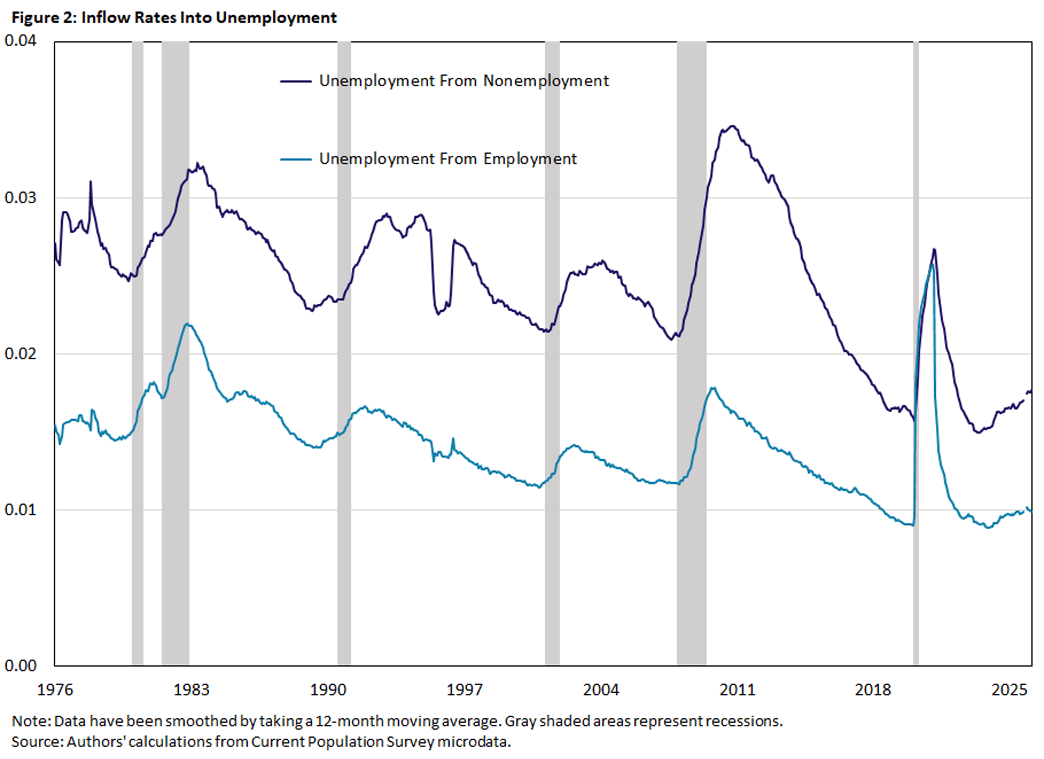
This combination — falling job-finding rates without rising separations — is unusual compared to the past several decades. It stands in particular contrast to the Great Recession, during which both elevated layoffs and depressed hiring contributed to the rise in unemployment (especially long-term unemployment).2
The Unemployment Gap by Duration Is Widening
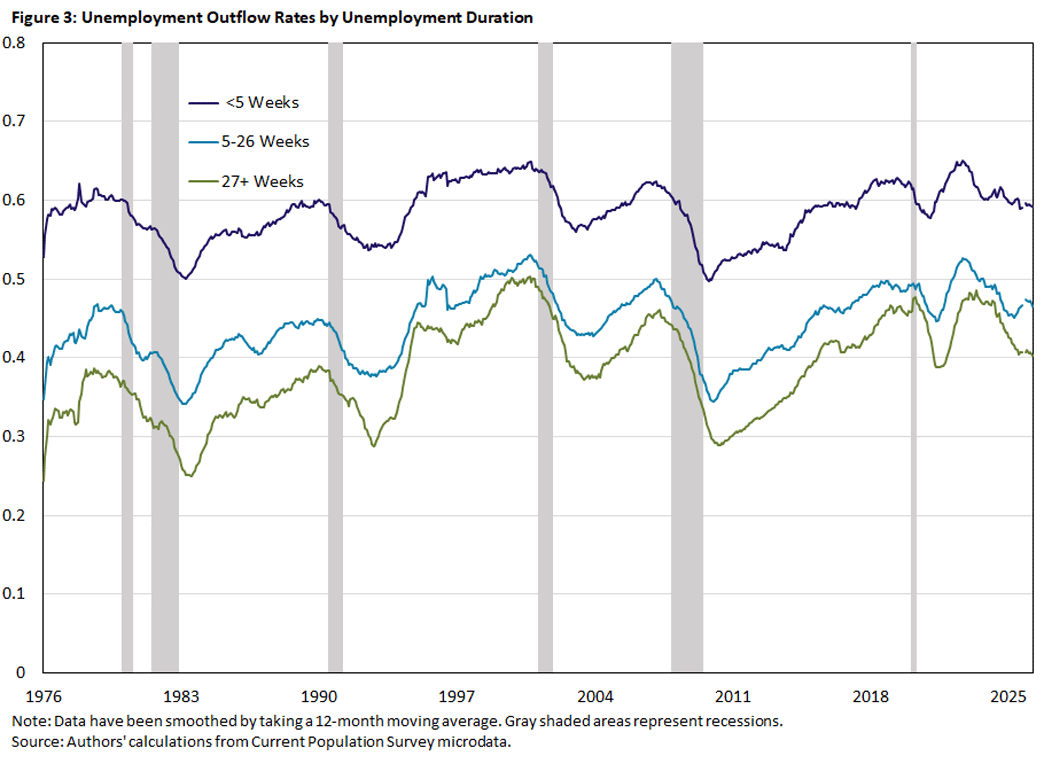
To understand which workers are accounting for the decline in UE, we examine outflow rates separately by spell length, shown in Figure 3.
Job-finding rates are always lower for the long-term unemployed than for the short-term unemployed. This pattern reflects two forces operating simultaneously. First, the long-term unemployed disproportionately consist of workers with persistently lower job-finding rates — a composition or selection effect — because workers with high job-finding rates exit the unemployment pool quickly. Second, time spent unemployed may itself reduce the probability of finding a job, perhaps because skills depreciate, networks thin or employers interpret long unemployment durations as a negative signal. Disentangling these forces is central to the literature on duration dependence. My (Katarina's) 2024 paper "Decomposing Duration Dependence in a Stopping Time Model" — co-authored with Fernando Alvarez and Robert Shimer — develops a structural framework in which the dynamic-selection mechanism plays a particularly important role.
What is unusual about the recent period is that the gap in outflow rates between long-term and short-term unemployed has widened. While this happens in recessions, observing this during expansions is unprecedented. The job-finding rate for those unemployed less than five weeks has held up reasonably well, while rates for the group unemployed for 27 weeks or longer have fallen more steeply. Whatever forces are at work, they appear to be hitting workers with longer unemployment spells especially hard.
A Note on Unemployment Measurement
The CPS measure of unemployment duration is, strictly speaking, the duration of job search rather than the duration of joblessness. Workers can search for jobs while employed, and individuals may be interviewed for the first time after being jobless for some time. As a result, we observe what appears to be unemployment inflows at long search durations. Quantitatively, these contribute only modestly to the recent rise in long-term unemployment. Conceptually, even these flows reflect changes in the underlying outflow rate: When outflow rates are low, the survey is more likely to interview people who are still searching at longer durations.
What's Next
The mechanics established here narrow the question. The recent rise in unemployment is, to a first approximation, a story about why job-finding rates have fallen, particularly for workers already deep into a spell of unemployment. The next article in this series asks who these workers are, examining heterogeneity by reason for job search, by latent worker type and by exposure to artificial intelligence. The third article will then turn to why, asking whether the divergent pattern across worker groups is best understood as an aggregate slack phenomenon or a technological one.
Katarína Borovičková is an economist, and Claudia Macaluso is a senior research economist, both in the Research Department at the Federal Reserve Bank of Richmond.
This framework was refined in the 2012 paper "Reassessing the Ins and Outs of Unemployment" by Robert Shimer, and it was extended to incorporate the labor force participation margin by the 2015 paper "On the Importance of the Participation Margin for Labor Market Fluctuations" by Michael Elsby, Bart Hobijn and Aysegul Sahin.
See the 2016 paper "Long-Term Unemployment and the Great Recession: The Role of Composition, Duration Dependence and Nonparticipation" by Kory Kroft, Fabian Lange, Matthew Notowidigdo and Lawrence Katz.
To cite this Economic Brief, please use the following format: Borovičková, Katarina; and Macaluso, Claudia. (August 2026) "The Ins and Outs of Long-Term Unemployment." Federal Reserve Bank of Richmond Economic Brief, No. 26-25.
This article may be photocopied or reprinted in its entirety. Please credit the authors, source, and the Federal Reserve Bank of Richmond and include the italicized statement below.
Views expressed in this article are those of the authors and not necessarily those of the Federal Reserve Bank of Richmond or the Federal Reserve System.


Receive a notification when Economic Brief is posted online.