
The Decline of Student Visas and Its Implications
Economic Brief
October 2026, No. 26-34
In the last year and a half, the debate over immigration policy centered on undocumented workers in the U.S. Legal immigration, on the contrary, has not faced significant changes that would directly limit the number of new legal immigrants coming into the country.
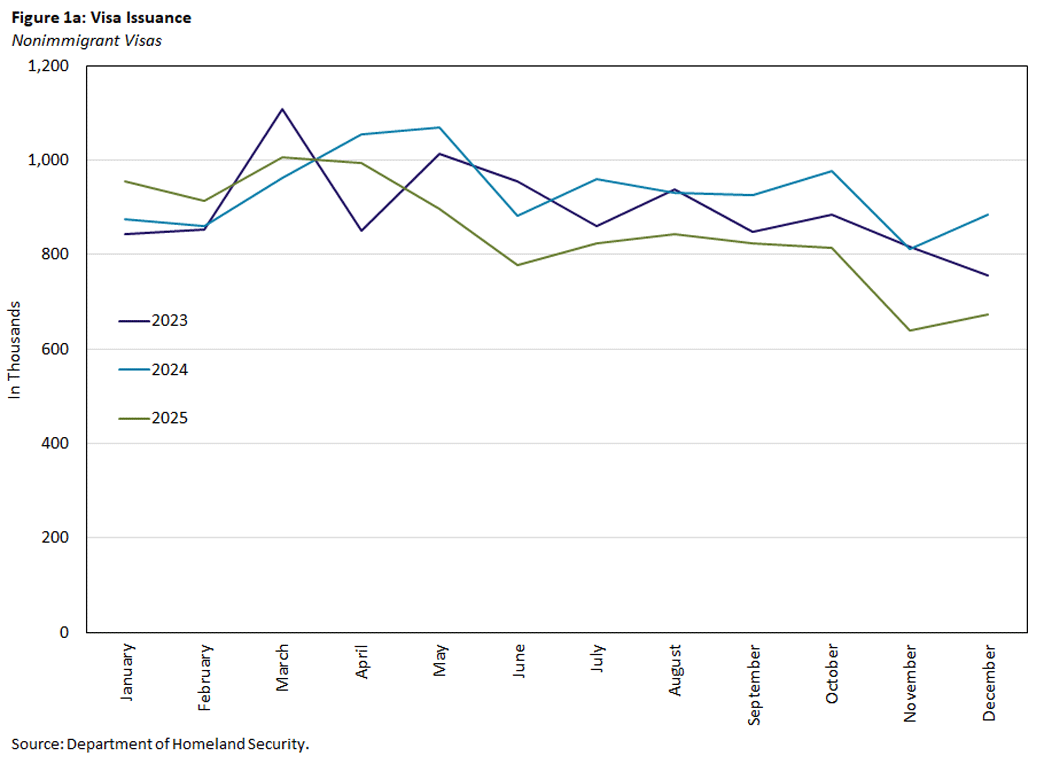
Despite this being true on the aggregate, a specific visa category does seem to show a significant decrease in numbers: the F-1 student visa, which is the primary visa used by full-time international students. As shown in Figure 1a, issuance of nonimmigrant visa has followed a similar aggregate trend in 2025 as in previous years.
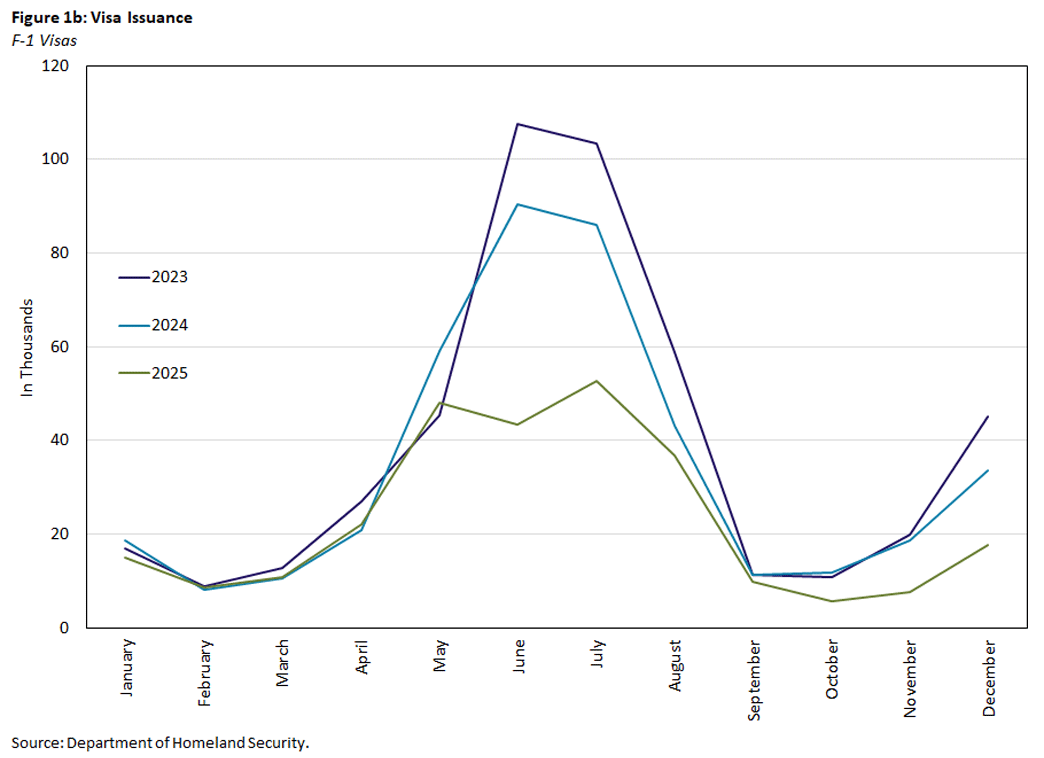
However, Figure 1b shows that new F-1 student visas in 2025 are at much lower overall levels relative to 2023 and 2024, with the biggest shortfall concentrated in the summer months when most students obtain visas ahead of the fall term.
A recent report notes that new international student enrollment decreased in the first quarter of 2026 relative to the first quarter in 2025 for large destination countries such as the U.S., Canada, Australia and the U.K., predominantly due to increasingly restrictive government policies.1 On the other hand, Asia-Pacific (excluding Australia) and European (excluding the U.K.) countries have seen an increase in enrollment.
Regarding the U.S., a May 2026 article noted that this is likely not a story of the U.S. becoming a less desirable place to study on the merits. Instead, declines in the U.S. are likely driven by "restrictive government policies," including travel bans covering more than a dozen countries, new student-visa vetting rules and a crackdown that has fallen especially hard on Chinese students.2
A Slow-Building Exposure, Now at Risk
Before this year's decline, nonresident students had become a steadily larger share of U.S. enrollment, particularly at the graduate level. Figure 2 shows the evolution of the nonresident share of enrollment nationally and in the Fifth District,3 separately for graduate and undergraduate students, from 2006 to 2024.
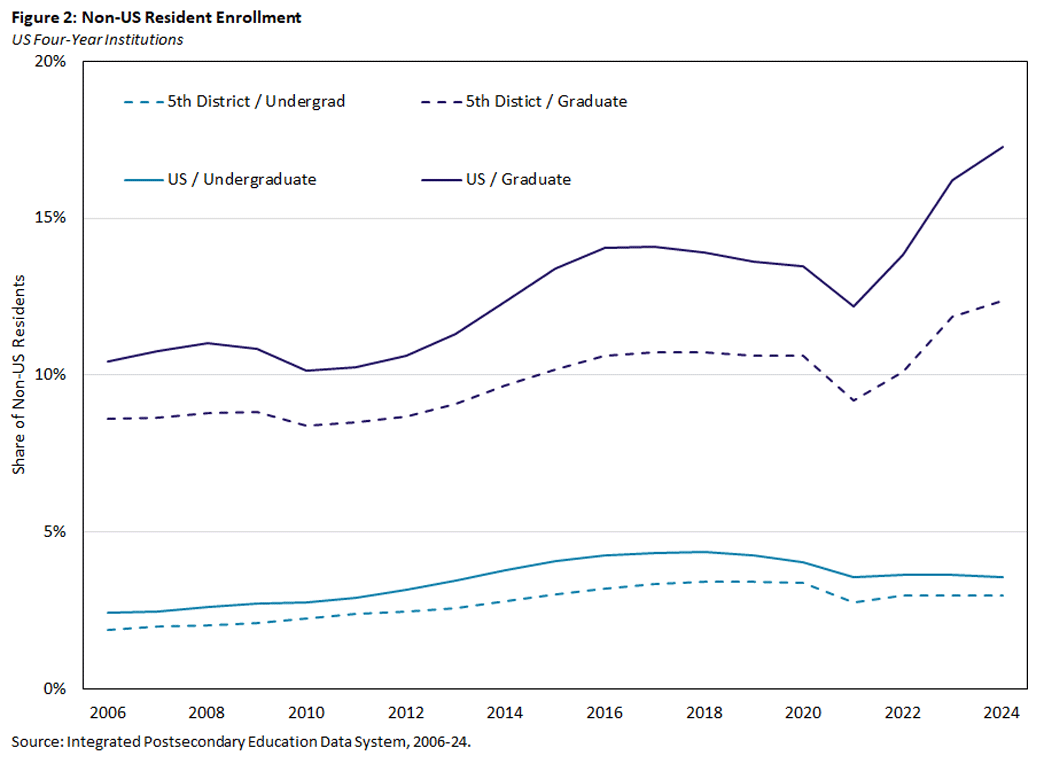
Two patterns stand out. First, graduate programs are far more reliant on international students than undergraduate programs, both nationally and in the Fifth District: The nonresident share of graduate enrollment reached roughly 17 percent nationally by 2024, compared with roughly 3.5 percent at the undergraduate level.
Second, the Fifth District has historically run a few percentage points below the national average at both levels, but international student enrollment has been increasing over time, with the District's graduate share climbing from under 9 percent in 2006 to above 12 percent in 2024. In both the nation and the Fifth District, the nonresident share dipped during the pandemic before rebounding (and even growing), which is precisely the run-up now exposed to reversal by the factors described above.
Exposure Is Quite Varied Across Universities
The Fifth District's exposure to a pullback in international enrollment is not evenly distributed. Figure 3a shows the share of non-U.S. resident students at the District's largest institutions.
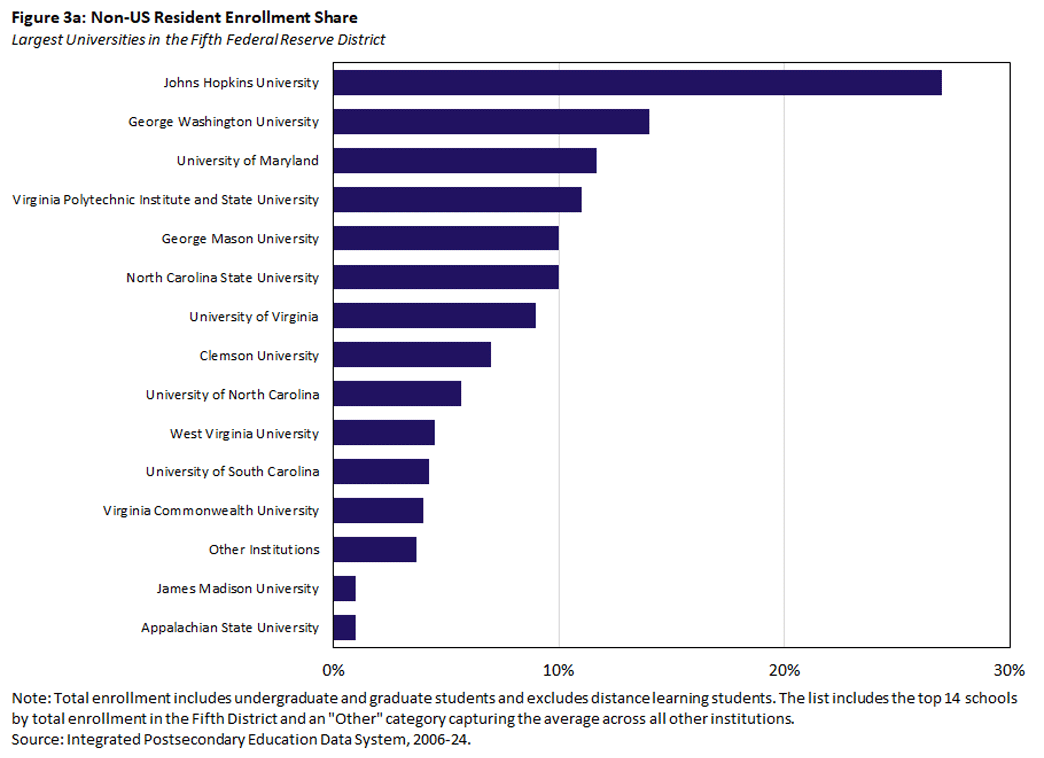
Johns Hopkins University stands well apart from the rest of the District, with more than a quarter of its enrollment classified as non-U.S. resident, roughly twice the next-highest share and well above flagship public research universities such as the University of Maryland, Virginia Tech, NC State and George Mason. This concentration matters for how a national decline in student visas will be felt locally: A small number of research-intensive institutions — and the metropolitan economies and labor markets around them — will absorb a disproportionate share of any pullback.
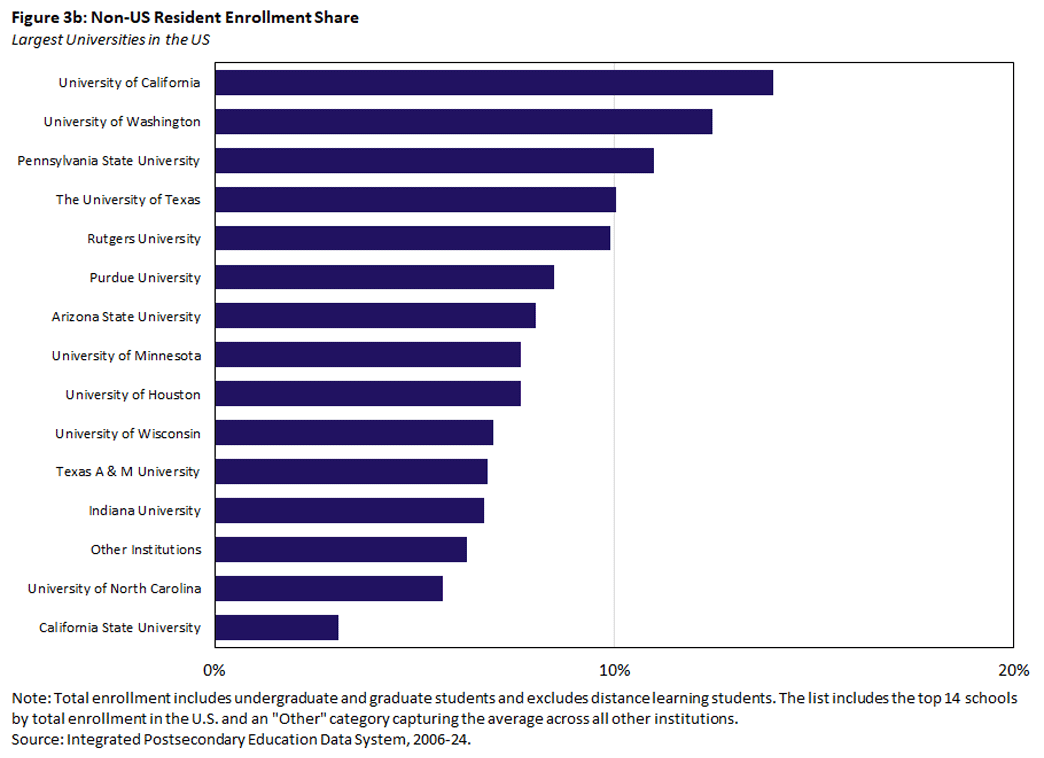
A similar story can be told for the rest of the country. As shown in Figure 3b, a few of the largest universities in the country have more than 10 percent of their total enrollment coming from non-U.S. residents.
International Students Are Disproportionately in STEM Fields
Finally, foreign and domestic students are not distributed the same way across fields of study. Figure 4 shows that non-U.S. resident students are far more concentrated in computer science, information science and math than domestic students — roughly 27 percent of nonresident enrollment versus about 6 percent of resident enrollment — and are somewhat more concentrated in engineering as well. Domestic students, in turn, are relatively more represented in the humanities, health professions and education.
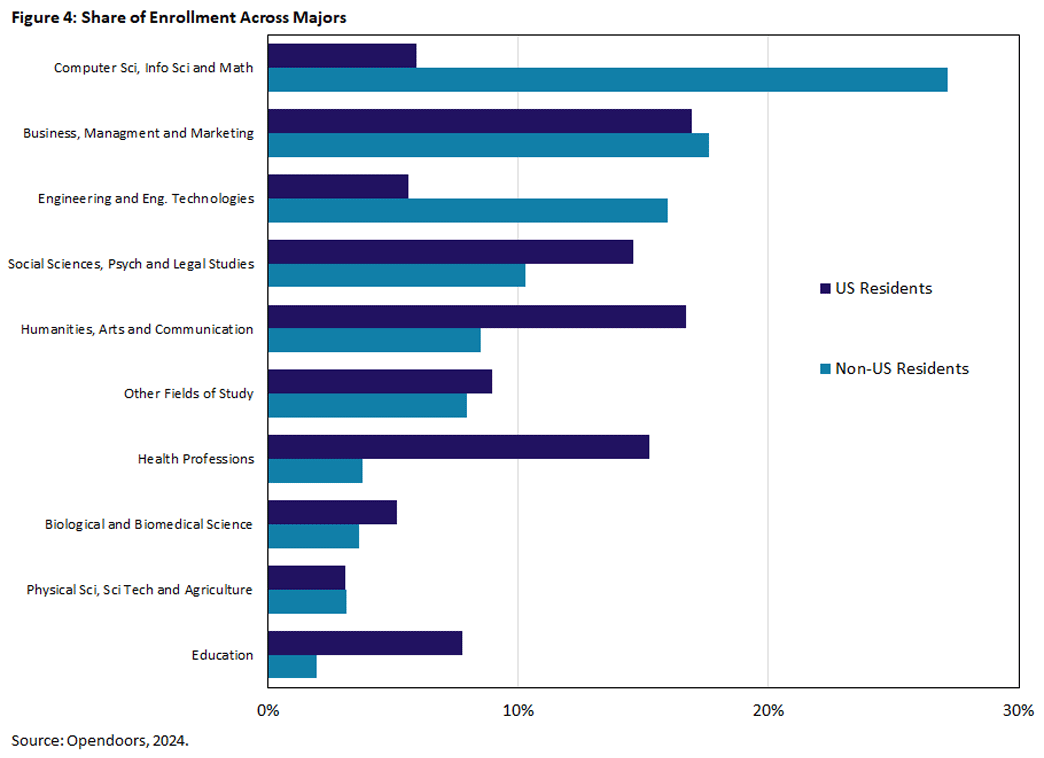
This compositional difference is central to why a decline in international enrollment is not merely a story about tuition revenue: It is concentrated in exactly the fields most tied to the technology workforce and innovation more broadly.
The Economic Impacts of Fewer Foreign Students
University Finances and Program Offerings
International students — particularly at the graduate level — have become an important source of revenue for U.S. universities facing constraints on other funding sources. A 2020 paper finds that declining state appropriations pushed public research universities to rely increasingly on out-of-state and international tuition to cross-subsidize instruction and that international students are an important source of revenue for public research universities facing declining state appropriations.4 Without the ability to enroll international students, universities would have likely had to cut instructional resources per student or substantially raise tuition.
A 2021 paper by the same authors shows this reliance has reshaped what universities offer: Many institutions responded to strong foreign demand by expanding master's programs targeted at international students.5 Thus, the number of U.S. master's programs where at least 80 percent of graduates were foreign rose from 354 in 2000 to 512 by 2012 and to nearly 1,000 by 2016, with growth concentrated in STEM fields where foreign, full-pay enrollment can help cross-subsidize doctoral programs.
A sudden reversal of these enrollment flows therefore poses two distinct risks to university finances in the Fifth District:
- An immediate tuition-revenue shortfall concentrated predominantly at the research universities identified in Figure 3
- A longer-run risk that some of the master's programs built up over the last two decades specifically to serve international demand become financially unviable, with knock-on effects for the graduate and doctoral programs they were helping to subsidize
Lower Economic Outcomes for the US and Fifth District Labor Markets
A second literature asks what the U.S. gives up in terms of skilled labor supply and innovation when fewer international students graduate from U.S. universities. A 2023 paper estimates how many international graduates go on to work in the U.S. shortly after graduation.6 It finds that attracting one additional international student to a U.S. university increases the local labor supply by about 0.23 employees for master's students and about 0.11 for bachelor's students. Also, this transition rate is concentrated among STEM students, who transition to U.S. employment at higher rates than non-STEM students.
Given the concentration of international students in computer science, math and engineering documented in Figure 4, a decline in foreign enrollment maps fairly directly onto a decline in the pipeline of STEM workers into local labor markets, including in the Fifth District cities that host the research universities most exposed to enrollment losses.
The effects extend beyond direct employment into innovation and firm formation. In related work, the same authors find in a 2024 working paper that increasing the foreign-born share of a university's master's graduating cohort has measurable effects on entrepreneurship: Each additional 10 percentage points of foreign students in a master's cohort is associated with 0.4 additional start-ups founded by graduates of that cohort.7
This complements a broader body of work showing that skilled immigrants — many of whom first arrive as students — contribute disproportionately to U.S. innovation and firm creation. A sustained decline in foreign graduate enrollment could be expected to reduce both the number of STEM workers entering local labor markets in the short run and the rate of new firm formation over a longer horizon.
Weaker Selection of the Students Who Do Come
A third, less obvious channel involves the quality of the students the U.S. can attract once it becomes harder to convert a student visa into a long-term U.S. career. A 2013 study examines how restrictions on the H-1B visa affect the pool of prospective international students, using the SAT scores of students who send scores to U.S. institutions as a measure of applicant quality.8 It finds that when the U.S. tightens the pathway from student visas into skilled employment, the students who still choose to apply are, on average, less academically strong. That is, tighter H-1B (and by extension broader immigration) restrictions worsen the quality of the applicant pool, not just its size.
This matters for interpreting the current episode: Because the decline in visas documented in Figure 1 is likely driven by restrictive immigration policy rather than by weaker global demand for a U.S. education, the 2013 paper's finding suggests the loss to the U.S. may not be limited to fewer students but may also include a shift toward a less-skilled group among those who continue to come, compounding the labor-supply and innovation effects described above.
Conclusion
The recent decline in student visa issuance marks a reversal of a two-decade trend in which international students — and international graduate students in particular — became an increasingly important part of U.S. higher education and the skilled labor pipeline that flows out of it. The evidence reviewed here suggests the decline is driven primarily by more restrictive immigration policy rather than by a weakening of global demand to study in the U.S., with competitor destinations in Europe and Asia gaining students at the same time enrollment in the U.S. has fallen.
For the Fifth District, the exposure to this reversal is uneven. A small number of research-intensive institutions account for a disproportionate share of the District's international enrollment, and international students are disproportionately concentrated in computer science, math and engineering. The academic literature points to three channels through which a sustained decline could affect the District and national economies:
- Strain on university finances and the graduate programs built up to serve international demand
- A reduced flow of STEM-trained workers into local labor markets and a corresponding drag on innovation and start-up formation
- A potentially less positively selected pool of the international students who continue to come
Taken together, these channels suggest that the economic consequences of the current decline may extend well beyond university tuition revenue and into the broader technology workforce and innovation ecosystem of the District's research university towns.
Nicolas Morales is an economist in the Research Department at the Federal Reserve Bank of Richmond.
1
See the 2026 report "The Global Enrollment Benchmark Survey" from Study Portals.
2
See the 2026 article "As US Enrolls Fewer International Students, Universities in Asia Are Going the Other Direction" by Miranda Jeyaretnam.
3
The Fifth Federal Reserve District includes the District of Columbia, Maryland, North Carolina, South Carolina, Virginia and most of West Virginia.
4
See the 2020 paper "A Passage to America: University Funding and International Students" by John Bound, Breno Braga, Gaurav Khanna and Sarah Turner.
5
See the 2021 paper "The Globalization of Postsecondary Education: The Role of International Students in the US Higher Education System" by Bound, Braga, Khanna and Turner.
6
See the 2023 paper "International College Students' Impact on the US Skilled Labor Supply" by Michel Beine, Giovanni Peri and Morgan Raux.
7
See the 2024 working paper "The Contribution of Foreign Master's Students to US Start-Ups" by Beine, Peri and Raux.
8
See the 2013 paper "Quotas and Quality: The Effect of H-1B Visa Restrictions on the Pool of Prospective Undergraduate Students From Abroad" by Takao Kato and Chad Sparbar.
To cite this Economic Brief, please use the following format: Morales, Nicolas. (October 2026) "The Decline of Student Visas and Its Implications." Federal Reserve Bank of Richmond Economic Brief, No. 26-34.
This article may be photocopied or reprinted in its entirety. Please credit the author, source, and the Federal Reserve Bank of Richmond and include the italicized statement below.
Views expressed in this article are those of the author and not necessarily those of the Federal Reserve Bank of Richmond or the Federal Reserve System.


Subscribe to Economic Brief
Receive a notification when Economic Brief is posted online.
Contact Us