

Beyond the Unemployment Rate: Reemployment Challenges for the Long-Term Jobless
Macro Minute
September 1, 2026
In the current "low-hire, low-fire" labor market — which features both slower job creation and less job separation activity (including firings and layoffs) — becoming unemployed can be particularly challenging as finding a new job can be more difficult. One consequence is a steady rise in the long-term unemployment rate, which represents the labor force that has been out of work for 27 weeks or more. Such increases are uncommon in the late phases of an economic expansion, as seen in Figure 1. Figure 1 also shows that the long-term unemployed are making up a rising share of total unemployment.
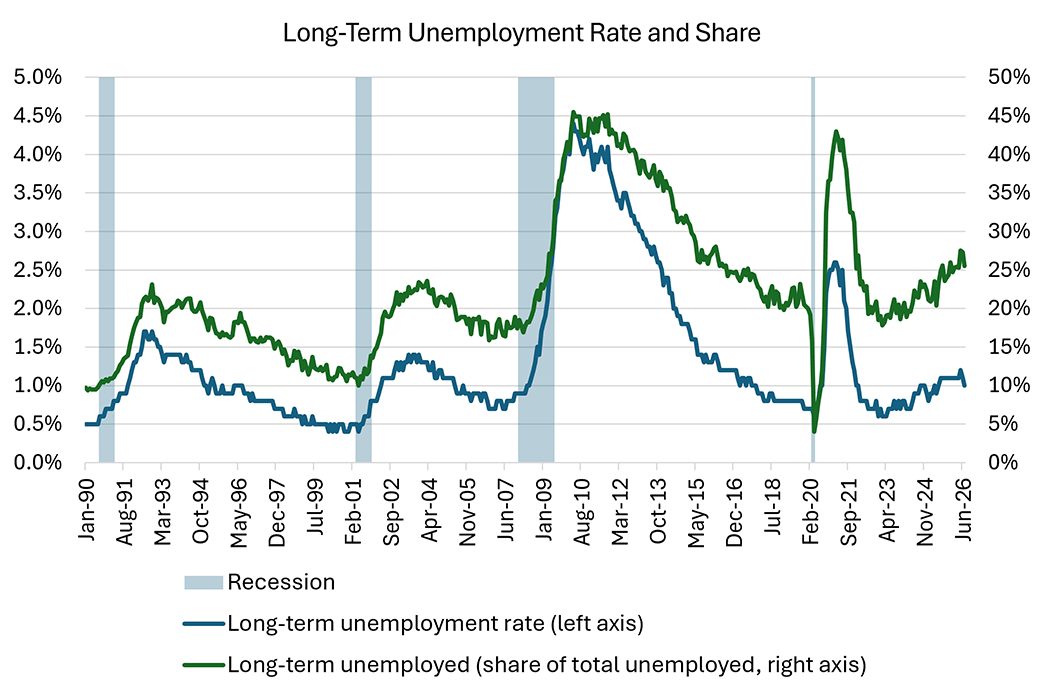
The July employment report offered a bit of positive news, as the long-term unemployment rate ticked down to a 13-month low of 1 percent, while the share dropped to 25.5 percent from 27.3 percent in June. However, it will take more months of good news to gain confidence that labor market conditions have improved for the long-term unemployed. Supplemental data from the Bureau of Labor Statistics also continue to point to challenges for this group. These data — which are released with each month's Employment Situation Report under the heading "Research series labor force status flows by duration of unemployment" — are derived from the Current Population Survey. By tracking the employment status of individuals who responded to both the current month's survey and prior month's survey, it is possible to estimate the probability of reemployment. This can be derived by dividing the number of individuals who transitioned from unemployed in the prior month to employed in the current month by the total number of unemployed in the prior month (who responded in both months).
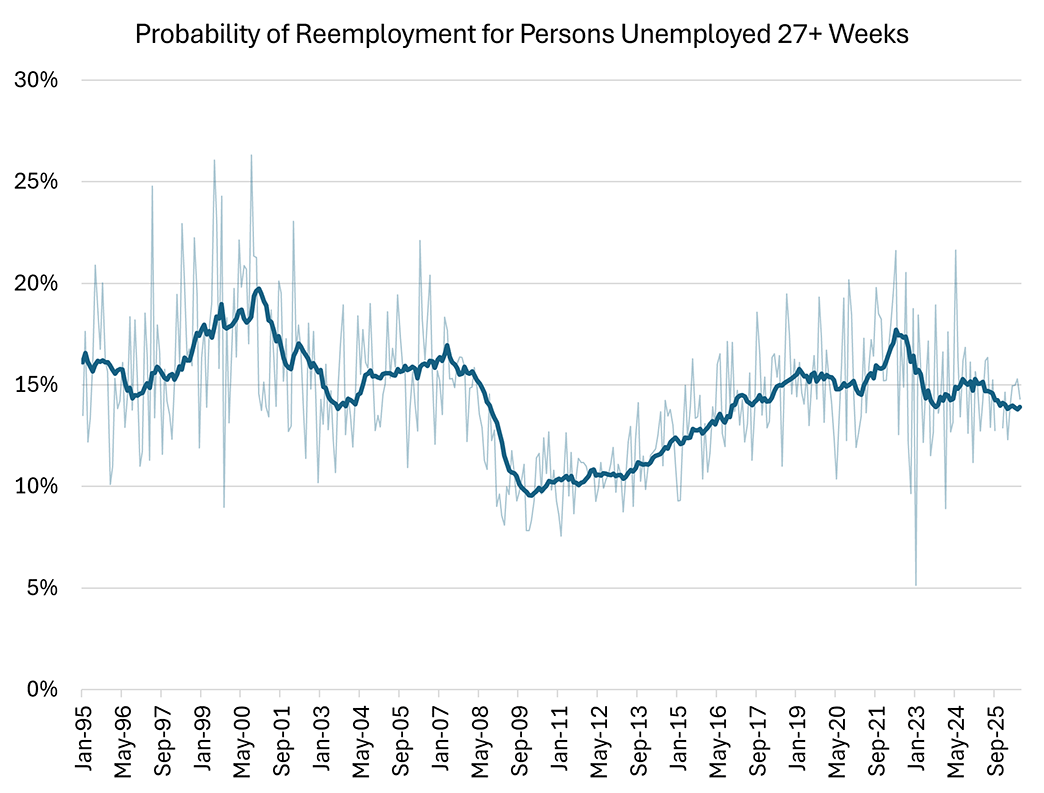
As these estimates are calculated on a subsample of households responding to both last month's survey and the current month's survey and further restricted to only long-term unemployed households, they are much more volatile than aggregate figures like the overall unemployment rate. The BLS recommends taking 12-month averages to smooth through the volatility, and I do so in the figures that follow.
As seen in Figure 2, data on labor force status flows from the Current Population Survey show that the probability of reemployment for long-term unemployed persons continues to decline. As of July 2026, the 12-month moving average probability was 14.3 percent, with the bold blue line in Figure 2 depicting a declining trend since the start of 2025. These levels are much lower than during the tight labor market of 2022 but similar to those observed from 2016 to 2017.
The data also allow a further breakdown of long-term unemployed into those unemployed between 27 and 52 weeks (LTU) and those unemployed for 53 weeks or more (the very long-term unemployed [VLTU]). Reemployment probabilities for both groups are shown in Figure 3. The figure shows that LTU reemployment probability has been roughly flat over the past three years. In contrast, VLTU reemployment probability has been more volatile this year, briefly dipping below levels seen over the 2016-19 prepandemic period before recently returning to levels similar to the immediate prepandemic period. Figure 3 also shows that VLTU reemployment probability has seen a larger decline versus the tight labor market of 2022 compared to that of the LTU.
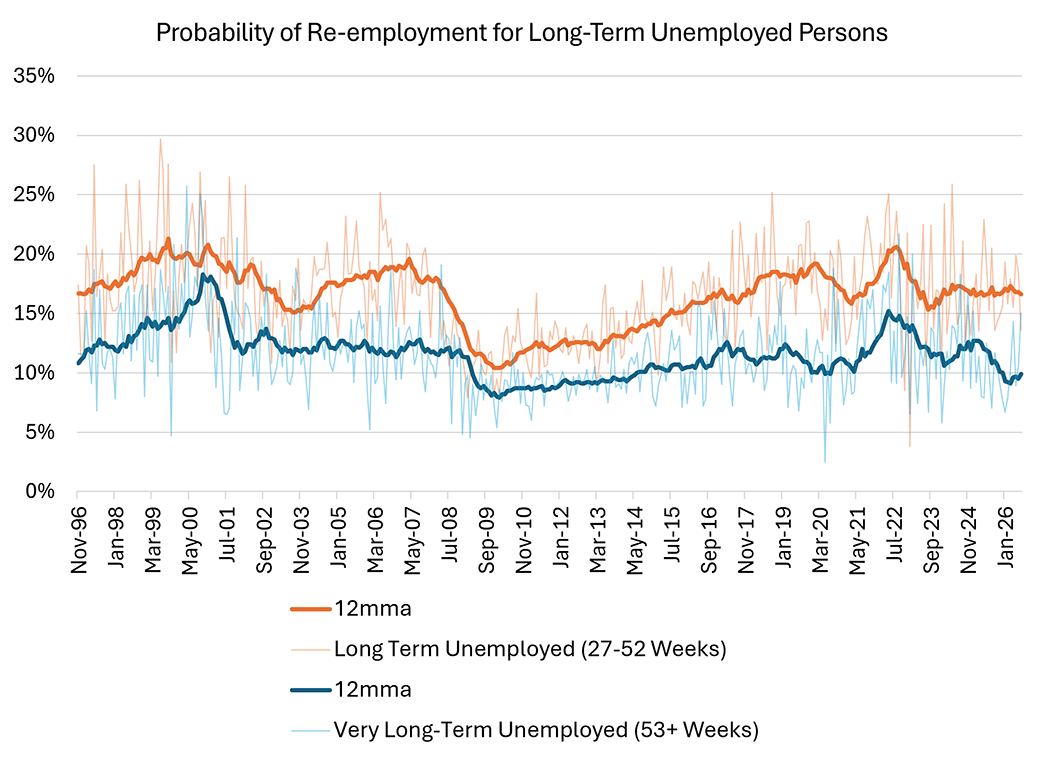
The low-hire, low-fire labor market may seem daunting for those undergoing a job transition, and challenges for the long-term unemployed are indeed significant. There are silver linings in the recent data: a dip in the long-term unemployment rate and share and stable job-finding rates for those unemployed between six months to one year. However, the data have yet to show that job-finding prospects are improving meaningfully for those who have been jobless for an extended duration. In particular, those who have been out of work for a year or more are experiencing more challenges seeking reemployment relative to the "standard" long-term unemployed.
Views expressed in this article are those of the author and not necessarily those of the Federal Reserve Bank of Richmond or the Federal Reserve System.


Contact Us