

Worker Types, AI Exposure and the Recent Decline in Job-Finding Rates
Economic Brief
August 2026, No. 26-26
Key Takeaways
- The recent decline in unemployment outflow rates is concentrated among specific groups of workers, rather than spread evenly across the labor force.
- Strongly attached workers — those with stable employment histories — have experienced the largest decline in job-finding rates.
- Workers in occupations highly exposed to artificial intelligence have seen larger declines in job-finding rates, pointing to AI affecting the labor market.
We previously showed that the recent rise in unemployment is almost entirely accounted for by a decline in the rate at which unemployed workers leave the unemployment pool, particularly by the rate at which they find jobs. That finding leaves open a sharper question: Which workers account for the decline? After all, the unemployed are not a homogeneous group, as workers differ in their attachment to the labor market, in why they are searching and in the kinds of work they do.
To diagnose the causes of the decline in job-finding rates, we need to know which workers are accounting for it. In this article, we classify the unemployed along three dimensions — why a worker is searching, how attached workers are to the labor market and how exposed occupations are to artificial intelligence (AI) — and ask, for each, how the recent dynamics differ from those of prior business cycles.
New Entrants vs. Incumbents
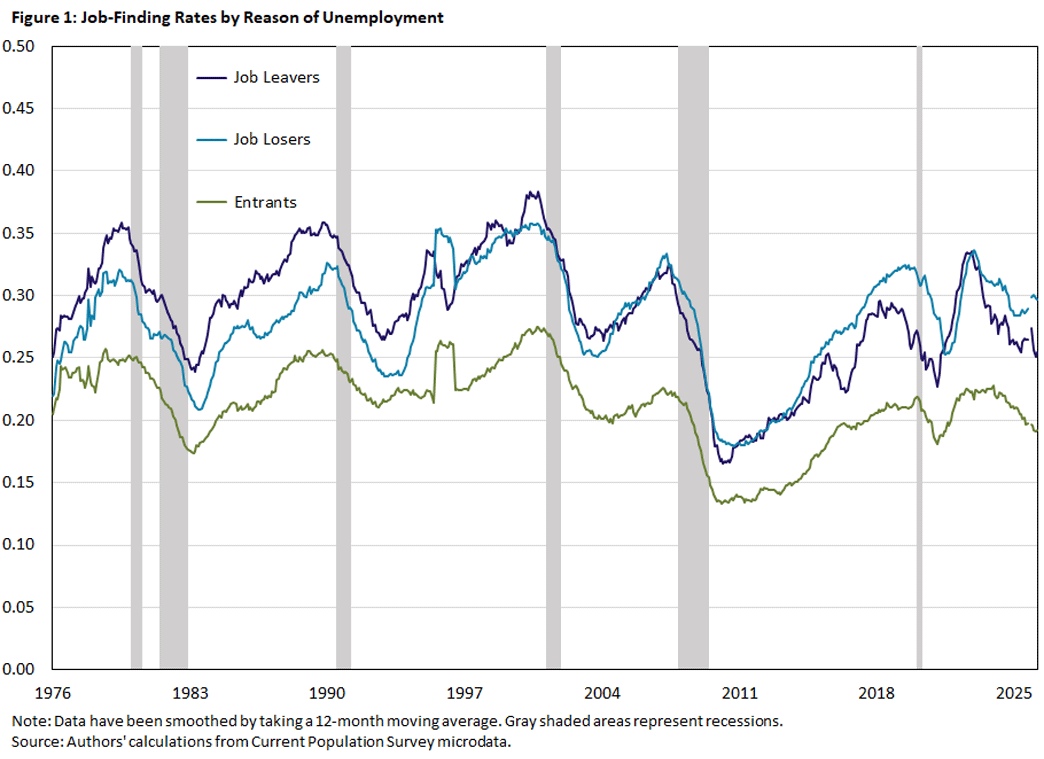
The first dimension is perhaps the most familiar: the reason a worker is searching. The Census Bureau's Current Population Survey distinguishes among job losers (laid off or otherwise involuntarily separated), job leavers (who quit) and entrants (new entrants into the labor force and re-entrants who have not searched in the prior five years).
One concern with new technologies is that they may disproportionately harm labor market entrants who lack the firm-specific human capital that incumbent workers accumulate over time. Figure 1 speaks to this directly: Job-finding rates for new entrants have declined in recent years, but the drop is modest relative to the declines among job losers and job leavers. Entrants do not appear to be the margin where the action is, and we set them aside in what follows.
The Secondary Type Carries the Cycle, but the Primary Type Moves the Most
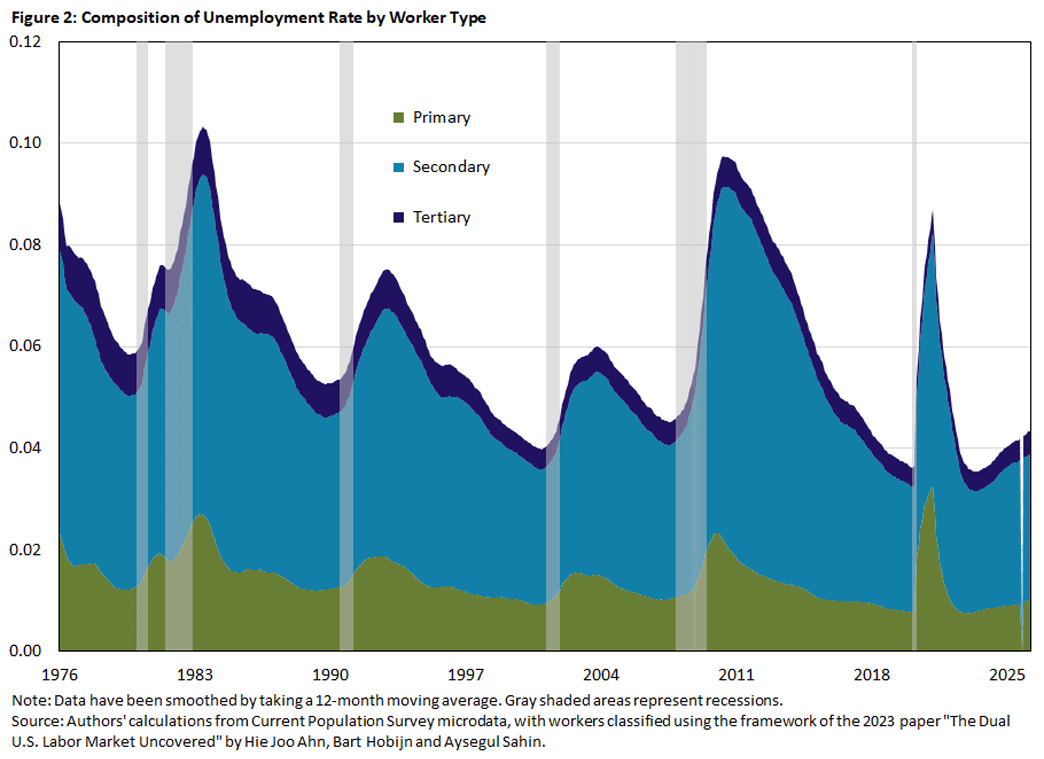
The second dimension — labor market attachment — is more novel than the first dimension we examined. Workers with the same observable characteristics can differ in how attached they are to the labor market. Some employed workers hold stable, long-tenure jobs, while others churn between employment and unemployment frequently. To capture this dimension, we use the latent-type framework from the 2023 working paper "The Dual U.S. Labor Market Uncovered" — co-authored by Hie Joo Ahn, Bart Hobijn and Ayşegül Şahin — which identifies three groups:
- A primary type (about 55 percent of the population, almost always employed)
- A secondary type (about 14 percent, strongly attached but unemployed more often)
- A tertiary type (about 31 percent, weakly attached and often out of the labor force)
As seen in Figure 2, the composition of unemployment by latent type displays a striking persistence: The secondary type accounts for the bulk of unemployment in essentially every year covered by the data, despite making up the smallest share of the population. This pattern reflects exactly what the latent-type framework is designed to detect: The secondary type accounts for most cyclical fluctuations in the labor market.
For understanding the recent rise in unemployment, however, the primary type deserves close attention. As shown in Figure 3, workers classified as primary have historically had the highest job-finding rates, consistent with their strong attachment to employment.
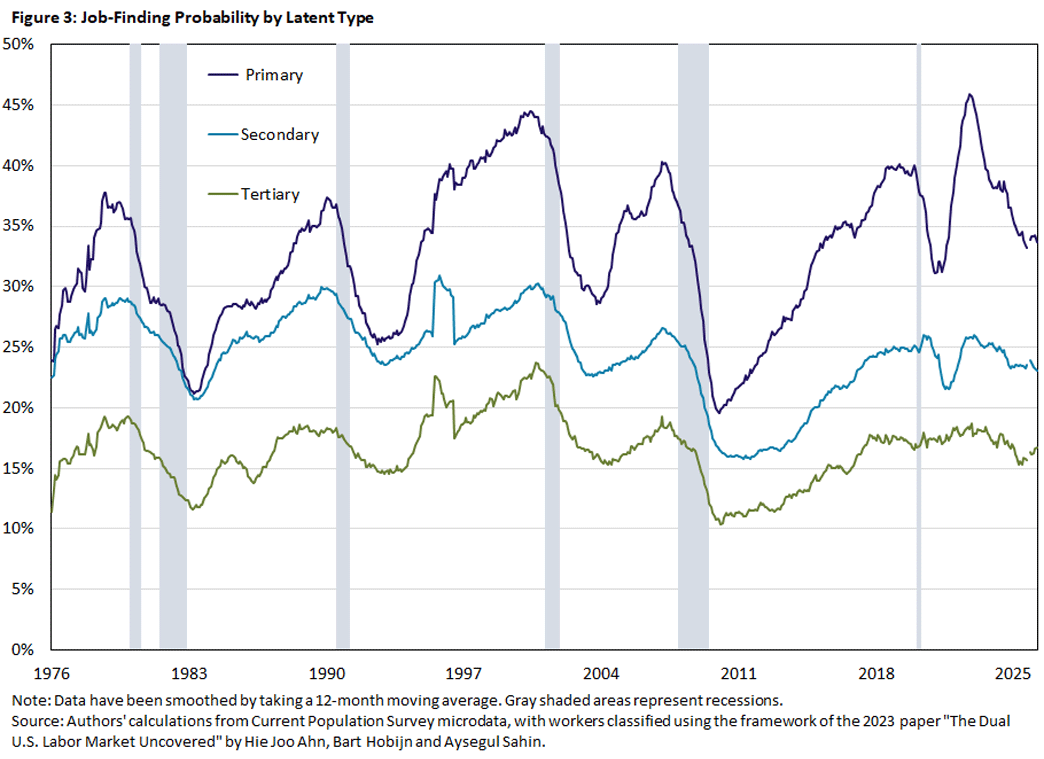
The job-finding rate for all worker types moves significantly over the cycle, rising in expansions and declining in recessions. We observe that, in every recession, the job-finding probability decreases most for the primary type. For example, in the Great Recession, the job-finding probability from peak to trough declined by 19 percentage points for the primary type and by 10 percentage points for the secondary type.
In the last several years, however, the drop in the job-finding rate for the primary type was disproportionately larger than for the secondary type. From the peak in November 2022 until the trough in September 2025, the job-finding rate declined 13 percentage points for the primary type but only 2 percentage points for the secondary type. We have not seen such a significant difference in any of the previous recessions, not to mention when the economy is expanding.
Thus, whatever is making it harder to find a new job in the current period is hitting strongly attached workers with particular force, even though those workers remain a small share of the unemployment pool.
AI Exposure: Outflows Down
The third dimension we examine is occupational exposure to AI. Following the 2019 working paper "The Impact of Artificial Intelligence on the Labor Market" by Michael Webb, workers can be classified by the share of their occupation's tasks that overlap with the technical capabilities described in AI patents. Highly exposed occupations include computer programmers, financial analysts and engineers. Less-exposed occupations include construction workers, food service and personal care aides. We sort workers into quartiles of AI exposure based on their current or most recent occupation.
Sorting workers by AI exposure produces a more recent and sharper divergence. Historically, outflow rates by AI-exposure quartile co-moved tightly with the business cycle (as seen in Figure 4), with only small level differences across quartiles likely reflecting correlations between AI exposure and other occupational characteristics.
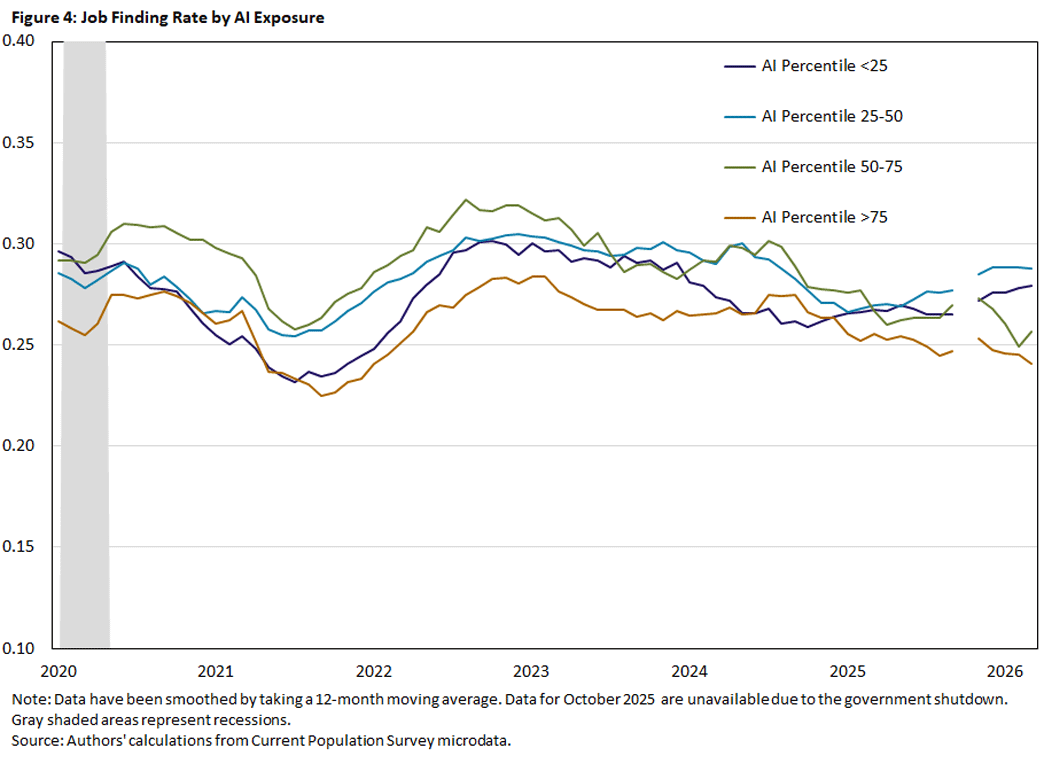
AI exposure as a useful classifier is, in principle, only meaningful once AI is in widespread use. Since 2023, outflow rates have diverged: Workers in highly AI-exposed occupations have seen the largest declines in the job-finding rate.
This pattern is consistent with a literature on automation that emphasizes displacement effects in exposed occupations alongside reallocation toward less-exposed work.1 It is also consistent with field experimental evidence that generative AI (when deployed in workplaces) can substantially increase productivity at the task level (particularly for less-experienced workers), potentially altering the composition of new hiring.2
Putting the Pieces Together
The classification exercises here paint a coherent picture. Most of the recent decline in unemployment outflow rates is being borne by strongly attached workers, particularly those whose occupations are exposed to AI. This is not the typical recessionary pattern, in which the secondary segment of the labor market absorbs most of the cyclical adjustment. The findings raise a natural follow-up question, which we take up in the third and final article in this series: How much of the aggregate decline in job-finding rates can be attributed to factors common to all worker groups (the aggregate component) versus factors specific to AI-exposed occupations (the technological component)?
Katarína Borovičková is an economist, and Claudia Macaluso is a senior research economist, both in the Research Department at the Federal Reserve Bank of Richmond.
1
See the 2020 paper "Robots and Jobs: Evidence from U.S. Labor Markets" by Daron Acemoglu and Pascual Restrepo.
2
See the 2025 paper "Generative AI at Work" by Erik Brynjolfsson, Danielle Li and Lindsey Raymond.
To cite this Economic Brief, please use the following format: Borovičková, Katarina; and Macaluso, Claudia. (August 2026) "Worker Types, AI Exposure and the Recent Decline in Job-Finding Rates." Federal Reserve Bank of Richmond Economic Brief, No. 26-26.
This article may be photocopied or reprinted in its entirety. Please credit the authors, source, and the Federal Reserve Bank of Richmond and include the italicized statement below.
Views expressed in this article are those of the authors and not necessarily those of the Federal Reserve Bank of Richmond or the Federal Reserve System.


Subscribe to Economic Brief
Receive a notification when Economic Brief is posted online.
Contact Us