

Micro Minutes: Tracking the FOMC's Reduced Verbosity
Federal Reserve communication strategy has varied over time, reflecting the preferences of Federal Open Market Committee (FOMC) policymakers. While new Fed Chair Kevin Warsh has presided over only two meetings so far, the FOMC's post-meeting statements have been notably shorter. How does the Fed's current brevity compare to historical patterns?
For our analysis, we scraped the content of every FOMC post-meeting statement — excluding boilerplate language such as the release date and records of policymakers' votes — and meeting minutes and tracked the word count over time. We also tallied an eight-meeting rolling average to better show trends over time. Figure 1 shows the results.
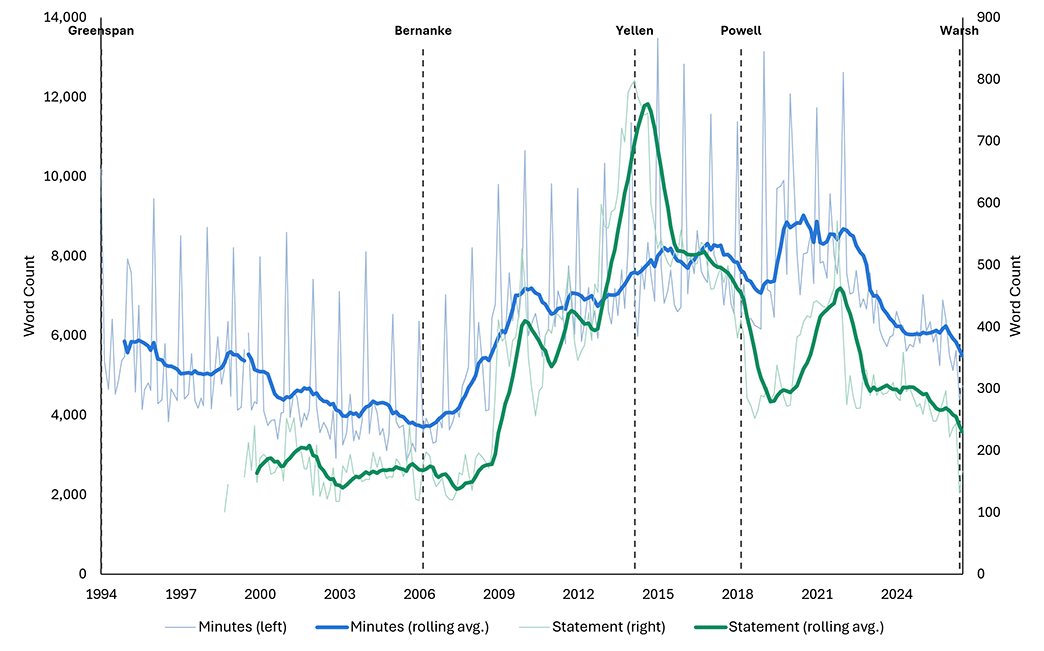
Meeting statement word counts have indeed been trending lower, and the two most recent post-FOMC meeting statements have the lowest word counts since January 2008. Furthermore, the FOMC minutes for Warsh's first two meetings as chair are the shortest since September 2008. The rolling average also reveals that the length of FOMC post-meeting statements tends to increase during periods of economic stress: There are large increases in word counts starting in 2008 (corresponding to the Great Recession) and 2020 (corresponding to the pandemic).
Beginning in mid-2009, the FOMC began consistently breaking up its minutes into six sections:
- Developments in Financial Markets and Open Market Operations: a review of market sentiment, financial markets and the Fed's balance sheet
- Staff Review of the Economic Situation: Federal Reserve Board economists' summary of economic conditions such as unemployment, gross domestic product, production and trade
- Staff Review of the Financial Situation: Board economists' review of current conditions in stock, Treasury, credit and money markets
- Staff Economic Outlook: Board economists' description of their economic forecasts
- Participants' Views on Current Conditions and the Economic Outlook: a summary of FOMC participants' interpretation of economic conditions and projections, which are generally aggregated in the minutes by topic
- Committee Policy Action: a description of FOMC members' monetary policy decisions
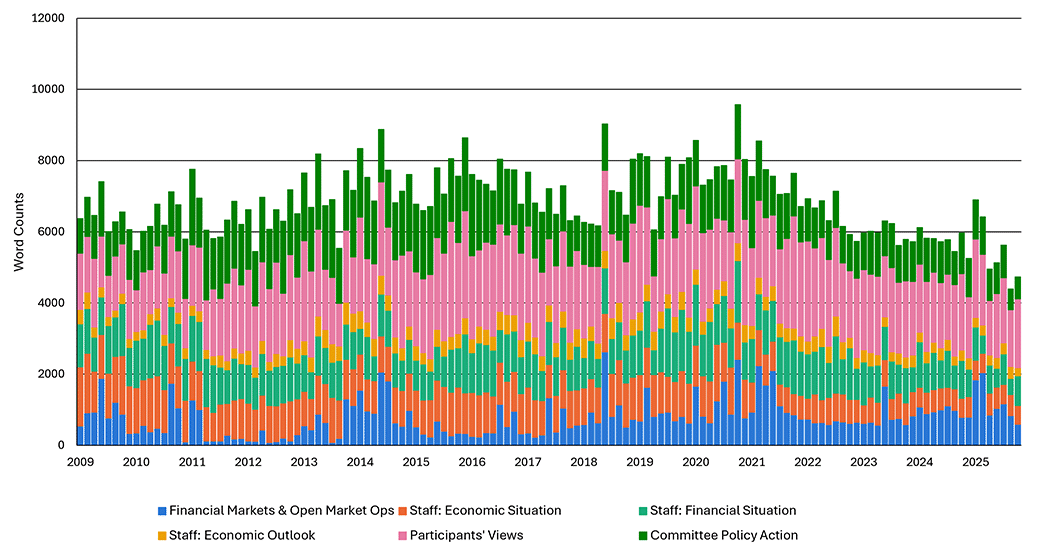
Breaking FOMC statements down by these component sections (Figure 2), we see that the reductions in word count in the two most recent sets of minutes were broad-based: Four sections shed at least 200 words compared to the FOMC's last meeting statement under Powell.
How does word count relate to the Fed's dual mandate? Figures 3 and 4 plot our word count measure against core personal consumption expenditure (PCE) inflation and unemployment. We find that FOMC statement word counts are correlated with unemployment and core PCE inflation but with different signs. When unemployment is high, statements tend to be longer (Figure 3). In contrast, when inflation is high, statements tend to be shorter (Figure 4).
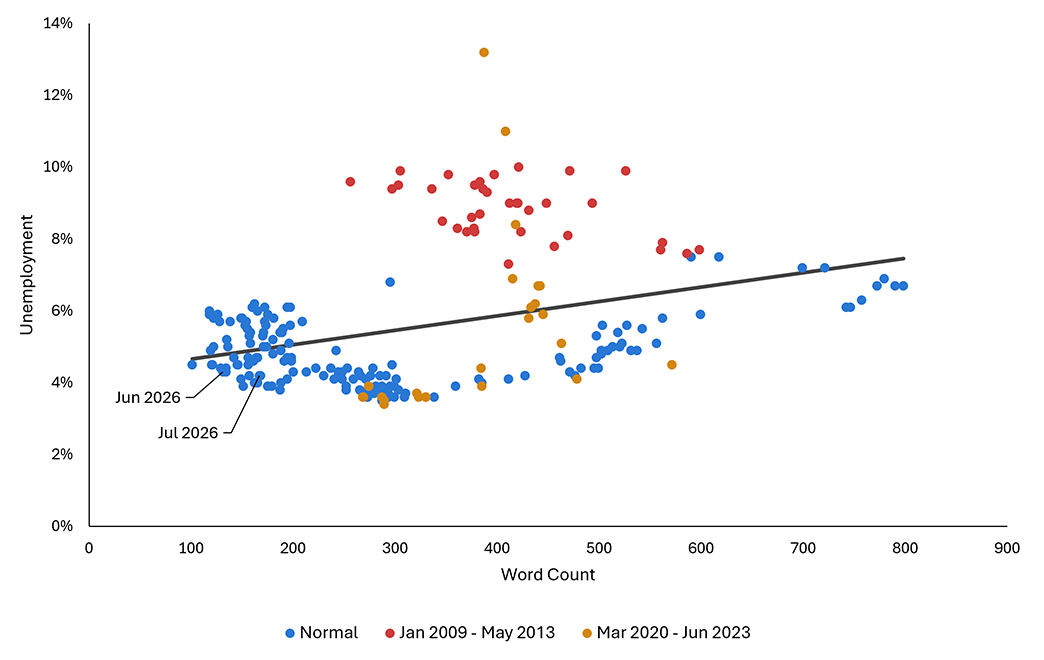
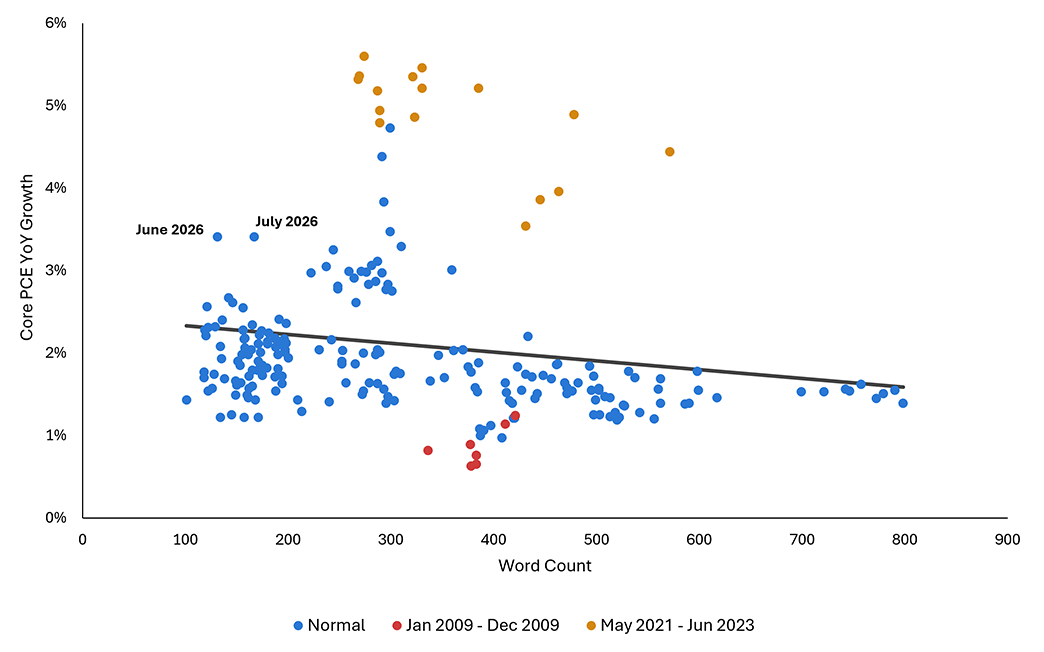
Figure 3 shows that the last two post-meeting statement lengths are in line with the historical relationship between word counts and the unemployment rate, but Figure 4 indicates that the statements have been unusually concise given the historical relationship between word counts and inflation. Whether and how the change in communication strategy matters for economic outcomes will undoubtedly be the subject of ongoing study.
Views expressed in this article are those of the author and not necessarily those of the Federal Reserve Bank of Richmond or the Federal Reserve System.


