

Rising Inequality at the Bottom: Low-Wage Workers Falling Behind Their Closest Peers
Macro Minute
February 24, 2026
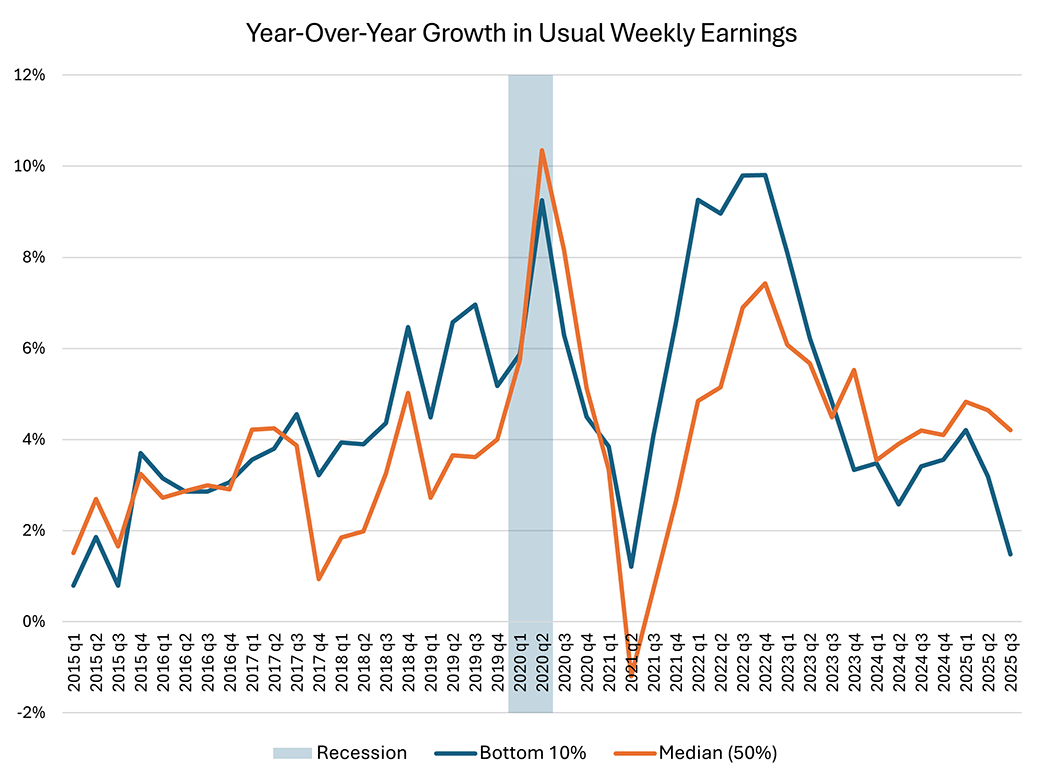
After the COVID-19 pandemic recession, earnings growth for lower-income earners significantly outpaced the median as demand for lower-paid, front-line, in-person services workers skyrocketed. However, as shown in Figure 1 below, that situation reversed in 2023, with year-over-year growth in usual weekly earnings for the bottom 10 percent remaining below median earnings growth in the latest data through the third quarter of 2025. In this week's post, I explore the implications of this change in earnings growth rates for inequality across the earnings distribution.
Does the slowdown in lower-income earnings growth mean that we're seeing a rise in inequality? It depends where you look. Figure 2 below shows the ratio of usual weekly earnings for workers at the 90th percentile of the earnings distribution versus those at the 10th percentile. This ratio declined from its 2012 peak to 2023, indicating that workers at the 10th percentile gained ground in terms of earnings relative to the earnings of the 90th percentile. Since 2023, that ratio has been relatively flat at levels below those observed during the 2010s, indicating that inequality between the top and bottom 10 percent of income earners remains stable and lower than during the 2010s.
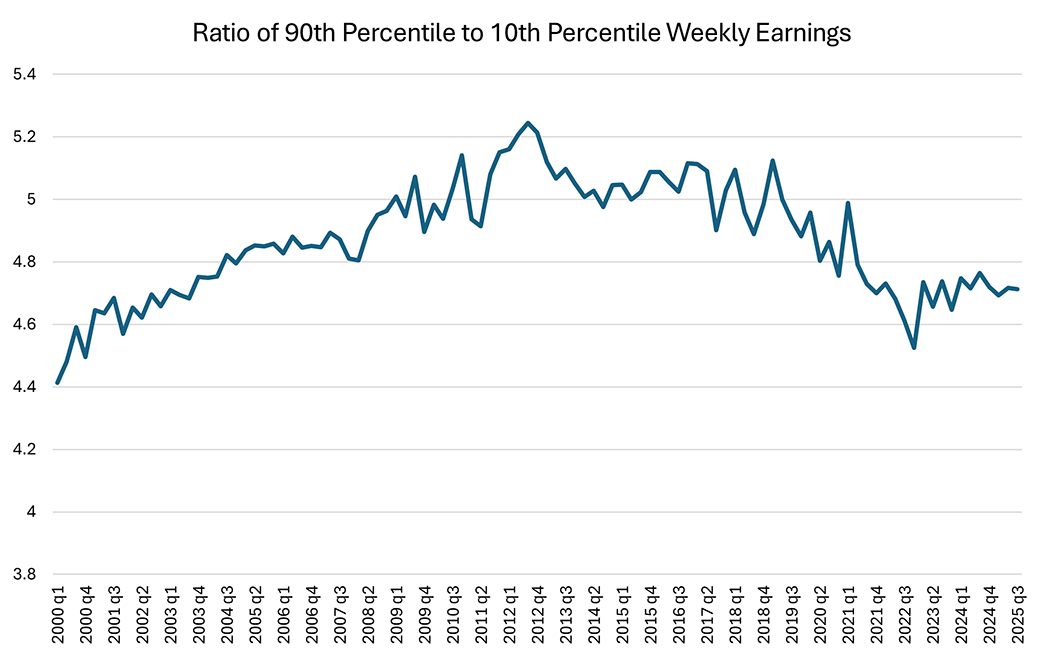
Figure 3 below shows similar inequality metrics for workers above the median of the income distribution. The 90-75, 90-50, and 75-50 ratios are mostly within their ranges observed during the 2010s, indicating little change in relative income differences among workers in the upper half of the income distribution.
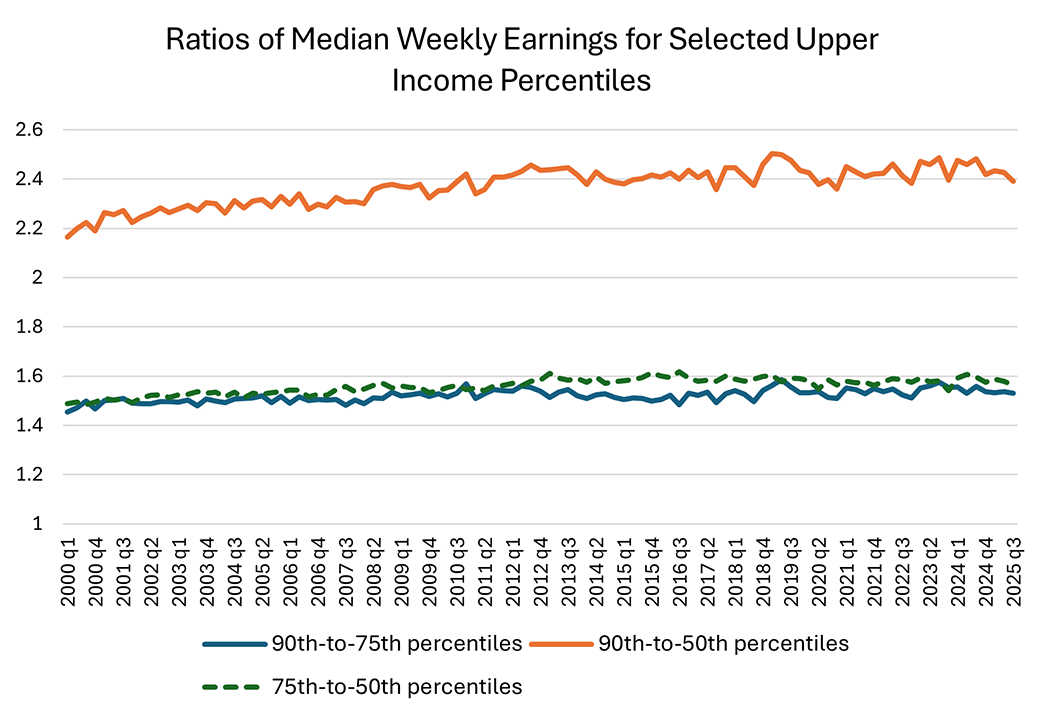
Figure 4 below shows earnings ratios for selected workers at the bottom half of the income distribution. In contrast to the trends shown in Figure 3, there is some evidence of rising inequality for workers toward the bottom of the earnings distribution. In particular, since 2022, earnings of workers at the 50th and 25th percentiles have risen relative to those at the 10th percentile since 2022. However, both ratios remain lower than the levels observed during the pre-pandemic decade.
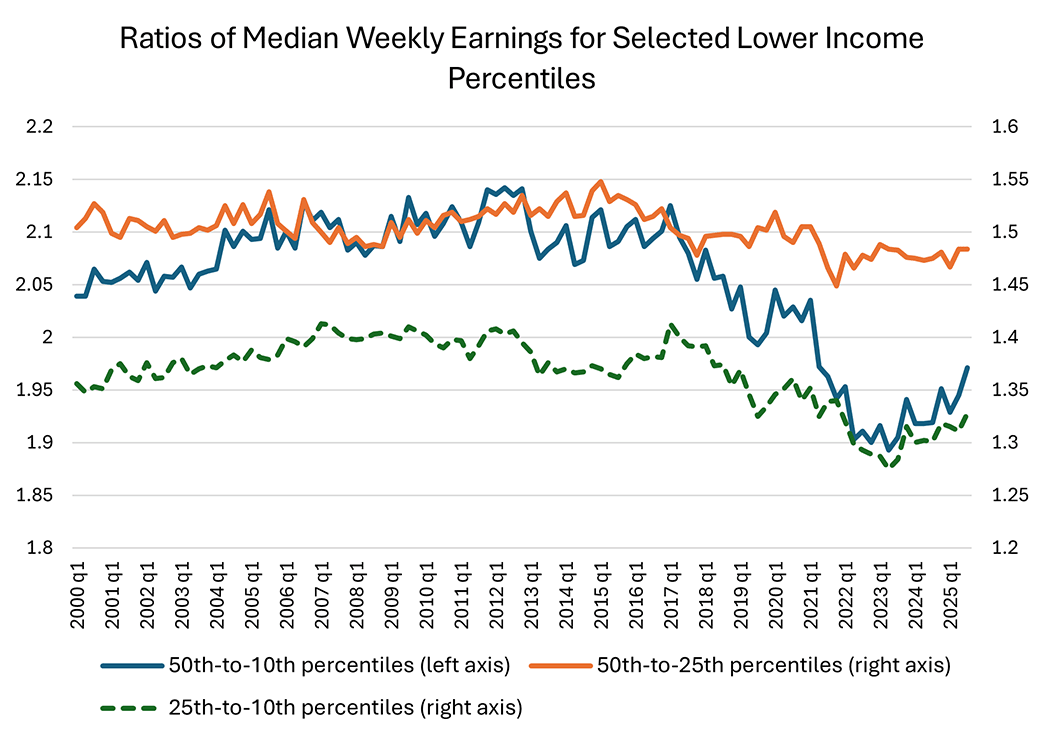
Workers at the bottom 10 percent of the earnings distribution are now seeing earnings growth below the median earner, a reversal compared to the early post-pandemic recovery. However, the implications for earnings inequality are complicated. With earnings growth also slowing for workers at the top of the distribution, there has been little change in relative earnings between the top and bottom 10 percent of workers. At the bottom half of the income distribution, earnings for the bottom 10 percent of workers are falling behind those at the 25th and 50th percentiles, leading to an uptick in their relative earnings ratios. Still, the current levels of these ratios are still below their 2000-2019 averages.
Finally, in considering these results, it's important to keep in mind that the composition of individuals in these groups is not fixed over time. Workers may be in lower earnings percentiles one year and in higher earnings percentiles the next, and vice versa. Thus, it is not possible to make welfare statements about individual groups based on this analysis.
Views expressed in this article are those of the author and not necessarily those of the Federal Reserve Bank of Richmond or the Federal Reserve System.


Contact Us