

Aggregate or Structural? Diagnosing the Rise in Unemployment
Economic Brief
August 2026, No. 26-27
Key Takeaways
- The decline in the job-finding rate is largest for strongly attached workers in occupations highly exposed to artificial intelligence, but this group is too small to drive the aggregate change on its own.
- A standard flows-based decomposition shows that less-exposed workers — both primary and secondary types — account for roughly half of the aggregate decline in the job-finding rate since mid-2023.
- AI exposure is an important but not dominant factor driving the decline in job-finding probability.
The first two articles in this series discussed two primary findings:
- Unemployment is rising primarily because workers are leaving unemployment more slowly, especially through finding jobs.
- The decline in job-finding rates is largest for strongly attached workers and in occupations highly exposed to artificial intelligence (AI).
It is tempting to think of these findings as part of a single story: AI is reducing job-finding rates for the workers it most threatens to displace, which is what we are observing in the aggregate. In the final article in this series, we test that concept more carefully.
We focus on unemployment outflow rates — the probability that an unemployed worker leaves unemployment, either to employment or out of the labor force — and ask how much of the aggregate decline since mid-2023 reflects forces common to all workers versus forces that are structural in nature. The answer is informative: Structural change is present and growing, but aggregate forces remain the dominant factor.
An Aggregate vs. Technological Framework
A useful starting point is to distinguish between aggregate and structural sources of change in unemployment outflow rates. We classify workers into two latent attachment types: primary (about 55 percent of the population, almost always employed) and secondary (about 14 percent, strongly attached but unemployed more often).1 A third group — the tertiary group, which represents about 31 percent of the population and is weakly attached and often out of the labor force — doesn't have significant impact on our discussion, which is why we focus on the primary and secondary groups.
Historically, outflow rates for primary and secondary workers move in close parallel over the business cycle. This can be seen in Figure 1: Both groups' rates fall together when labor demand weakens, and both recover together when it strengthens. We interpret this parallel movement as the signature of aggregate conditions.
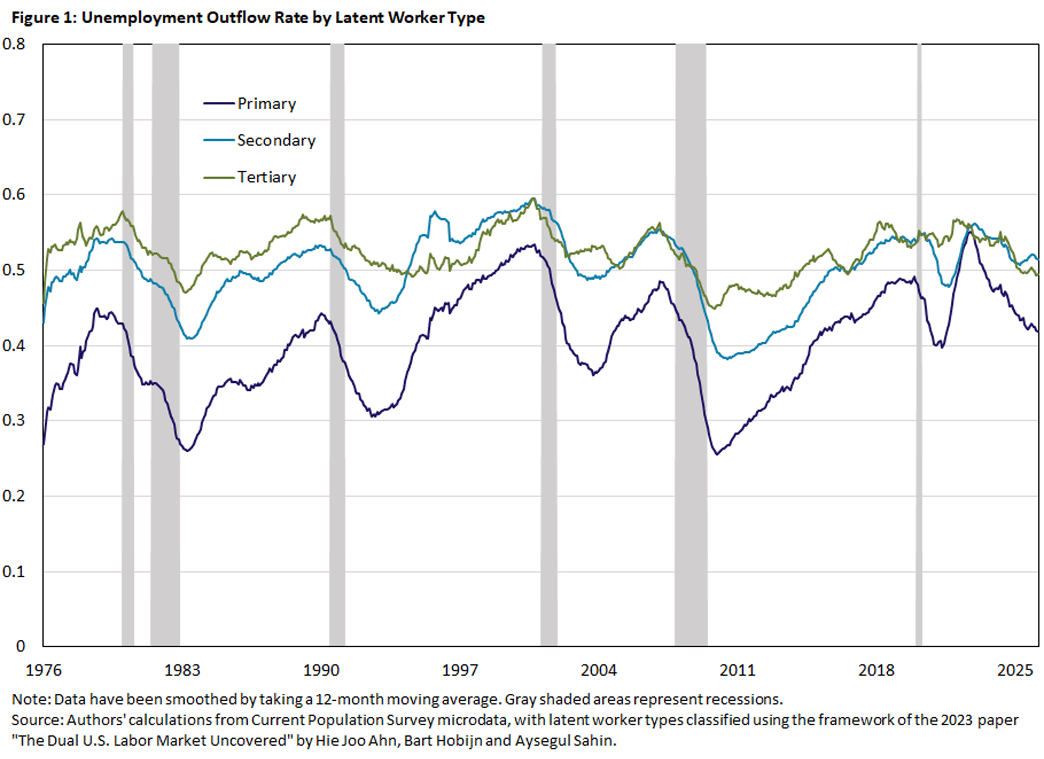
What we have observed since 2023 is different. The gap between outflow rates for primary and secondary workers has widened persistently. Primary workers — who are more strongly attached to the labor force and typically benefit most from a healthy labor market — are now leaving unemployment more slowly relative to secondary workers than historical patterns would predict. We interpret this divergence as evidence of structural change: Something has shifted that disproportionately affects the job-finding prospects of the most attached workers.
To assess whether that structural shift is related to AI, we take a further step and split primary and secondary workers by their degree of AI exposure.2 If AI is driving the structural change, we would expect the widening gap to be concentrated among primary workers in highly exposed occupations, with less-exposed primary workers and secondary workers tracking each other more closely.
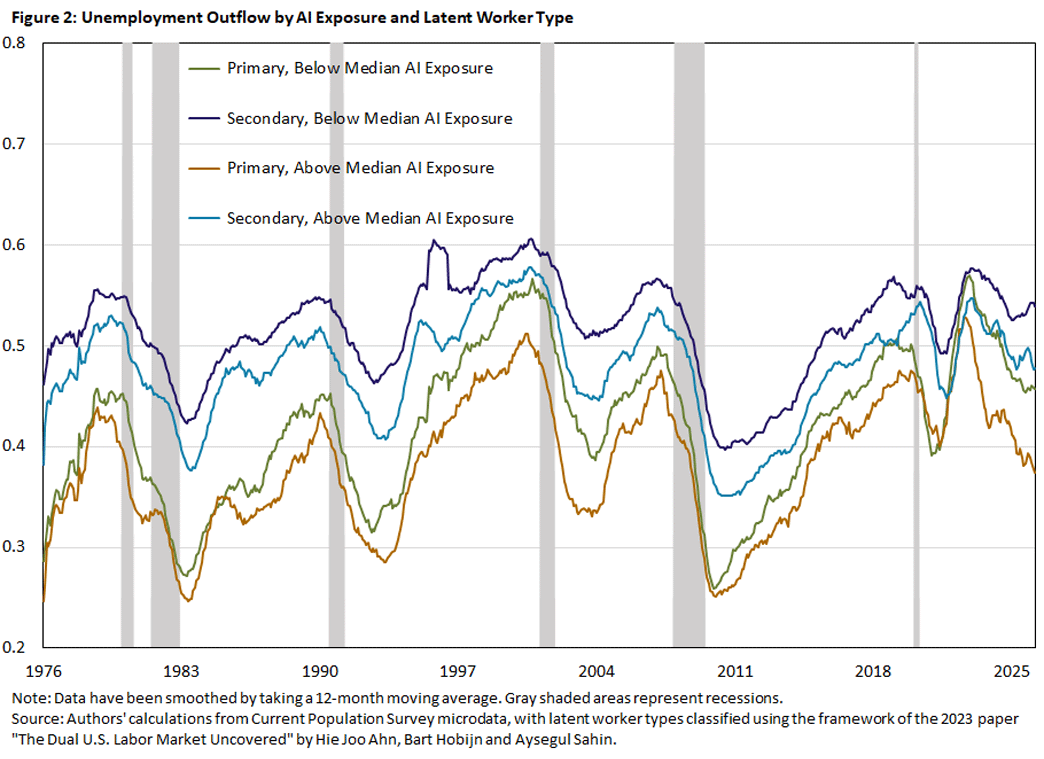
The evidence, shown in Figure 2, is consistent with this prediction. Before 2023, outflow rates for primary workers in high-exposure and low-exposure occupations moved closely together. (One exception was in the early 2000s, when the diffusion of personal computers briefly opened a similar gap.) Since 2023, however, the gap has widened persistently: Outflow rates for primary workers in AI-exposed occupations have fallen faster than for either less-exposed primary workers or secondary workers.
We interpret movements common across all groups as the aggregate component and the divergence between primary and secondary workers as evidence of structural change. A further split within primary workers clarifies the mechanism: The decline is concentrated among those in AI-exposed occupations, while less-exposed primary workers track secondary workers more closely. This indicates that AI — rather than structural change of a more generic kind — is the driving force.
The next step is to weight these components by the shares of workers in each group to obtain their respective contributions to the aggregate outflow rate.
Decomposing the Change Unemployment Outflow Rate
Our exact specification can be found in the appendix, but in short, we aggregate the unemployment outflow rates for various groups of workers, with the rates weighted by each group's share of unemployment. This allows us to measure the change in the outflow rate, capturing changes both from within-group movements in unemployment outflow rate and from the compositional shifts across groups.
We use July 2023 as the benchmark month and consider five groups:
- Primary workers in low-AI-exposure occupations
- Primary workers in high-AI-exposure occupations
- Secondary workers in low-AI-exposure occupations
- Secondary workers in high-AI-exposure occupations
- Tertiary workers
For each month between July 2023 and March 2026, we compute the unemployment outflow rate and unemployment share for each of the five groups and depict their contributions to the decline in aggregate unemployment outflow rate, which are shown in Figure 3.
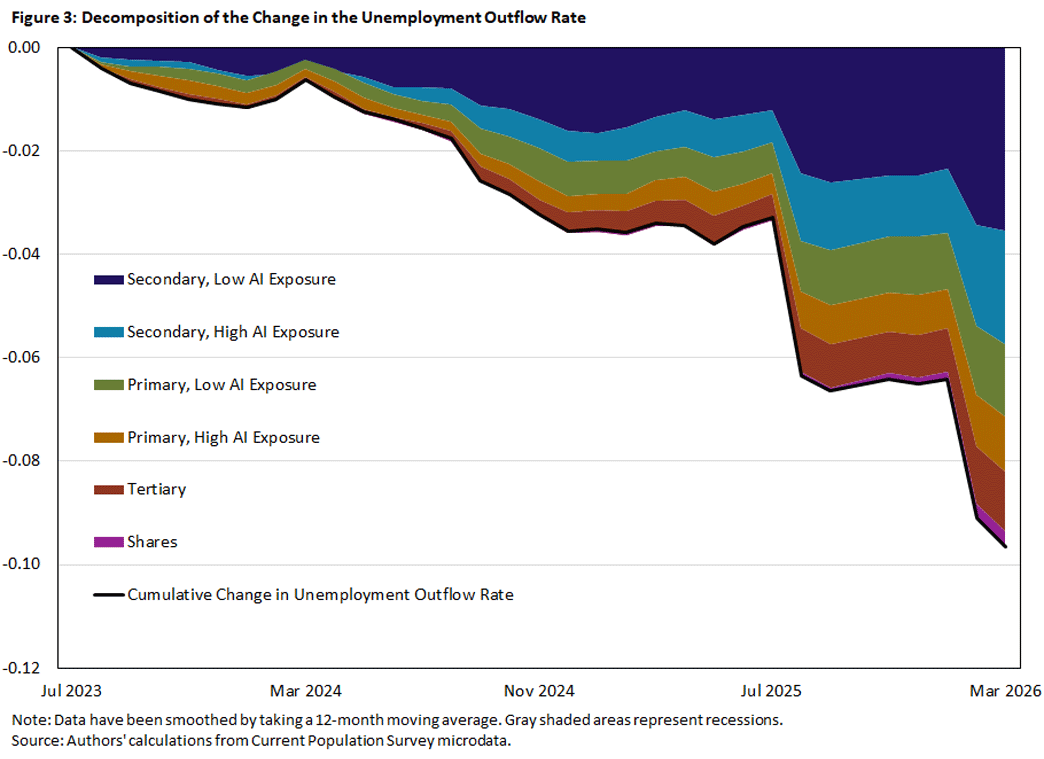
The largest single contribution to the decline comes from secondary workers in low-AI-exposure occupations, a group whose work is largely insulated from direct AI displacement. Primary workers in low-AI-exposure occupations are the third largest contributor. Together, less-exposed workers — primary and secondary — account for roughly half of the aggregate decline in the job-finding rate.
Workers in high-AI-exposure occupations do contribute meaningfully to the decline. Strongly attached workers in high-AI-exposure occupations exhibit the largest within-group decline in job-finding rates, consistent with the divergence highlighted in our previous article. But their share of total unemployment is small, and their contribution to the aggregate decline is correspondingly limited, at most about one-third of the total.
The compositional shift does not contribute much to the overall change. The joint contribution of the shares across all groups is less than 3 percent.
Implications
What should we conclude from this exercise? Our decomposition points to two distinct forces behind the decline in unemployment outflow rates since mid-2023.
Historically, outflow rates for primary and secondary workers move in close parallel over the business cycle, as both fall in downturns and recover in expansions. What we observe since 2023 is a departure from this pattern: Outflow rates for primary workers have fallen considerably more than for secondary workers, a divergence that is the hallmark of structural change rather than aggregate change.
Looking within primary workers, the decline is further concentrated among those in AI-exposed occupations, implicating AI as the dominant source of that structural shift. Both the aggregate and structural components contribute to the overall decline, but they are not equal in magnitude. The structural, AI-related component — while meaningful and unprecedented outside of the proliferation of personal computers in the early 2000s — accounts for a minority of the total decline.
This conclusion is consistent with recent macro analyses of AI's near-term impact. A 2025 paper argues that the macroeconomic implications of current AI capabilities are likely modest in the medium term, in part because the share of tasks affected and the cost savings per task are bounded.3 Field studies of generative AI deployment likewise show large effects on individual worker productivity but more limited effects on the broader hiring environment.4
For policymakers and analysts seeking to interpret the rise in unemployment, the diagnostic implication is straightforward. Targeted interventions aimed at workers displaced by AI — for example, retraining programs focused on highly exposed occupations — may reach an important segment of the unemployed. They will not, however, address the larger share of the decline in job-finding rates, which falls on workers whose work has little direct overlap with AI capabilities. Understanding what is happening to those workers is the natural next step.
Katarína Borovičková is an economist, and Claudia Macaluso is a senior research economist, both in the Research Department at the Federal Reserve Bank of Richmond.
1
This follows the approach of the 2023 working paper "The Dual U.S. Labor Market Uncovered" by Hie Joo Ahn, Bart Hobijn and Aysegul Sahin.
2
Specifically, we split based on whether they work in occupations above or below the median AI-exposure score from the 2020 working paper "The Impact of Artificial Intelligence on the Labor Market" by Michael Webb.
3
See the 2025 paper "The Simple Macroeconomics of AI" by Daron Acemoglu.
4
See the 2025 paper "Generative AI at Work" by Erik Brynjolfsson, Danielle Li and Lindsey Raymond.
To cite this Economic Brief, please use the following format: Borovičková, Katarina; and Macaluso, Claudia. (August 2026) "Aggregate or Structural? Diagnosing the Rise in Unemployment" Federal Reserve Bank of Richmond Economic Brief, No. 26-27.
This article may be photocopied or reprinted in its entirety. Please credit the authors, source, and the Federal Reserve Bank of Richmond and include the italicized statement below.
Views expressed in this article are those of the authors and not necessarily those of the Federal Reserve Bank of Richmond or the Federal Reserve System.
 Download Appendix


Subscribe to Economic Brief
Receive a notification when Economic Brief is posted online.
Contact Us