


< !--cell-- >
< !--end grid-x-->


The Missing Boomerang Buyers
Does it matter whether those who lost their homes during the crisis come back to the housing market?
Econ Focus
First Quarter 2017
Cover Story
In July 2006, the Mortgage Insurance Companies of America, a now-defunct trade group, sent a letter to the Federal Reserve and other bank regulators. "[We] are deeply concerned about the potential contagion effect from poorly underwritten or unsuitable mortgages and home-equity loans," wrote Suzanne Hutchinson, the group's executive vice president. "[T]he most recent market trends show alarming signs of ongoing undue risk-taking that puts both lenders and consumers at risk."
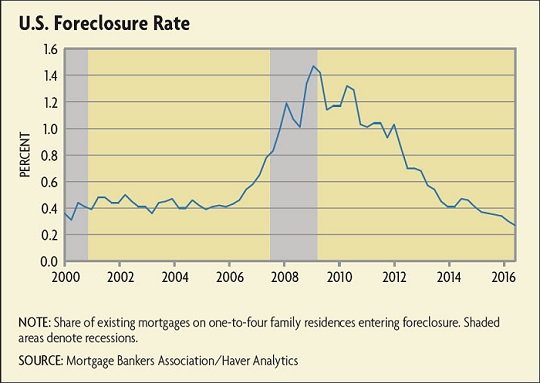
The concerns were well-founded. Around the same time, the seemingly unlimited increase in house prices turned out to have a limit after all. As prices declined and the U.S. economy worsened, a wave of defaults that originated in the subprime mortgage sector eventually spread through the entire housing market. Millions of homes would be lost to foreclosure over the next decade.
A foreclosure is a serious black mark on a consumer's credit report, making mortgages and other types of credit more expensive to obtain. But most negative credit information is erased after seven years, so, in theory, homeowners who experienced a foreclosure during the first few years of the crisis should have the damage to their credit behind them now. As those foreclosures began to clear, many observers speculated that a slew of "boomerang buyers" was poised to return to the housing market.
Those buyers have been slow to materialize, which might seem surprising in light of rising home prices and reports of bidding wars in many areas of the country. Higher prices, however, appear to reflect a relatively low supply of housing rather than a surge in demand. To the extent the housing market contributes to GDP, the absence of boomerang buyers could have implications for near-term economic growth in the United States. So what's hindering their return?
Mortgage Mania
The kinds of loans the potential boomerang buyers took out the first time around might influence their likelihood to return to the housing market.
In general, mortgages are classified according to features of the borrower or features of the loan. With respect to borrowers, loans are either prime or nonprime; the latter category includes both subprime loans and "alt-A" loans. While there is no legal definition of prime or subprime, most lenders use a FICO credit score in the mid-600s as the cutoff. (FICO scores range from 300-850.) Alt-A loans are made to borrowers who have higher-than-subprime credit scores but are unable to obtain a prime loan for other reasons, such as a high debt-to-income ratio or an inability (or unwillingness) to document their income.
With respect to loan features, loans are either traditional or nontraditional. In general, a traditional mortgage is any product that does not allow the borrower to defer repaying interest or principal. Nontraditional mortgages include products with negative amortization, interest-only payment options, balloon payments, or little to no down payment, among other characteristics. While not all nontraditional mortgages are nonprime and vice versa, there is significant overlap between the two categories.
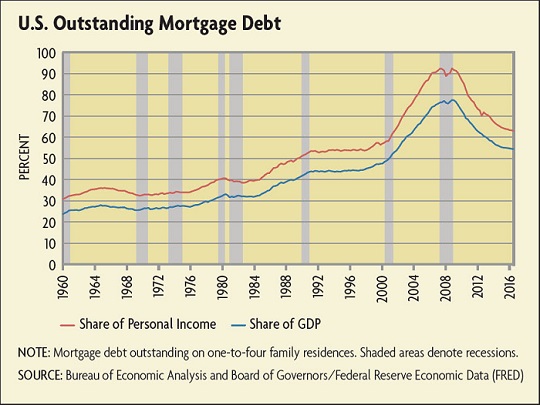
Mortgage lending increased dramatically beginning around 2000; outstanding residential mortgage debt grew from 48 percent of GDP to 75 percent by the end of 2006. As a share of personal income, mortgage debt grew from 56 percent to 91 percent over the same period. Prior to 2000, it took more than two decades for the shares to increase by a similar proportion. (See chart below.) At the same time debt was increasing, there was a marked shift in the composition of loans. In the late 1990s, between 10 percent and 15 percent of mortgage originations, including both purchase and refinance loans, were nonprime; the share grew to nearly 40 percent by 2006. (Subprime loans made up about three-quarters of nonprime loans in the early 2000s, and the share fell to roughly 60 percent after 2003.) Between 2004 and 2007, the share of nontraditional mortgages nearly tripled, from 12.5 percent of originations to 35.1 percent, according to the industry publication Inside Mortgage Finance. These loans were taken out by borrowers from all demographic groups, but a number of researchers have documented that black and Hispanic borrowers were more likely to receive higher-cost or nontraditional loans, even after controlling for characteristics such as income and credit score.
Readings
Belsky, Eric S., and Nela Richardson. "Understanding the Boom and Bust in Nonprime Mortgage Lending." Joint Center for Housing Studies of Harvard University, September 2010.
Brevoort, Kenneth P., and Cheryl R. Cooper. "Foreclosure's Wake: The Credit Experiences of Individuals Following Foreclosure." Federal Reserve Board of Governors Finance and Economics Discussion Series, Working Paper No. 2010-59, Nov. 18, 2010.
Dharmasankar, Sharada, and Bhashkar Mazumder. "Have Borrowers Recovered from Foreclosures during the Great Recession?" Federal Reserve Bank of Chicago Fed Letter No. 370, 2016.
Ferreira, Fernando, and Joseph Gyourko. "A New Look at the U.S. Foreclosure Crisis: Panel Data Evidence of Prime and Subprime Borrowers from 1997 to 2012."National Bureau of Economic Research Working Paper No. 21261, June 2015. (Article available with subscription.)
Haughwout, Andrew, Richard Peach, and Joseph Tracy. "A Close Look at the Decline of Homeownership." Federal Reserve Bank of New York Liberty Street Economics blog, Feb. 17, 2017.
Haughwout, Andrew, Donghoon Lee, Joseph Tracy, and Wilbert van der Klaauw. "Real Estate Investors, the Leverage Cycle, and the Housing Market Crisis." Federal Reserve Bank of New York Staff Report No. 514, September 2011.
Starace, Alex. "Redfin Housing Demand Index Drops Amid Lower-Than-Expected Buyer Activity in March." Redfin blog, April 25, 2017.
 Download article
Subscribe to Econ Focus
Receive an email notification when Econ Focus is posted online.
By submitting this form you agree to the Bank's Terms & Conditions and Privacy Notice.
Contact Us