


< !--cell-- >
< !--end grid-x-->


Will the Graying of America Change Monetary Policy?
Economists ponder whether demographic change will reduce the potency of the Fed's interest rate moves
Econ Focus
Second Quarter 2014
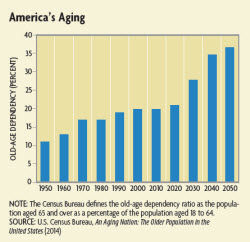
America, like many industrialized countries, is aging. The Census Bureau projects that by 2030, over 20 percent of U.S. residents will be 65 or older, up from 13 percent in 2010 and less than 10 percent in 1970. For elder-law attorneys and hearing-aid companies, the economic implications of this trend are more or less obvious. For fiscal policymakers, especially with regard to programs like Social Security and Medicare, the implications are also obvious — although the precise extent of the effect is up for debate. But what are the trend's implications for monetary policy?
Despite the certainty of the oncoming demographic change, little is known about how it is likely to affect the Fed's policy tools. Some policymakers and observers have expressed concern, however, that the Fed's ability to stimulate the economy may decline for demographic reasons, if it hasn't already done so. For example, New York Fed President William Dudley suggested in a 2012 speech that "demographic factors have played a role in restraining the recovery," in part because spending by older Americans is "less likely to be easily stimulated by monetary policy."
If the contentions of some economists are correct, the aging trend will affect asset markets in ways that will influence how the Fed conducts monetary policy, perhaps forcing the Fed to make bigger interest rate changes for the same amount of stimulus or tightening it wishes to apply to the economy. It could also lead the Fed to resort more frequently to unconventional tools such as massive purchases of assets — the so-called "quantitative easing" in which the Fed engaged after the Great Recession.
 Download article
Subscribe to Econ Focus
Receive an email notification when Econ Focus is posted online.
By submitting this form you agree to the Bank's Terms & Conditions and Privacy Notice.
Contact Us