


< !--cell-- >
< !--end grid-x-->


Crowded
While more is not always merrier, population growth over the last century has had many positive effects
Econ Focus
Second Quarter 2014
Cover Story
The 1973 science-fiction film Soylent Green may be best remembered for Charlton Heston's line about the titular food source: "Soylent Green is people!" The story takes place in the year 2022, when severe overpopulation has exhausted nearly all natural resources and people scrape by in hot, dirty, crowded cities. Outside of theater walls, that future seemed even more imminent. In 1968, American biologist Paul Ehrlich published The Population Bomb, which opened with the prediction that "a minimum of ten million people, most of them children, will starve to death during each year of the 1970s." In 1973, then-president of the World Bank Robert McNamara declared that "the threat of unmanageable population pressures is much like the threat of nuclear war."
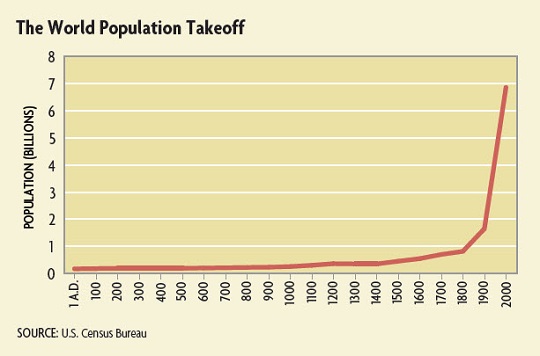
Why were Ehrlich, McNamara, and others so worried? In the last two centuries, world population underwent a previously unimaginable growth spurt (see chart 1). It took roughly 200 years for the population to double from 500 million in the 17th century to 1 billion around 1830. But within 100 years it had doubled to 2 billion, and then it doubled again by the mid-1970s — less than 50 years. This geometric growth, coupled with apparent resource shortages like the oil crises of the 1970s, alarmed both scientists and the public.
 Download article
Subscribe to Econ Focus
Receive an email notification when Econ Focus is posted online.
By submitting this form you agree to the Bank's Terms & Conditions and Privacy Notice.
Contact Us