


< !--cell-- >
< !--end grid-x-->



Is Dollar Dominance in Doubt?
The dollar has been the global currency of choice for nearly a century, but in light of recent U.S.-led financial sanctions, some wonder whether that status will endure
Econ Focus
Second Quarter 2022
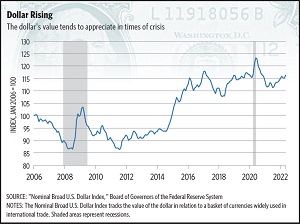
The world runs on the U.S. dollar. Apart from Europe, where the euro dominates, the majority of global trade is invoiced in dollars. The Fed estimates that foreign investors held nearly $1 trillion in cash at the end of the first quarter of 2021, roughly half of all U.S. notes in circulation. Central banks around the world hold about 59 percent of their foreign currency reserves in dollars. Much of these reserves are held as dollar-denominated debt — that is, U.S. Treasuries — rather than currency. About a third of all U.S. debt was held abroad as of 2021, and a little over 60 percent of debt issued by non-U.S. companies in a foreign currency was denominated in dollars.
The widespread adoption of the dollar as a global currency has long been thought of as a source of "exorbitant privilege" for the United States, a term coined in the 1960s by France's then Finance Minister Valéry Giscard d'Estaing. Having a large share of trade invoiced in dollars protects U.S. exporters and importers from exchange rate risk. And insatiable global demand for U.S. Treasuries enables America to service its more than $30 trillion in federal debt at favorable interest rates.
The dollar's dominance abroad also grants the United States increased leverage against other countries through financial sanctions. In response to Russia's invasion of Ukraine in February, the United States and its allies froze about half of the $630 billion of foreign reserves held by Russia's central bank and barred several major Russian banks from SWIFT (the Society for Worldwide Interbank Financial Telecommunication), an international messaging system used for interbank transfers. Because of the dollar's commanding role in international trade and finance, limiting who can access dollar banking and payment services represents a potent weapon in the U.S. arsenal.
But some worry that weaponizing the dollar in this way could diminish its role in the world economy by driving other countries to seek alternatives. Although the dollar is still the dominant global currency by a wide margin today, there is some evidence that its future could be in jeopardy.
Becoming a Hegemon
Our Related Research
"What is SWIFT, and Could Sanctions Impact the U.S. Dollar's Dominance?" Economic Brief No. 22-09, March 2022
"Government Debt and Deficits: Does the U.S. Spend Beyond Its Means? (Part 1)," Speaking of the Economy podcast, July 30, 2021
"MMT and Government Finance: You Can't Always Get What You Want," Economic Brief No. 21-12, April 2021
"The road toward the renminbi becoming an international currency is a difficult one that will take some time and face its inevitable setbacks," says Maggiori.
And while the use of financial sanctions by the United States may prompt some countries to try to diversify away from the dollar, others have argued that it could actually strengthen the dollar's appeal overall. In a recent NBER working paper, Michael Dooley of the University of California, Santa Cruz and David Folkerts-Landau and Peter Garber of Deutsche Bank argued that part of the role of the provider of the world's dominant reserve currency is to police the global financial system and sanction misbehavior.
"The U.S. administration is probably betting that the controls imposed on Russia will not be perceived as arbitrary, but as proportionate retaliation on a country waging aggressive war," says Maggiori.
The Long View
While there may not be a single obvious replacement for the dollar, that doesn't mean that countries haven't been diversifying into other currencies. The dollar's share of global foreign exchange reserves fell to a 25-year low at the end of 2020, to 59 percent from 71 percent in 1999.
Serkan Arslanalp and Chima Simpson-Bell of the IMF and Barry Eichengreen of the University of California, Berkeley, referred to this development in a recent IMF working paper as "the stealth erosion of dollar dominance." The dollar isn't being replaced on bank balance sheets by another single currency like the euro or renminbi, they found. Rather, most of the shift away from dollars has been into dozens of smaller currencies. They cited a greater desire for portfolio diversification on the part of central banks as well as the falling cost of transacting in smaller currencies as factors that have contributed to this change. This has led some economists to speculate that we could be heading toward a "multipolar" world of many different competing currencies, which could have some advantages.
"Just like biodiversity makes for a more robust global ecology, a multipolar system will be more robust," says Eichengreen. "In addition, an expanding global economy needs additional international liquidity to grease the wheels of globalization, and the U.S. can't provide the requisite safe and liquid assets all by itself."
Indeed, many economists point to a new kind of Triffin dilemma as a greater risk to dollar supremacy than the use of sanctions. Just as the United States faced a crisis of confidence in its ability to back the dollars in circulation during the Bretton Woods era, economists have warned that it could face a similar challenge in the coming years to supply enough safe assets to meet global demand while simultaneously maintaining confidence in its ability to repay its debts. Having more options for safe assets to choose from in the form of different currencies could solve this problem, but not all economists agree that a multipolar system would necessarily be more stable. Competition among countries to grab the reserve currency crown could lead to coordination challenges and questions about which assets are truly safe.
Moreover, the transition from the dollar regime to its successor could be unstable. "One historical precedent is the coexistence of dollar and sterling during the interwar years," the late Harvard University macroeconomist Emmanuel Farhi told Econ Focus in a 2019 interview. "It's not a particularly happy precedent; it was a period of monetary instability. You saw frequent rebalancing of international portfolios into one reserve currency and out of another, which created a lot of volatility."
History teaches that dominant currencies change infrequently and often over long transition periods. But crises can be the catalyst for those transitions, as was the case when the British pound's centuries-long reign started to unravel after World War I. While almost no economist predicts that the dollar will be replaced soon, market confidence is fickle, and the types of crises that spark a changing of the reserve currency guard are inherently hard to predict.
READINGS
Arslanalp, Serkan, Barry Eichengreen, and Chima Simpson-Bell. "The Stealth Erosion of Dollar Dominance: Active Diversifiers and the Rise of Nontraditional Reserve Currencies." IMF Working Paper No. 22/58, March 2022.
Clayton, Christopher, Amanda Dos Santos, Matteo Maggiori, and Jesse Schreger. "Internationalizing Like China." Manuscript, March 2022.
Farhi, Emmanuel, and Matteo Maggiori. “A Model of the International Monetary System.” Quarterly Journal of Economics, February 2018, vol. 133, no. 1, pp. 295-355.
Gopinath, Gita, and Jeremy C. Stein. "Banking, Trade, and the Making of a Dominant Currency." Quarterly Journal of Economics, May 2021, vol. 136, no. 2, pp. 783-830. (Article available with subscription.)
Gourinchas, Pierre-Olivier, and Hélène Rey. "Exorbitant Privilege and Exorbitant Duty." Centre for Economic Policy Research Discussion Paper No. DP16944, January 2022. (Article available with subscription.)
Taylor, Timothy. “Some Economics of Dominant Currencies.” Conversable Economist blog, May 3, 2022.
 Download article
Subscribe to Econ Focus
Receive an email notification when Econ Focus is posted online.
By submitting this form you agree to the Bank's Terms & Conditions and Privacy Notice.
Contact Us